
Title
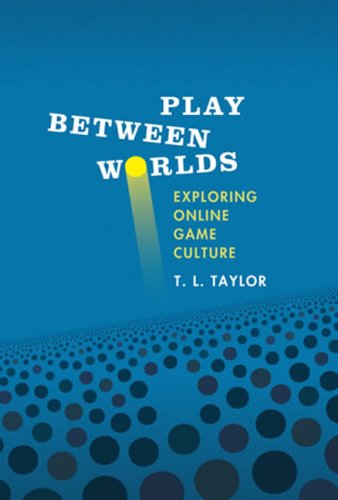
Play Between Worlds: Exploring Online Game Culture,Used
Sold by Ergodebooks, an authorized reseller.
Returns accepted within 30 days | support@ergodebooks.com
Shipping Information
- Free Standard Shipping — United States only
- Processing Time: 3–5 business days
- Estimated Delivery: 6–10 business days after dispatch
- Double-boxed, fully insured & discreetly packaged
- Tracking number sent via email once dispatched
Returns & Refund
Returns accepted within 30 days of delivery.
Damaged or Defective Item
Free return shipping + replacement or full refund
Wrong Item Received
Free return shipping + replacement or full refund
Change of Mind
Return shipping at customer's expense · 25% restocking fee applies
Payment Option

A study of Everquest that provides a snapshot of multiplayer gaming culture, questions the truism that computer games are isolating and alienating, and offers insights into broader issues of work and play, gender identity, technology, and commercial culture.In Play Between Worlds, T. L. Taylor examines multiplayer gaming life as it is lived on the borders, in the gapsas players slip in and out of complex social networks that cross online and offline space. Taylor questions the common assumption that playing computer games is an isolating and alienating activity indulged in by solitary teenage boys. Massively multiplayer online games (MMOGs), in which thousands of players participate in a virtual game world in real time, are in fact actively designed for sociability. Games like the popular Everquest, she argues, are fundamentally social spaces.Taylor's detailed look at Everquest offers a snapshot of multiplayer culture. Drawing on her own experience as an Everquest player (as a female Gnome Necromancer)including her attendance at an Everquest Fan Faire, with its blurring of onlineand offline lifeand extensive research, Taylor not only shows us something about games but raises broader cultural issues. She considers 'power gamers,' who play in ways that seem closer to work, and examines our underlying notions of what constitutes playand why play sometimes feels like work and may even be painful, repetitive, and boring. She looks at the women who play Everquest and finds they don't fit the narrow stereotype of women gamers, which may cast into doubt our standardized and preconceived ideas of femininity. And she explores the questions of who owns game spacewhat happens when emergent player culture confronts the major corporation behind the game.
⚠️ WARNING (California Proposition 65):
This product may contain chemicals known to the State of California to cause cancer, birth defects, or other reproductive harm.
For more information, please visit www.P65Warnings.ca.gov.