
Title
Pleasure And Gender In The Writings Of Thomas More: Pursuing The Common Weal (Medieval & Renaissance Literary Studies),Used
Sold by Ergodebooks, an authorized reseller.
Returns accepted within 30 days | support@ergodebooks.com
Shipping Information
- Free Standard Shipping — United States only
- Processing Time: 3–5 business days
- Estimated Delivery: 6–10 business days after dispatch
- Double-boxed, fully insured & discreetly packaged
- Tracking number sent via email once dispatched
Returns & Refund
Returns accepted within 30 days of delivery.
Damaged or Defective Item
Free return shipping + replacement or full refund
Wrong Item Received
Free return shipping + replacement or full refund
Change of Mind
Return shipping at customer's expense · 25% restocking fee applies
Payment Option

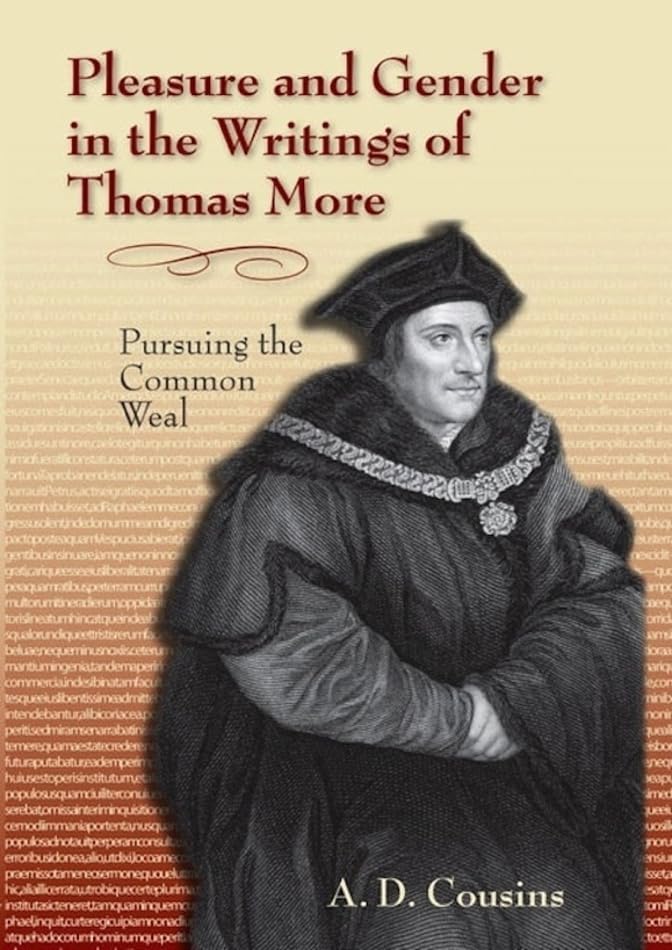
A prominent scholar of the life and work of Thomas More, A. D. Cousins goes beyond the scope of existing studies to focus primarily and closely on Mores interpretations of the major cultural categories informing his view of the common weal, the common good, and correlatively on the (good) state. Thus, this study identifies categories that relate to the individual in civil life, categories that are pervasive and interconnected within Mores nonpolemical writingsmost specifically, Cousins focuses on pleasure and gender, considering chance, friendship, and roleplay throughout.Exploring pleasure and gender in relation to issues of the common good and of the (good) state, More probes how people make sense of chance (and, alternatively, how they do not), how friendship works interpersonally and beyond national boundaries, and what roles people play (as well as to what roles they can aspire). As Cousins asserts, pursuing the common weal was for More both necessary and desirable, and he himself pursued this on behalf of his country, the republic of letters, and the Church Militant. argues that, from what appears to be his earliest nonpolemical work, Pageant Verses, until what we know to be his last, De Tristitia Christi, More sees the will to pleasure as central to the experience of being human: as a primary human impulse or, at the least, a compelling power within the human consciousness. In tracing how More examines the will to pleasure in our lives, Cousins also examines Mores recurrent concern with genders inflecting and expressing this desire. More clearly views gender as potentially restrictive or empowering in many respects, which is discussed in relation to several of Mores texts.
⚠️ WARNING (California Proposition 65):
This product may contain chemicals known to the State of California to cause cancer, birth defects, or other reproductive harm.
For more information, please visit www.P65Warnings.ca.gov.