
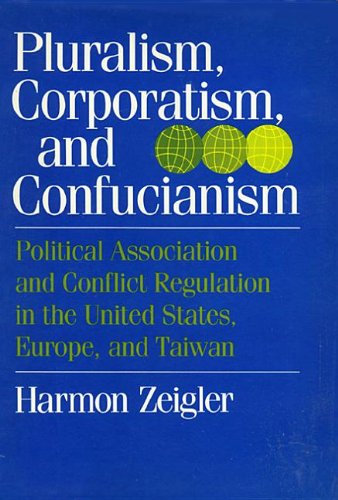
Title
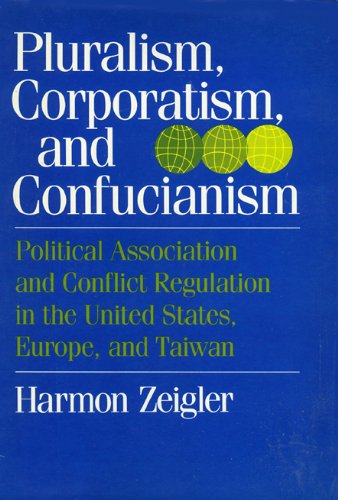
Pluralism Corporatism: And Confucianism,Used
Processing time: 1-3 days
US Orders Ships in: 3-5 days
International Orders Ships in: 8-12 days
Return Policy: 15-days return on defective items
Payment Option

In this comparison of the role of interest groups in three different political settings, Harmon Zeigler addresses two main questions: Why do people join organizations? and, Does it matter how a government regulates conflict? In confronting these questions, he describes and contrasts the characteristics of pluralism in the United States, societal corporatism in Europe, and state corporatism, or authoritarianism, in Taiwan. The first book to compare such disparate cultures, Pluralism, Corporatism, and Confucianism examines the motivations for group membership and the functions of "encompassing" organizations.While it is generally accepted that the form of government is not the major contributor to the shape or content of policy, Zeigler suggests that there are substantial differences between individualist and collectivist societies. Because Taiwan is a "soft authoritarian" government in its mode of interest group regulation he sees it as lending itself to comparison, as an example of state corporatism, with societal corporatism of Europe.The influence of Confucianism, a secular religion that considers conflict unnatural, is evident in most Asian governments. While "Confucian" countries may vary substantially in their mode of conflict resolution, they usually adhere to the basic ethical principles of Confucius: groups are more important than individuals, and society should be organized hierarchically. In his discussion of Asian corporatism, Zeigler takes note of the recent upheavals in South Korea.
⚠️ WARNING (California Proposition 65):
This product may contain chemicals known to the State of California to cause cancer, birth defects, or other reproductive harm.
For more information, please visit www.P65Warnings.ca.gov.
- Q: What is the main focus of 'Pluralism Corporatism: And Confucianism'? A: The book compares the role of interest groups in the United States, Europe, and Taiwan, addressing why people join organizations and how government regulation affects conflict.
- Q: Who is the author of this book? A: The author is Harmon Zeigler.
- Q: What are the key themes explored in this book? A: Key themes include individualism versus collectivism, the influence of Confucianism on governance, and the comparison of different political systems regarding interest group regulation.
- Q: What type of binding does this book have? A: This book is available in hardcover binding.
- Q: How many pages are in 'Pluralism Corporatism: And Confucianism'? A: The book contains 272 pages.
- Q: When was this book published? A: The book was published on April 25, 1988.
- Q: Is this book a first edition? A: Yes, this is the first edition of the book.
- Q: What condition is the book in? A: The book is listed as a used book in good condition.
- Q: What category does this book fall under? A: The book falls under the category of Political Science.
- Q: Does the book discuss the impact of Confucianism on interest groups? A: Yes, the book discusses how Confucianism influences conflict resolution and group dynamics in Asian governments.