If you have any questions, you are always welcome to contact us. We'll get back to you as soon as possible, withing 24 hours on weekdays.
Customer service
All questions about your order, return and delivery must be sent to our customer service team by e-mail at yourstore@yourdomain.com
Sale & Press
If you are interested in selling our products, need more information about our brand or wish to make a collaboration, please contact us at press@yourdomain.com
Help
If you have any questions, you are always welcome to contact us. We'll get back to you as soon as possible, withing 24 hours on weekdays.
Customer service
All questions about your order, return and delivery must be sent to our customer service team by e-mail at yourstore@yourdomain.com
Sale & Press
If you are interested in selling our products, need more information about our brand or wish to make a collaboration, please contact us at press@yourdomain.com
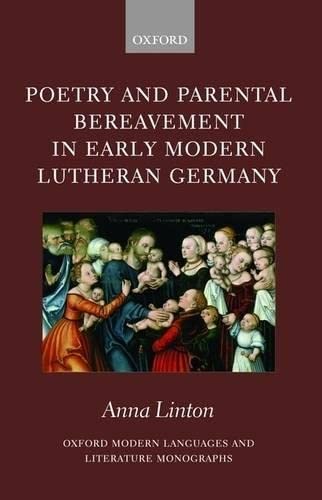
In early modern Europe it has been estimated that up to one in two children did not survive to the age of ten. In the light of this high mortality rate, some historians have argued that parents did not form close relationships with their children, especially the very young. This is clearly refuted by the testimony of bereaved parents such as Martin Luther, and by the volume of consolatory writings produced for grieving families in early modern Lutheran Germany. The authors, clergymen and lay people, regarded grief as a deep wound which required treatment, and they applied the balm of consolation through sermons, tracts and occasional poetry. This study analyses these writings, focusing particularly on the neglected genre of the epicedium (funeral poem). It asks how and why poetry was used to counter the affective impact of parental bereavement, and considers what makes it a suitable vehicle for consolation. The poems, which are analyzed against the contemporary theological, philosophical, and poetological background, are taken from Leichenpredigten (printed funeral booklets), as well as from collections by two contrasting poets, Paul Fleming (160940), an unmarried man who wrote to console others, and Margarethe Susanna von Kuntsch (16511717), who lost thirteen of her fourteen children. The study seeks to rehabilitate a neglected genre and participates in discussions on the sociology of death, Lutheran teachings about death and mourning, literary presentations of mortality and loss, and the depiction of children and parentchild relations in literature.
⚠️ WARNING (California Proposition 65):
This product may contain chemicals known to the State of California to cause cancer,
birth defects, or other reproductive harm.
For MAP (Minimum Advertised Price) violations and Intellectual Property (IP) or Trademark concerns, please contact:
support@ergodebooks.com
⚠️ California Proposition 65 Warning: Some products sold on this website may expose you to chemicals known to the State of California to cause cancer, birth defects, or other reproductive harm. For more information, visit www.P65Warnings.ca.gov.