
Title
Polarized America: The Dance of Ideology and Unequal Riches (WalrasPareto Lectures),Used
Sold by Ergodebooks, an authorized reseller.
Returns accepted within 30 days | support@ergodebooks.com
Shipping Information
- Free Standard Shipping — United States only
- Processing Time: 3–5 business days
- Estimated Delivery: 6–10 business days after dispatch
- Double-boxed, fully insured & discreetly packaged
- Tracking number sent via email once dispatched
Returns & Refund
Returns accepted within 30 days of delivery.
Damaged or Defective Item
Free return shipping + replacement or full refund
Wrong Item Received
Free return shipping + replacement or full refund
Change of Mind
Return shipping at customer's expense · 25% restocking fee applies
Payment Option

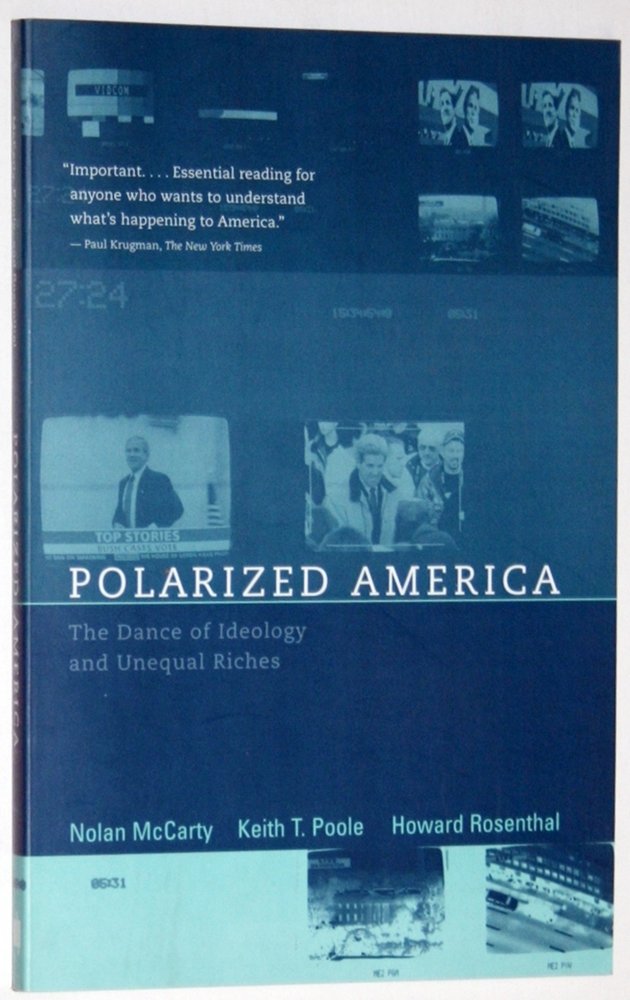
The idea of America as politically polarizedthat there is an unbridgeable divide between right and left, red and blue stateshas become a clich. What commentators miss, however, is that increasing polarization in recent decades has been closely accompanied by fundamental social and economic changesmost notably, a parallel rise in income inequality. In Polarized America, Nolan McCarty, Keith Poole, and Howard Rosenthal examine the relationships of polarization, wealth disparity, immigration, and other forces, characterizing it as a dance of give and take and back and forth causality. Using NOMINATE (a quantitative procedure that, like interest group ratings, scores politicians on the basis of their roll call voting records) to measure polarization in Congress and public opinion, census data and Federal Election Commission finance records to measure polarization among the public, the authors find that polarization and income inequality fell in tandem from 1913 to 1957 and rose together dramatically from 1977 on; they trace a parallel rise in immigration beginning in the 1970s. They show that Republicans have moved right, away from redistributive policies that would reduce income inequality. Immigration, meanwhile, has facilitated the move to the right: noncitizens, a larger share of the population and disproportionately poor, cannot vote; thus there is less political pressure from the bottom for redistribution than there is from the top against it. In "the choreography of American politics" inequality feeds directly into political polarization, and polarization in turn creates policies that further increase inequality.
⚠️ WARNING (California Proposition 65):
This product may contain chemicals known to the State of California to cause cancer, birth defects, or other reproductive harm.
For more information, please visit www.P65Warnings.ca.gov.