If you have any questions, you are always welcome to contact us. We'll get back to you as soon as possible, withing 24 hours on weekdays.
Customer service
All questions about your order, return and delivery must be sent to our customer service team by e-mail at yourstore@yourdomain.com
Sale & Press
If you are interested in selling our products, need more information about our brand or wish to make a collaboration, please contact us at press@yourdomain.com
Help
If you have any questions, you are always welcome to contact us. We'll get back to you as soon as possible, withing 24 hours on weekdays.
Customer service
All questions about your order, return and delivery must be sent to our customer service team by e-mail at yourstore@yourdomain.com
Sale & Press
If you are interested in selling our products, need more information about our brand or wish to make a collaboration, please contact us at press@yourdomain.com
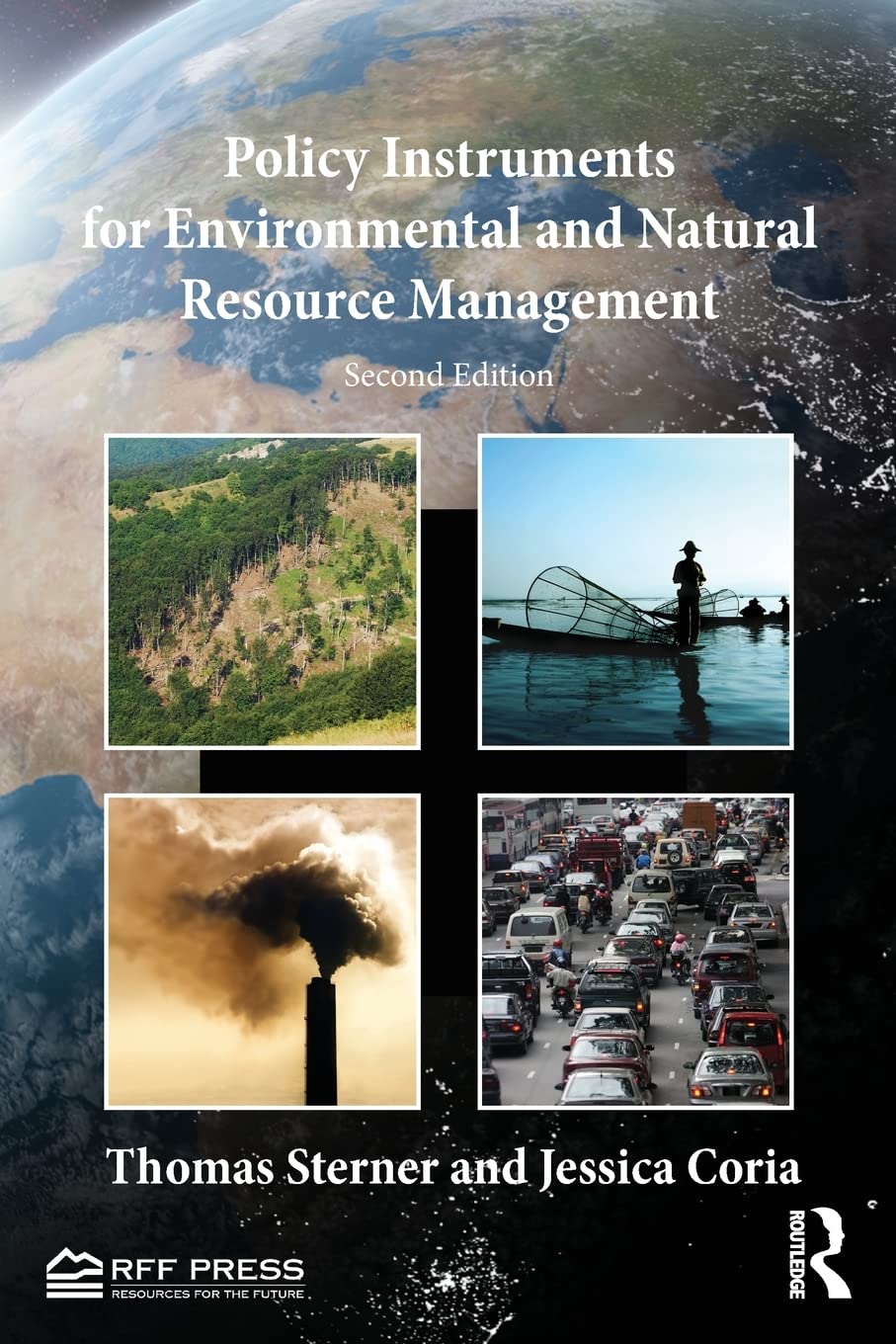
Thomas Sterner's book is an attempt to encourage more widespread and careful use of economic policy instruments. The book compares the accumulated experiences of the use of economic policy instruments in the U.S. and Europe, as well as in rich and poor countries in Asia, Africa, and Latin America. Ambitious in scope, it discusses the design of instruments that can be employed in any country in a wide range of contexts, including transportation, industrial pollution, water pricing, waste, fisheries, forests, and agriculture.While deeply rooted in economics, Policy Instruments for Environmental and Natural Resource Management is informed by political, legal, ecological, and psychological research. The new edition enhances what has already been widely hailed as a highly innovative work. The book includes greatly expanded coverage of climate change, covering aspects related to policy design, international equity and discounting, voluntary carbon markets, permit trading in United States, and the Clean Development Mechanism. Focusing ever more on leading ideas in both theory and policy, the new edition brings experimental economics into the main of its discussions. It features expanded coverage of the monitoring and enforcement of environmental policy, technological change, the choice of policy instruments under imperfect competition, and subjects such as corporate social responsibility, biofuels, payments for ecosystem services, and REDD.
⚠️ WARNING (California Proposition 65):
This product may contain chemicals known to the State of California to cause cancer,
birth defects, or other reproductive harm.
For MAP (Minimum Advertised Price) violations and Intellectual Property (IP) or Trademark concerns, please contact:
support@ergodebooks.com
⚠️ California Proposition 65 Warning: Some products sold on this website may expose you to chemicals known to the State of California to cause cancer, birth defects, or other reproductive harm. For more information, visit www.P65Warnings.ca.gov.