
Title
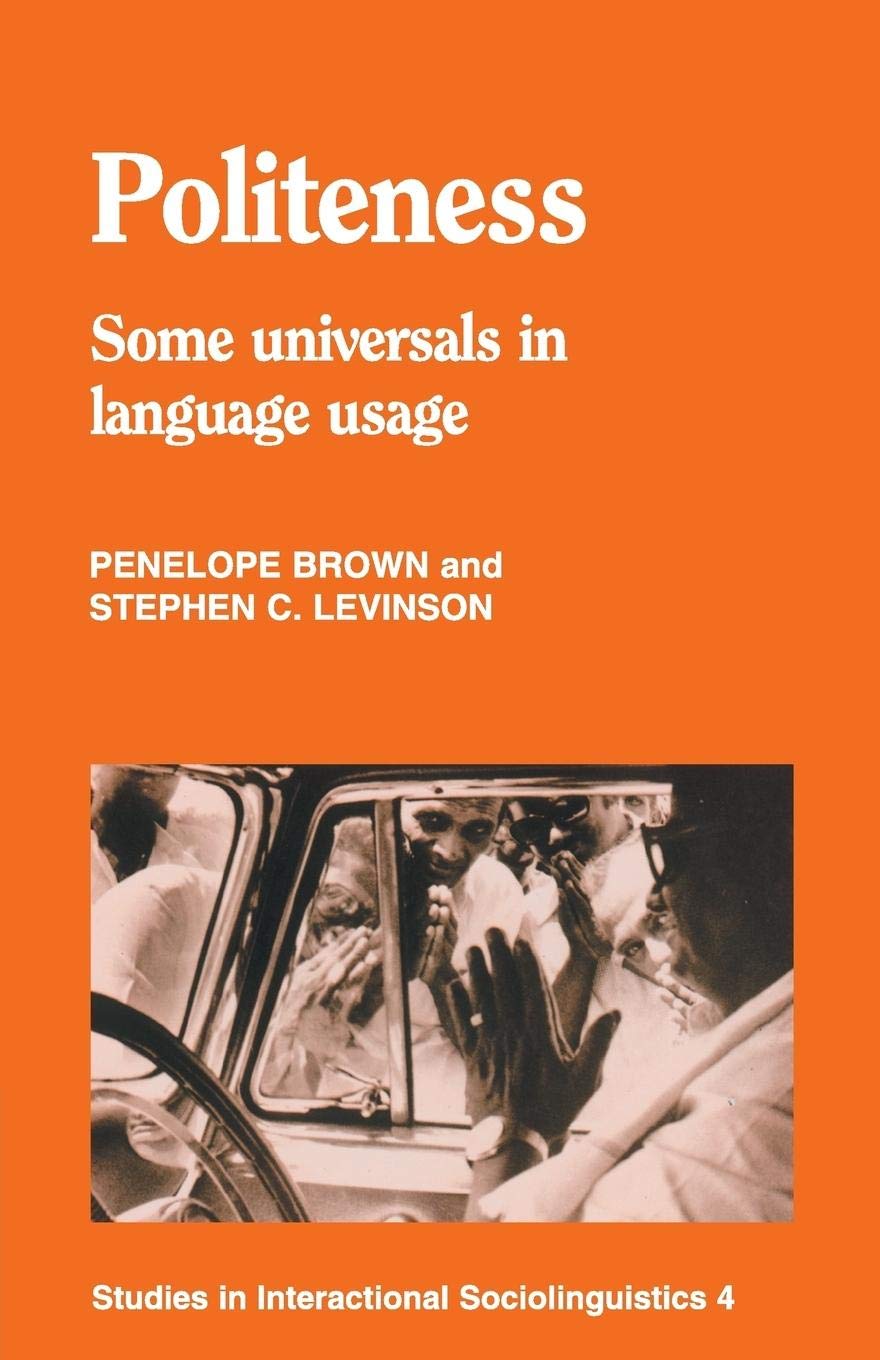
Politeness: Some Universals In Language Usage (Studies In Interactional Sociolinguistics 4)
Sold by Ergodebooks, an authorized reseller.
Returns accepted within 30 days | support@ergodebooks.com
Shipping Information
- Free Standard Shipping — United States only
- Processing Time: 3–5 business days
- Estimated Delivery: 6–10 business days after dispatch
- Double-boxed, fully insured & discreetly packaged
- Tracking number sent via email once dispatched
Returns & Refund
Returns accepted within 30 days of delivery.
Damaged or Defective Item
Free return shipping + replacement or full refund
Wrong Item Received
Free return shipping + replacement or full refund
Change of Mind
Return shipping at customer's expense · 25% restocking fee applies
Payment Option

This Study Is About The Principles For Constructing Polite Speeches. The Core Of It First Appeared In Questions And Politeness, Edited By Esther N. Goody (Now Out Of Print). It Is Here Reissued With A Fresh Introduction That Surveys The Considerable Literature In Linguistics, Psychology And The Social Sciences That The Original Extended Essay Stimulated, And Suggests Distinct Directions For Research. The Authors Describe And Account For Some Remarkable Parallelisms In The Linguistic Construction Of Utterances With Which People Express Themselves In Different Languages And Cultures. A Motive For These Parallels Is Isolated And A Universal Model Is Constructed Outlining The Abstract Principles Underlying Polite Usages. This Is Based On The Detailed Study Of Three Unrelated Languages And Cultures: The Tamil Of South India, The Tzeltal Spoken By Mayan Indians In Chiapas, Mexico, And The English Of The Usa And England. This Volume Will Be Of Special Interest To Students In Linguistic Pragmatics, Sociolinguistics, Applied Linguistics, Anthropology, And The Sociology And Social Psychology Of Interaction.
⚠️ WARNING (California Proposition 65):
This product may contain chemicals known to the State of California to cause cancer, birth defects, or other reproductive harm.
For more information, please visit www.P65Warnings.ca.gov.
- Q: What is the page count of this book? A: This book has three hundred forty-five pages. It offers an in-depth exploration of politeness principles in language usage.
- Q: What is the binding type of this book? A: This book is a paperback. The binding allows for flexible reading and easy handling.
- Q: Who is the author of this book? A: The author of this book is Penelope Brown. She is known for her contributions to linguistic pragmatics and sociolinguistics.
- Q: How do I read this book? A: You can read this book at your own pace. It is suitable for students and researchers interested in sociolinguistics.
- Q: Is this book suitable for beginners? A: Yes, this book is suitable for beginners. It provides foundational insights into politeness in language.
- Q: Can I use this book for research purposes? A: Yes, this book is excellent for research. It includes extensive references and a fresh introduction to related literature.
- Q: How do I keep this book in good condition? A: Store this book in a dry place away from direct sunlight. This will help preserve its quality over time.
- Q: What if the book arrives damaged? A: If the book arrives damaged, you should contact the seller for a return or exchange. Most sellers have customer support for issues like this.
- Q: Is this book safe for children? A: No, this book is not specifically aimed at children. It is designed for an academic audience.
- Q: What topics does this book cover? A: This book covers topics related to politeness and language usage across different cultures. It examines linguistic constructions and social interactions.
- Q: Is this book out of print? A: No, this book is currently available. It has been reissued with new content for readers.
- Q: Does this book include illustrations? A: Yes, the book includes three tables and unspecified line drawings. These visuals support the text's concepts.
- Q: What is the size of this book? A: This book measures five point five one inches in length and eight point five inches in height. Its compact size makes it easy to handle.
- Q: What is the main focus of this book? A: The main focus of this book is the principles of constructing polite speeches. It offers a universal model for polite language across cultures.
- Q: Who published this book? A: This book is published by Cambridge University Press. They are known for high-quality academic publications.