
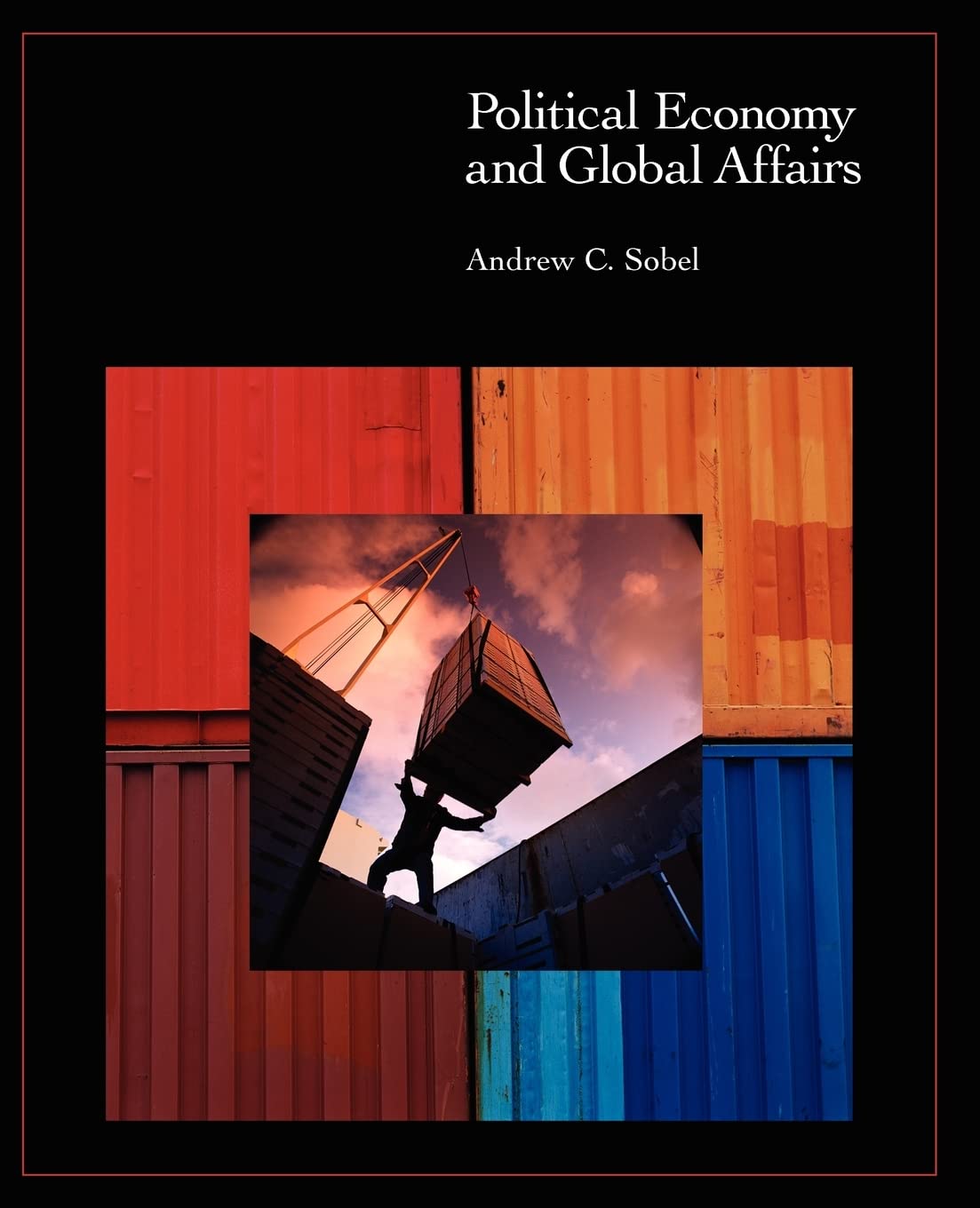
Title
Political Economy and Global Affairs,Used
Sold by Ergodebooks, an authorized reseller.
Returns accepted within 30 days | support@ergodebooks.com
Shipping Information
- Free Standard Shipping — United States only
- Processing Time: 3–5 business days
- Estimated Delivery: 6–10 business days after dispatch
- Double-boxed, fully insured & discreetly packaged
- Tracking number sent via email once dispatched
Returns & Refund
Returns accepted within 30 days of delivery.
Damaged or Defective Item
Free return shipping + replacement or full refund
Wrong Item Received
Free return shipping + replacement or full refund
Change of Mind
Return shipping at customer's expense · 25% restocking fee applies
Payment Option

Policy decisions at the domestic levelwhether relating to currency rates, tariffs on certain goods, or labor protectionfactor heavily on such issues as trade, monetary policy, foreign debt, and development. How can we best understand the way those decisions and events at the national level affect outcomes and policy at the international level? A focus on one over the other paints an incomplete picture for students. Sobel contends that we must focus on the individual preferences, strategies, and choices of politicaleconomic policymakers in order to fully understand the larger, macro view of international political economy. With the aim of linking the two, Sobel helps students develop analytic skills for describing both what happens in the international political economy, and why policymakers make the choices they do.In this groundbreaking new text, Sobel presentsin a lucid and intuitive waythe core assumptions of scarcity, political survival, and rationality which form the basis of the books "microlevel" approach. Individualsnot nationsmake choices. With constraints as to what resources and opportunities are available, policymakers choose among alternatives that are most in sync with their selfinterest. If students understand market failure and social traps, as well as how collective action problems affect interest group and institutional performance, they will be able to answer questions about a wide spectrum of events that start at the domestic level and spill over into global economic markets.To add context, Sobel presents a concise but detailed historical overview of globalization that demonstrates the shortcomings of common macrolevel models in the field, from realism to liberalism to hegemonic stability theory. Your students will be equipped with a set of analytic tools that better explain individual behavior and social outcomes in areas such as trade liberalization, institutional bargains, factor endowments, currency exchange systems and convertibility, and development.Special features: Exercises at the end of each chapter encourage students to apply the concepts theyve just read about. A suggested reading list for each chapter provides rich sources for further study. Valuable figures and tables as well as highlighted key terms and a glossary help students grasp important concepts and aid in study. Photos enliven the books presentation and provide visual examples to help students understand core concepts.
⚠️ WARNING (California Proposition 65):
This product may contain chemicals known to the State of California to cause cancer, birth defects, or other reproductive harm.
For more information, please visit www.P65Warnings.ca.gov.