If you have any questions, you are always welcome to contact us. We'll get back to you as soon as possible, withing 24 hours on weekdays.
Customer service
All questions about your order, return and delivery must be sent to our customer service team by e-mail at yourstore@yourdomain.com
Sale & Press
If you are interested in selling our products, need more information about our brand or wish to make a collaboration, please contact us at press@yourdomain.com
Help
If you have any questions, you are always welcome to contact us. We'll get back to you as soon as possible, withing 24 hours on weekdays.
Customer service
All questions about your order, return and delivery must be sent to our customer service team by e-mail at yourstore@yourdomain.com
Sale & Press
If you are interested in selling our products, need more information about our brand or wish to make a collaboration, please contact us at press@yourdomain.com
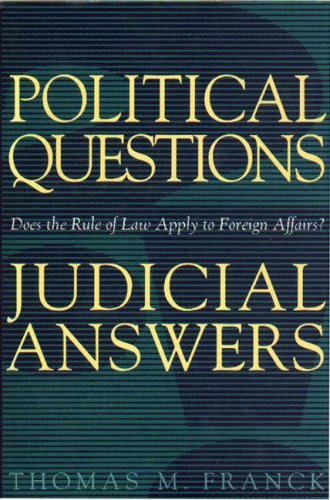
Almost since the beginning of the republic, America's rigorous separation of powers among Executive, Legislative, and Judicial Branches has been umpired by the federal judiciary. It may seem surprising, then, that many otherwise ordinary cases are not decided in court even when they include allegations that the President, or Congress, has violated a law or the Constitution itself. Most of these orphan cases are shunned by the judiciary simply because they have foreign policy aspects. In refusing to address the issues involved, judges indicate that judicial review, like politics, should stop at the water's edgeand foreign policy managers find it convenient to agree! Thomas Franck, however, maintains that when courts invoke the 'political question' doctrine to justify such reticence, they evade a constitutional duty. In his view, whether the government has acted constitutionally in sending men and women to die in foreign battles is just as appropriate an issue for a court to decide as whether property has been taken without due process. In this revisionist work, Franck proposes ways to subject the conduct of foreign policy to the rule of law without compromising either judicial integrity or the national interest. By examining the historical origins of the separation of powers in the American constitutional tradition, with comparative reference to the practices of judiciaries in other federal systems, he broadens and enriches discussions of an important national issue that has particular significance for critical debate about the 'imperial presidency.'
⚠️ WARNING (California Proposition 65):
This product may contain chemicals known to the State of California to cause cancer,
birth defects, or other reproductive harm.
For MAP (Minimum Advertised Price) violations and Intellectual Property (IP) or Trademark concerns, please contact:
support@ergodebooks.com
⚠️ California Proposition 65 Warning: Some products sold on this website may expose you to chemicals known to the State of California to cause cancer, birth defects, or other reproductive harm. For more information, visit www.P65Warnings.ca.gov.