If you have any questions, you are always welcome to contact us. We'll get back to you as soon as possible, withing 24 hours on weekdays.
Customer service
All questions about your order, return and delivery must be sent to our customer service team by e-mail at yourstore@yourdomain.com
Sale & Press
If you are interested in selling our products, need more information about our brand or wish to make a collaboration, please contact us at press@yourdomain.com
Help
If you have any questions, you are always welcome to contact us. We'll get back to you as soon as possible, withing 24 hours on weekdays.
Customer service
All questions about your order, return and delivery must be sent to our customer service team by e-mail at yourstore@yourdomain.com
Sale & Press
If you are interested in selling our products, need more information about our brand or wish to make a collaboration, please contact us at press@yourdomain.com
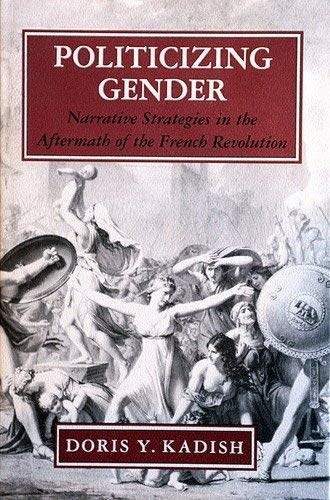
It is Doris Kadish's contention in this book that gender and politics went handinhand in the nineteenth century; that nineteenthcentury works can often be read as retellings of the French Revolution; and that the political meanings of these works can be gleaned through the study of narrative strategies that she chooses to call "semiotic readings." Building on the work of Marina Warner, Lynn Hunt, Joan Landes, Nancy Armstrong, Foucault and others, she shows how the strategy of politicizing gender during and after the revolution served many functionsamong them to articulate representations of revolution, to form the nineteenthcentury public sphere, to constitute bourgeois ideology, to distance the unruly masses, and ultimately, perhaps, to express a deep seated fear of women as a threat to the status quo. Looking at the French and English novel, and even selected relevant paintings in this way, she is able to read muchread texts in new and refreshing ways. She shows us how a collective story or master narrative of the revolution was retold and refashioned throughout the century, even where we might least expect to find it. She looks first at small details in order to see the larger patterns, and is among the first to show us how semiotics may make a contribution to gender studies.
⚠️ WARNING (California Proposition 65):
This product may contain chemicals known to the State of California to cause cancer,
birth defects, or other reproductive harm.
For MAP (Minimum Advertised Price) violations and Intellectual Property (IP) or Trademark concerns, please contact:
support@ergodebooks.com
⚠️ California Proposition 65 Warning: Some products sold on this website may expose you to chemicals known to the State of California to cause cancer, birth defects, or other reproductive harm. For more information, visit www.P65Warnings.ca.gov.