
Title
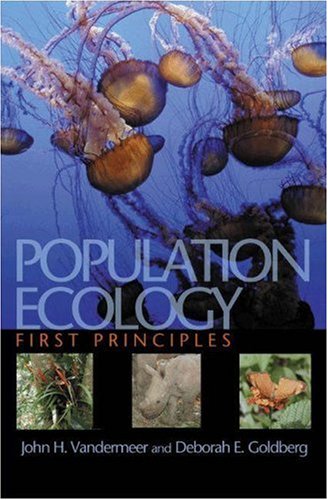
Population Ecology: First Principles,Used
Sold by Ergodebooks, an authorized reseller.
Returns accepted within 30 days | support@ergodebooks.com
Shipping Information
- Free Standard Shipping — United States only
- Processing Time: 3–5 business days
- Estimated Delivery: 6–10 business days after dispatch
- Double-boxed, fully insured & discreetly packaged
- Tracking number sent via email once dispatched
Returns & Refund
Returns accepted within 30 days of delivery.
Damaged or Defective Item
Free return shipping + replacement or full refund
Wrong Item Received
Free return shipping + replacement or full refund
Change of Mind
Return shipping at customer's expense · 25% restocking fee applies
Payment Option

How can the future number of deer, agricultural pests, or cod be calculated based on the present number of individuals and their age distribution? How long will it take for a viral outbreak in a particular city to reach another city five hundred miles away? In addressing such basic questions, ecologists today are as likely to turn to complicated differential equations as to life historiesa dramatic change from thirty years ago. Population ecology is the mathematical backbone of ecology. Here, two leading experts provide the underlying quantitative concepts that all modernday ecologists need.John Vandermeer and Deborah Goldberg show that populations are more than simply collections of individuals. Complex variables such as the size distribution of individuals and allotted territory for expanding groups come into play when mathematical models are applied. The authors build these models from the ground up, from first principles, using a much broader range of empirical examplesfrom plants to animals, from viruses to humansthan do standard texts. And they address several complicating issues such as agestructured populations, spatially distributed populations, and metapopulations.Beginning with a review of elementary principles, the book goes on to consider theoretical issues involving life histories, complications in the application of the core principles, statistical descriptions of spatial aggregation of individuals and populations as well as population dynamic models incorporating spatial information, and introductions to twospecies interactions.Complemented by superb illustrations that further clarify the links between the mathematical models and biology, Population Ecology is the most straightforward and authoritative overview of the field to date. It will have broad appeal among undergraduates, graduate students, and practicing ecologists.
⚠️ WARNING (California Proposition 65):
This product may contain chemicals known to the State of California to cause cancer, birth defects, or other reproductive harm.
For more information, please visit www.P65Warnings.ca.gov.