
Title
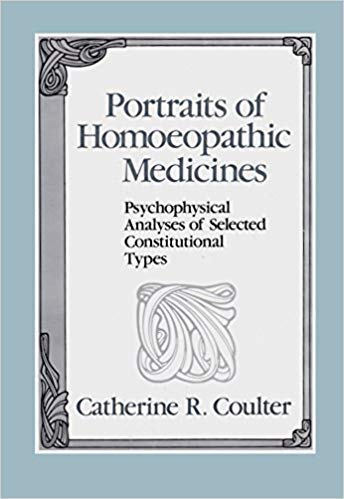
Portraits of Homeopathic Medicines: Psychophysical Analyses of Selected Constitutional Types,Used
Sold by Ergodebooks, an authorized reseller.
Returns accepted within 30 days | support@ergodebooks.com
Shipping Information
- Free Standard Shipping — United States only
- Processing Time: 3–5 business days
- Estimated Delivery: 6–10 business days after dispatch
- Double-boxed, fully insured & discreetly packaged
- Tracking number sent via email once dispatched
Returns & Refund
Returns accepted within 30 days of delivery.
Damaged or Defective Item
Free return shipping + replacement or full refund
Wrong Item Received
Free return shipping + replacement or full refund
Change of Mind
Return shipping at customer's expense · 25% restocking fee applies
Payment Option

In this rich, textured study of the characters of 9 homoeopathic medicines, C.Coulter has revived a muchneglected archetypal science: the study of mindbody types upon which healing by similars is based. While most psychologists and doctors either avoid or oversimplify the issues of inherited constitutional dispositions and psychophysiological unity, Coulter presumes the existence of dynamic fields around which each creature is formed and energized. 'These fields are intrinsic to the very organismic process,' writes Edward C. Whitmont, a homoeopathic physician and a founding member of the C.G. Jung Training Center in NY, 'our own as well as the planet's.' Every mineral, plant, and animal embodies discrete patterns and thus has the intrinsic power to call forth the disease of these patterns and then to heal through them. Unless we recognize these fields and constitutional types and learn to diagnose in terms of the phenomenological totality of living beings, we cannot hope to realize the potential of a medicine of similars. Dr. Whitmont goes on to write: 'A child's personality is then not only structured by parental and environmental influences, but also, selectively, in its own individual ways, evokes and responds to 'like' or corresponding parental and environmental influences. In its own way it will also constellate and call forth environmental factors that a child of a different makeup will not. A Natrum muriaticum or Lycopodium child may stoically withdraw, even sever communication, where a Sulphur child may respond with overactivity or a Hepar or Arsenic type with fury or anxiety respectively. It is also to be considered that environments that encourage anxiety or withdrawal may help produce corresponding Arsenic or Hepar constitutional states. In either case the somatic indications for a particular remedy can alert the experienced prescriber to the potential presence of specific psychological predispositions as yet dormant and unrecognized.'
⚠️ WARNING (California Proposition 65):
This product may contain chemicals known to the State of California to cause cancer, birth defects, or other reproductive harm.
For more information, please visit www.P65Warnings.ca.gov.
- Q: What is the main focus of 'Portraits of Homeopathic Medicines'? A: The book primarily focuses on the psychophysical analyses of nine homoeopathic medicines, exploring the mind-body types that underpin healing by similars.
- Q: Who is the author of this book? A: The author of 'Portraits of Homeopathic Medicines' is Catherine R. Coulter.
- Q: How many pages does this book have? A: The book contains 422 pages.
- Q: What type of binding does this edition have? A: This edition of the book is bound in hardcover.
- Q: When was 'Portraits of Homeopathic Medicines' published? A: The book was published on January 1, 1986.
- Q: What condition is the used book in? A: The used book is in good condition.
- Q: What are the key themes discussed in the book? A: Key themes include the dynamic fields of constitutional types, the relationship between inherited dispositions and psychological states, and the holistic nature of healing.
- Q: Is this book suitable for beginners in homeopathy? A: While the book provides valuable insights, it may be more suitable for those with some prior knowledge of homeopathy due to its in-depth analyses.
- Q: Does this book cover practical applications of homeopathic medicines? A: Yes, it discusses how understanding constitutional types can enhance the practice of prescribing homeopathic remedies.
- Q: What is the edition of this book? A: This is the first edition of 'Portraits of Homeopathic Medicines'.