
Title
Possibility And Necessity: Volume 1,Used
Processing time: 1-3 days
US Orders Ships in: 3-5 days
International Orders Ships in: 8-12 days
Return Policy: 15-days return on defective items
Payment Option

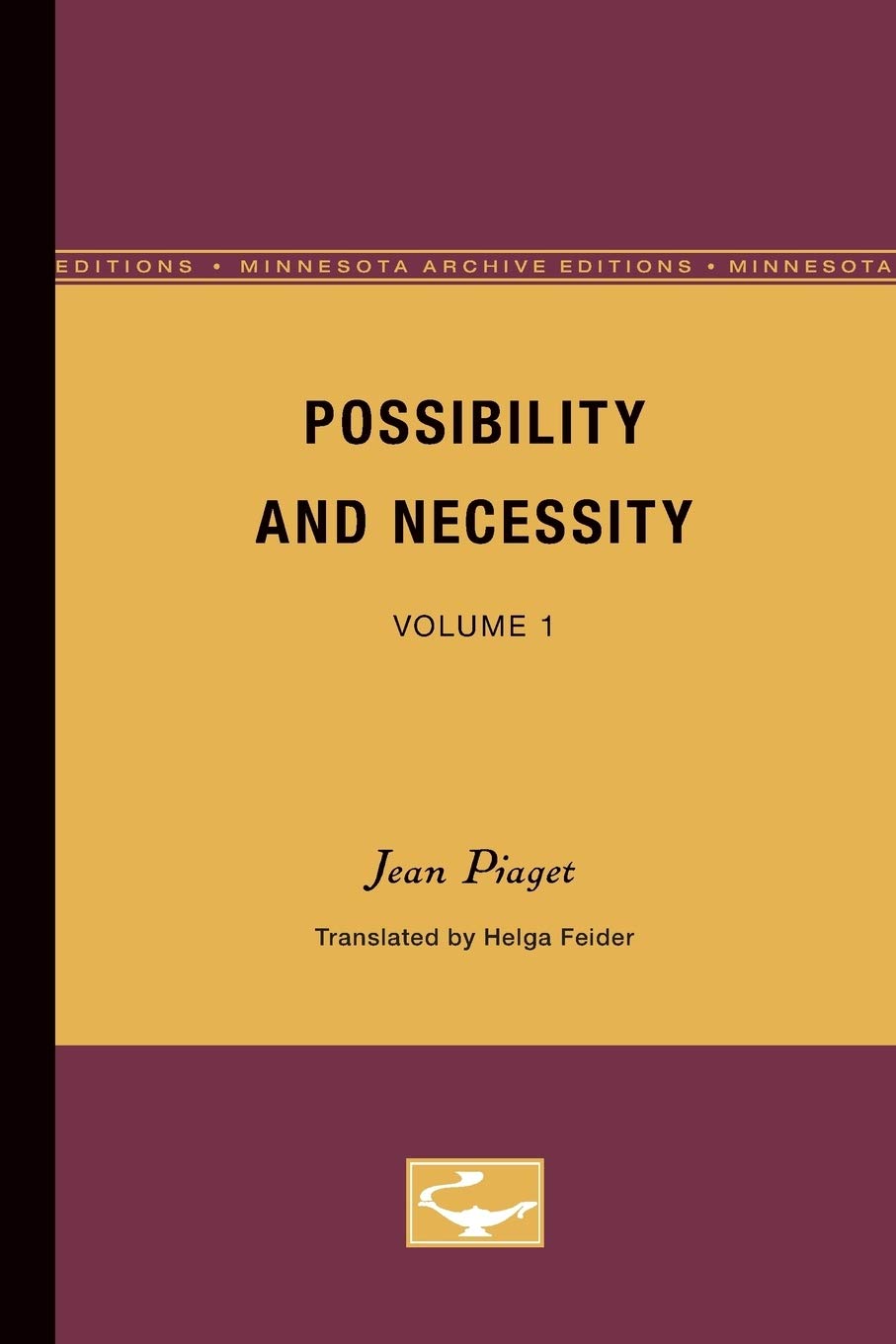
Product Description Possibility and Necessity was first published in 1987. Minnesota Archive Editions uses digital technology to make longunavailable books once again accessible, and are published unaltered from the original University of Minnesota Press editions.Jean Piaget was preoccupied, later in life, with the developing child's understanding of possibilityhow the child becomes aware of the potentially unlimited scope of possible actions and learns to choose among them. Piaget's approach to this question took on a new openness to reallife situations, less deterministic than his earlier, groundbreaking work in cognitive development. The resulting twovolume workhis lastwas published in France in 1981 and 1983 and is not available for the first time in English translation. Possibility and Necessity combines theoretical interpretation with detailed summaries of the experiments that Piaget and his colleagues used to test their hypotheses.Piaget's intent, in Volume 1, is to explore the process whereby possibilities are formed. He chooses to understand 'the possible' not as something predetermined by initial conditions; rather, in his use of the term, possibilities are constantly coming into being, and have no static characteristicseach arises from an event which has produced an opening onto it, and its actualization will in turn give rise to other openings. In perceiving that a possibility can be realized, and in acting upon it, the child creates something that did not exist before.To observe this process, Piaget and his associates devised a series of thirteen problems appropriate for children ranging in age from four or five to eleven or twelve; they were asked to name all possible ways three dice might be arranged, for example, or a square of paper sectioned. The experimenters had two primary aimsto discover to what extent the child's capacity to see possibilities develops with age, and to determine the place in cognitive development of this capacitydoes it precede or follow the advent of operational thought structures? In charting this process, Piaget discerns a growing interaction between possibility and necessity. How the child comes to understand necessity and achieves a dynamic synthesisor equilibrium between the possible and the necessary is discussed by Piaget and his colleagues in Volume 2, The Role of Necessity in Cognitive Development, also published by Minnesota. From the Back Cover Minnesota Archive Editions uses digital technology to make longunavailable books once again accessible to scholars, students, researchers, and general readers. Rich with historical and cultural value, these works are published unaltered from the original University of Minnesota Press editions. The books offered through Minnesota Archive Editions are produced in limited quantities according to customer demand and are available through select distribution partners. About the Author Translator Helga Feider was a professor of psychology at the Universite de Quebec a Montreal.
⚠️ WARNING (California Proposition 65):
This product may contain chemicals known to the State of California to cause cancer, birth defects, or other reproductive harm.
For more information, please visit www.P65Warnings.ca.gov.