

Title
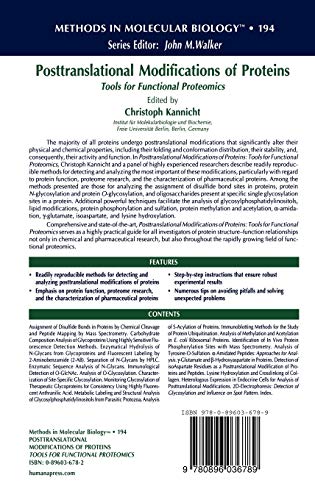
Posttranslational Modification of Proteins: Tools for Functional Proteomics (Methods in Molecular Biology, 194),Used
Sold by Ergodebooks, an authorized reseller.
Returns accepted within 30 days | support@ergodebooks.com
Shipping Information
- Free Standard Shipping — United States only
- Processing Time: 3–5 business days
- Estimated Delivery: 6–10 business days after dispatch
- Double-boxed, fully insured & discreetly packaged
- Tracking number sent via email once dispatched
Returns & Refund
Returns accepted within 30 days of delivery.
Damaged or Defective Item
Free return shipping + replacement or full refund
Wrong Item Received
Free return shipping + replacement or full refund
Change of Mind
Return shipping at customer's expense · 25% restocking fee applies
Payment Option

Posttranslational Modifications of Proteins: Tools for Functional Proteomics is a compilation of detailed protocols needed to detect and analyze the most important co and posttranslational modifications of proteins. Though, for reasons of simplicity not explicitly mentioned in the title, both kinds of modifications are covered, whether they occur during, or after, biosynthesis of the protein. My intention was to cover the most significant protein modifications, focusing on the fields of protein function, proteome research, and the characterization of pharmaceutical proteins. The majority of all proteins undergo co and/or posttranslational modifications. Knowledge of these modifications is extremely important, since they may alter physical and chemical properties, folding, conformation distribution, stability, act ity, and, consequently, function of the proteins. Moreover, the modification itself can act as an added functional group. Examples of the biological effects of protein mo fications include: phosphorylation for signal transduction, ubiquitination for p teolysis, attachment of fatty acids for membrane anchoring or association, glycosylation for protein halflife, targeting, cellcell and cellmatrix interactions, and carboxylation in proteinligand binding to name just a few. Full understanding of a specific protein structurefunction relationship requires detailed information not only on its amino acid sequence, which is determined by the corresponding DNA sequence, but also on the presence and structure of protein modifications.
⚠️ WARNING (California Proposition 65):
This product may contain chemicals known to the State of California to cause cancer, birth defects, or other reproductive harm.
For more information, please visit www.P65Warnings.ca.gov.