
Title
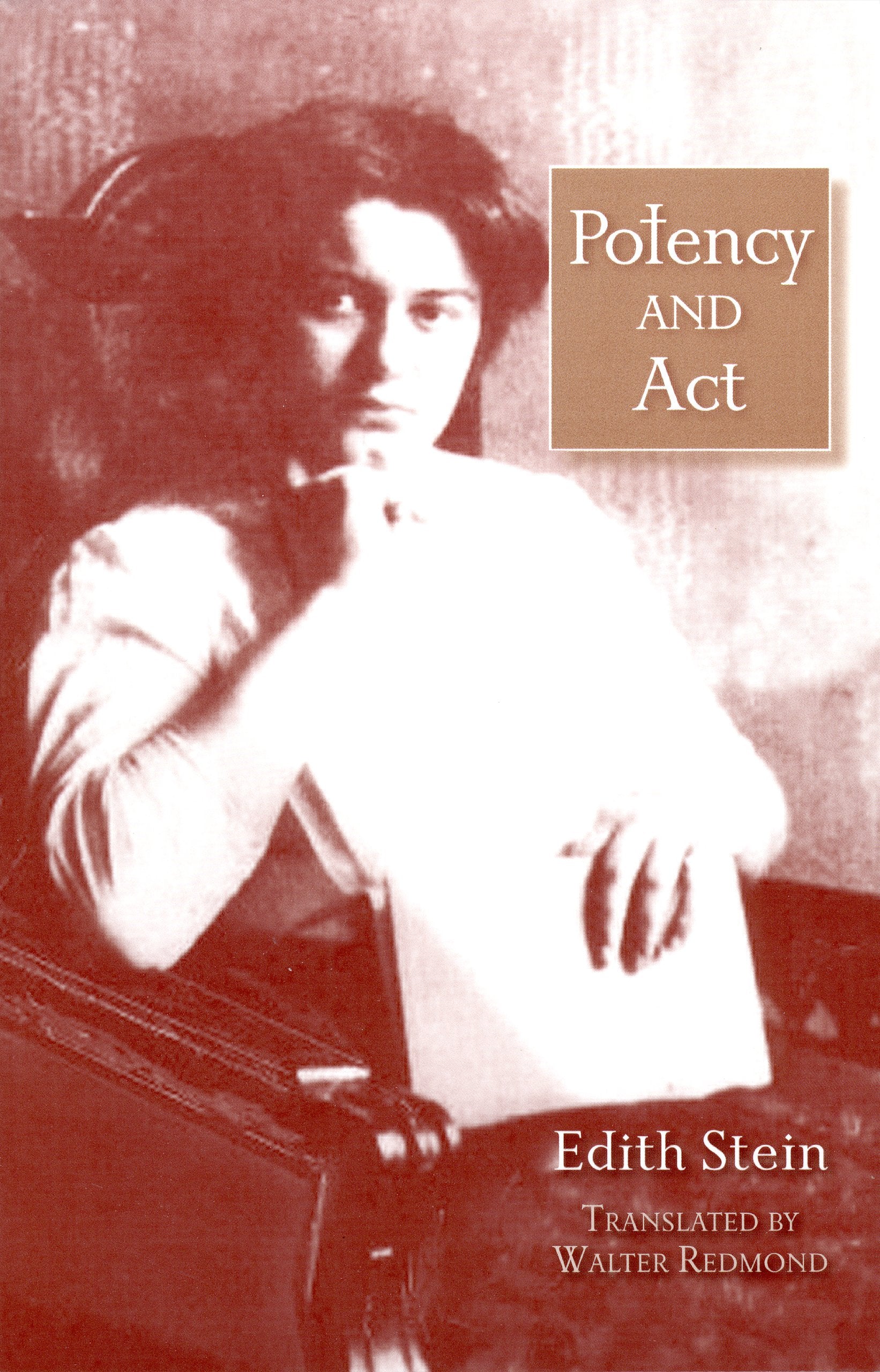
Potency and Act: Studies Toward a Philosophy of Being (The Collected Works of Edith Stein),Used
Sold by Ergodebooks, an authorized reseller.
Returns accepted within 30 days | support@ergodebooks.com
Shipping Information
- Free Standard Shipping — United States only
- Processing Time: 3–5 business days
- Estimated Delivery: 6–10 business days after dispatch
- Double-boxed, fully insured & discreetly packaged
- Tracking number sent via email once dispatched
Returns & Refund
Returns accepted within 30 days of delivery.
Damaged or Defective Item
Free return shipping + replacement or full refund
Wrong Item Received
Free return shipping + replacement or full refund
Change of Mind
Return shipping at customer's expense · 25% restocking fee applies
Payment Option

Potency and Act is the second of three works in which Edith Stein said she endeavored to fulfill her proper mission in philosophy, her life s task : relating the phenomenology of her teacher Edmund Husserl and the scholasticism of St. Thomas Aquinas. But more than critically comparing the two ways of thinking, she wished to fuse them into her own philosophical system, searching for that perennial philosophy lying beyond ages and peoples, common to all who honestly seek truth.Edith Stein was a Jewish phenomenologist who became a Catholic after reading the autobiography of St. Teresa of Jesus and entered the order of Discalced Carmelites founded by the saint. Stein died in Auschwitz in 1942 and was herself canonized in 1998 as St. Teresa Benedicta of the Cross.Her philosophical thinking had been formed by Husserl, but she came to find a home in Aquinas s thought world. In Potency and Act she aimed to get from scholasticism to phenomenology and vice versa and allow the two ways of doing philosophy to come to resolution within herself.The first of the three works in which she carried out her mission was a play where Husserl and Aquinas appear on stage to discuss their agreements and differences (in Knowledge and Faith, ICS Publications, Edith Stein s Collected Works, vol. 8). The second, Potency and Act, was written in 1931 but published for the first time in 1998. The third was her major work, Finite and Eternal Being, written around 1935 and also published posthumously, in 1950 (Collected Works, vol. 9).Potency and Act is complementary to Finite and Eternal Being, for they are quite different in content. The approach to the study of being in Potency and Act is modal as the title implies; her treatment of possible worlds and of form prescribing possibilities relates to phenomenological themes and also to recent developments in logical semantics.Philosophy of religion, of course, is a central concern. We reach God not only through faith and contemplation, she says, but by thinking, using logical reasoning both from the world without (as in St. Thomas) and from the world within ( the way of St. Augustine ); indeed, God s existence is also a purely formal conclusion.Her many searching analyses are suggestive in their own right: on human freedom, temporality, selfknowledge, individuality, evolution (which she fits into the scholastic world view ), atheism, eschatology.
⚠️ WARNING (California Proposition 65):
This product may contain chemicals known to the State of California to cause cancer, birth defects, or other reproductive harm.
For more information, please visit www.P65Warnings.ca.gov.
- Q: What is the main focus of 'Potency and Act' by Edith Stein? A: 'Potency and Act' explores the relationship between phenomenology and scholasticism, aiming to fuse the philosophical approaches of Edmund Husserl and St. Thomas Aquinas.
- Q: What are the primary themes discussed in the book? A: The book discusses themes such as human freedom, temporality, self-knowledge, individuality, evolution, and the philosophy of religion.
- Q: Who was Edith Stein and what is her significance? A: Edith Stein was a Jewish phenomenologist who became a Catholic saint. Her work integrates phenomenology with scholasticism, and she was canonized as St. Teresa Benedicta of the Cross.
- Q: How many pages does 'Potency and Act' have? A: 'Potency and Act' consists of 576 pages.
- Q: What type of binding does this book have? A: The book is available in paperback binding.
- Q: When was 'Potency and Act' published? A: 'Potency and Act' was published for the first time on March 31, 2009.
- Q: Is 'Potency and Act' suitable for beginners in philosophy? A: While 'Potency and Act' covers complex philosophical concepts, it can be valuable for those with a foundational interest in philosophy, particularly in the areas of phenomenology and scholasticism.
- Q: What distinguishes 'Potency and Act' from Edith Stein's other works? A: 'Potency and Act' is complementary to her major work 'Finite and Eternal Being' and focuses specifically on a modal approach to the study of being.
- Q: Does the book include discussions on the existence of God? A: Yes, the book addresses the existence of God through logical reasoning and contemplation, drawing from both external and internal perspectives.
- Q: Can this book be used for academic studies in philosophy? A: 'Potency and Act' is suitable for academic studies, especially for those focusing on metaphysics, phenomenology, and the philosophy of religion.