
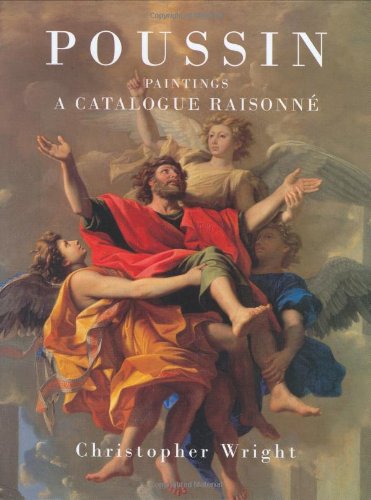
Title
Poussin,New
Sold by Ergodebooks, an authorized reseller.
Returns accepted within 30 days | support@ergodebooks.com
Shipping Information
- Free Standard Shipping — United States only
- Processing Time: 3–5 business days
- Estimated Delivery: 6–10 business days after dispatch
- Double-boxed, fully insured & discreetly packaged
- Tracking number sent via email once dispatched
Returns & Refund
Returns accepted within 30 days of delivery.
Damaged or Defective Item
Free return shipping + replacement or full refund
Wrong Item Received
Free return shipping + replacement or full refund
Change of Mind
Return shipping at customer's expense · 25% restocking fee applies
Payment Option

Born in Normandy in 1594, Poussin was in his early twenties before his interest in the arts led him to Rome. He detached himself from the popular Baroque movement of his native school, choosing instead to echo the monumentality and classical clarity of the Renaissance. Poussins influences, from the sensuous renderings of Titian to the later, bolder themes of antiquity, mythology and religion produced an impressive collection of paintings ranging from The Worship of the Golden Calf (c.1634) to Four Seasons (c.1664, painted shortly before his death in 1665).All his works testified to a strong classical idiom and, though Poussin did not live to see his style accepted, his combination of clarity and logic strongly influenced classically oriented artists such as Benjamin West, JacquesLouis David and Paul Czanne. In this revealing study, illustrated in full color, Christopher Wright, charts Poussins stylistic development in 17th century Rome from his experimental early pictures through to the uncompromising works of his later years. In the last twenty years at least a dozen new paintings have come to light, including the spectacular Sack of the Temple of Jerusalem by the Roman Emperor Titus, now in the Israel Museum, Jerusalem. Wright presents considered arguments on the interpretation of Poussins corpus of paintings as well as the violent controversies surrounding the authenticity of many of them.
⚠️ WARNING (California Proposition 65):
This product may contain chemicals known to the State of California to cause cancer, birth defects, or other reproductive harm.
For more information, please visit www.P65Warnings.ca.gov.
- Q: What is the main focus of 'Poussin: Paintings, a Catalogue Raisonne'? A: 'Poussin: Paintings, a Catalogue Raisonne' focuses on the life and works of the artist Nicolas Poussin, highlighting his stylistic development and contributions to classical art during the 17th century.
- Q: Who is the author of this book? A: The author of 'Poussin: Paintings, a Catalogue Raisonne' is Christopher Wright.
- Q: What type of binding does this book have? A: 'Poussin: Paintings, a Catalogue Raisonne' is published in hardcover binding, making it durable for long-term use.
- Q: How many pages are in 'Poussin: Paintings, a Catalogue Raisonne'? A: The book contains 320 pages, providing a comprehensive overview of Poussin's life and works.
- Q: When was 'Poussin: Paintings, a Catalogue Raisonne' published? A: The book was published on January 7, 2007.
- Q: What art movements influenced Poussin's work? A: Poussin's work was influenced by the Baroque movement as well as the classical clarity and monumentality of the Renaissance.
- Q: What notable works by Poussin are discussed in the book? A: The book discusses notable works by Poussin such as 'The Worship of the Golden Calf' and 'Four Seasons', along with newer discoveries like 'Sack of the Temple of Jerusalem'.
- Q: Is 'Poussin: Paintings, a Catalogue Raisonne' suitable for art students? A: Yes, the book is suitable for art students and enthusiasts as it offers in-depth analysis and insights into Poussin's work and historical context.
- Q: Does the book include illustrations? A: Yes, 'Poussin: Paintings, a Catalogue Raisonne' is illustrated in full color, showcasing Poussin's artwork.
- Q: What can readers expect to learn from this book? A: Readers can expect to learn about Poussin's stylistic development, the interpretation of his artworks, and the controversies regarding their authenticity.