
Title
Poverty and Leadership in the Later Roman Empire (The Menahem Stern Jerusalem Lectures),Used
Sold by Ergodebooks, an authorized reseller.
Returns accepted within 30 days | support@ergodebooks.com
Shipping Information
- Free Standard Shipping — United States only
- Processing Time: 3–5 business days
- Estimated Delivery: 6–10 business days after dispatch
- Double-boxed, fully insured & discreetly packaged
- Tracking number sent via email once dispatched
Returns & Refund
Returns accepted within 30 days of delivery.
Damaged or Defective Item
Free return shipping + replacement or full refund
Wrong Item Received
Free return shipping + replacement or full refund
Change of Mind
Return shipping at customer's expense · 25% restocking fee applies
Payment Option

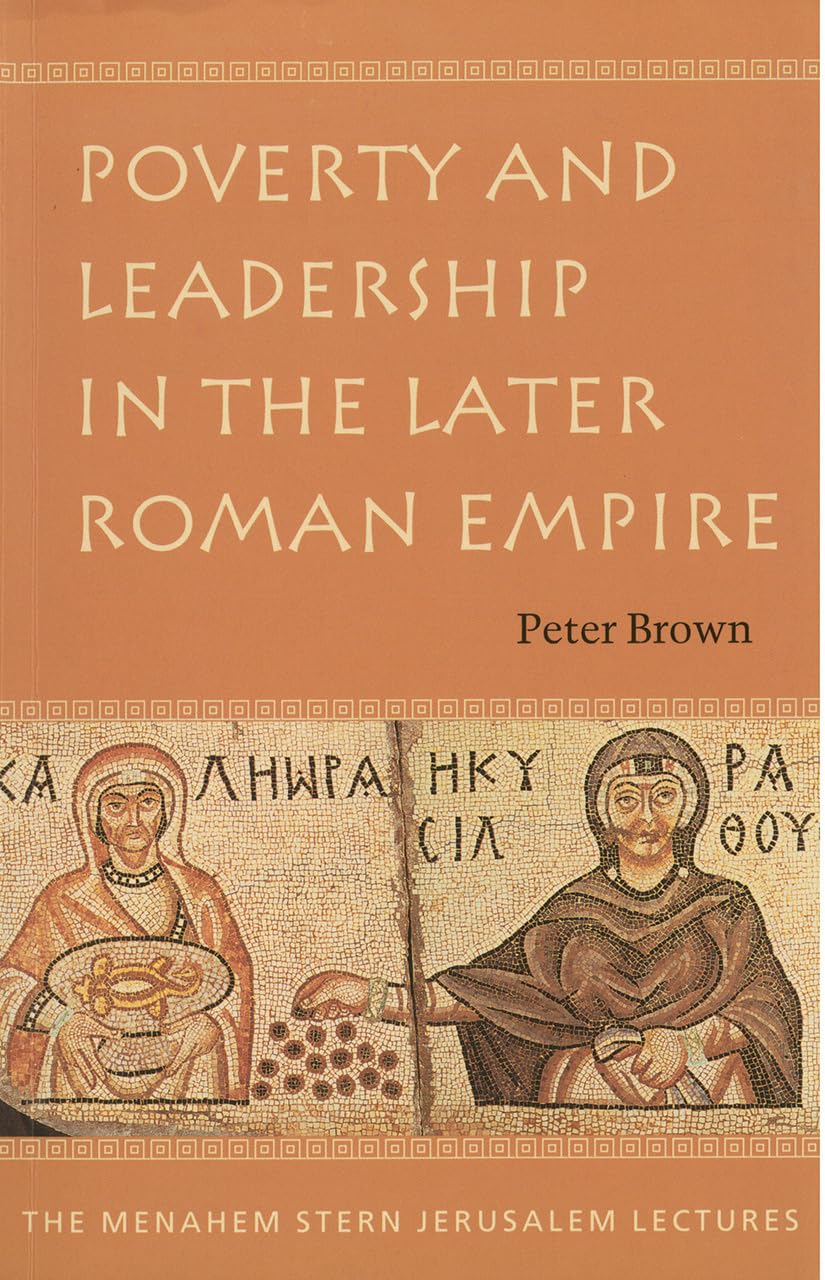
In three magisterial essays, Peter Brown, one of the world's foremost scholars of the society and culture of late antiquity, explores the emergence in late Roman society of 'the poor' as a distinct social class, one for which the Christian church claimed a special responsibility. It is the story of how a society came to see itself as responsible for the care of a particular class of people a class that had not previously been cared for and of who benefited from that shift in interests. In his characteristically elegant and lucid prose, Brown seeks to recover the preChristian status of poor people, the actual nature of the relations between the Christian church and the poor, and the true motivations sometimes sincere, sometimes selfserving behind Christian rhetoric of love for the poor. He draws not only on the standard Greek and Latin sources for the later Roman Empire, but also on Jewish sources to document the interactions between Middle Eastern provincial societies and classical Roman traditions. Brown gracefully illuminates a crucial transition from classical to Christian culture: the emergence of a new understanding of what society and the Church owes to the poor that continues to resonate.
⚠️ WARNING (California Proposition 65):
This product may contain chemicals known to the State of California to cause cancer, birth defects, or other reproductive harm.
For more information, please visit www.P65Warnings.ca.gov.
- Q: What is the main focus of 'Poverty and Leadership in the Later Roman Empire'? A: The book explores the emergence of 'the poor' as a distinct social class in late Roman society and the responsibilities the Christian church assumed towards them.
- Q: Who is the author of this book? A: The author is Peter Brown, a renowned scholar of late antiquity.
- Q: When was this book published? A: The book was published on November 1, 2001.
- Q: How many pages does this book have? A: The book contains 176 pages.
- Q: What type of binding does this book have? A: This book is available in paperback binding.
- Q: What is the condition of the book? A: The book is in new condition.
- Q: What topics does Peter Brown address in his essays? A: Brown addresses the historical status of the poor, the relationship between the Christian church and the poor, and the motivations behind the church's rhetoric regarding care for the poor.
- Q: Does this book include sources beyond Greek and Latin literature? A: Yes, Brown also draws on Jewish sources to document interactions between Middle Eastern provincial societies and classical Roman traditions.
- Q: Is this book suitable for someone interested in early Christian history? A: Yes, it is suitable for readers interested in the transition from classical to Christian culture and the sociocultural dynamics of late antiquity.
- Q: What edition of the book is available? A: This is the first edition of the book.