
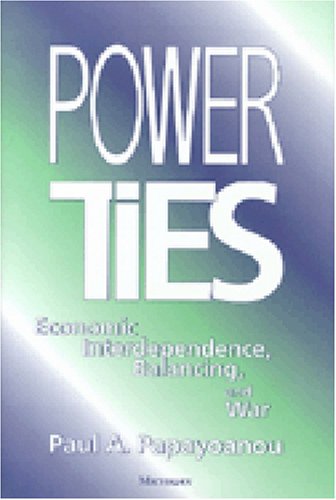
Title
Power Ties: Economic Interdependence, Balancing, And War
Sold by Ergodebooks, an authorized reseller.
Returns accepted within 30 days | support@ergodebooks.com
Shipping Information
- Free Standard Shipping — United States only
- Processing Time: 3–5 business days
- Estimated Delivery: 6–10 business days after dispatch
- Double-boxed, fully insured & discreetly packaged
- Tracking number sent via email once dispatched
Returns & Refund
Returns accepted within 30 days of delivery.
Damaged or Defective Item
Free return shipping + replacement or full refund
Wrong Item Received
Free return shipping + replacement or full refund
Change of Mind
Return shipping at customer's expense · 25% restocking fee applies
Payment Option

Will The Growth Of Economic Interdependence Since The Second World War Help To Maintain The Peace That We Have Seen For More Than Fifty Years Among The Great Powers? Some Argue That The Benefits That Come From Being Integrated Into Today'S World Economy Make It Unlikely That Countries Will Pursue Aggressive Policies. Others Are Not So Sanguine, Arguing That International Economic Ties Have Little Effect On The Making Of National Security Strategies.Power Ties Contradicts Both Arguments. Analyzing The History Of The Greatpower System Since The Late Nineteenth Century, Paul Papayoanou Shows That International Economic Relations Have A Significant Impact On States'S Security Strategies. A Great Power'S Economic Ties Generate Powerful Domestic Economic Interests That Influence A Leader'S Ability To Mobilize Support And Resources For Credibly Opposing Threatening Powers In The International System. This Accounts For The Strength Or Weakness Of Alliance Commitments And Defense Expenditures, And In Turn, The Likelihood That Aspiring Revisionist Powers Will Be Deterred From Initiating A Military Offensive That Upsets The Territorial Status Quo. Power Ties Also Revises Much Of The Conventional Wisdom About The Pacifying Effects Of Economic Interdependence, For It Demonstrates That Extensive Economic Ties Are Not Necessarily Associated With Peace And Can Make War More Likely.Papayoanou'S Union Of Theory And History Provides A Bold New Interpretation Of The Most Significant Developments In International Politics Over The Past Century. This Book Will Be Of Interest To Students And Scholars Of Political Science, History, And International Relations.Paul Papayoanou Is Assistant Professor Of Political Science And Assistant Adjunct Professor, Graduate School Of International Relations And Pacific Studies, University Of California, San Diego.
⚠️ WARNING (California Proposition 65):
This product may contain chemicals known to the State of California to cause cancer, birth defects, or other reproductive harm.
For more information, please visit www.P65Warnings.ca.gov.
- Q: What is the binding type of the book? A: The book is hardcover. This binding type is known for its durability and longevity.
- Q: How many pages does 'Power Ties' have? A: The book has two hundred sixteen pages. It offers a comprehensive analysis of economic interdependence and international relations.
- Q: What are the dimensions of the book? A: The dimensions are six point three inches in length, one point zero six inches in width, and nine point two nine inches in height. These dimensions make it a standard size for a hardcover book.
- Q: Who is the author of 'Power Ties'? A: The author is Paul Papayoanou. He is an Assistant Professor of Political Science at the University of California, San Diego.
- Q: What category does this book fall under? A: The book falls under the category of Economic Conditions. It explores the relationship between economics and international security.
- Q: Is 'Power Ties' suitable for academic research? A: Yes, it is suitable for academic research. The book provides significant insights into political science, history, and international relations.
- Q: What themes are explored in 'Power Ties'? A: The book explores themes of economic interdependence, national security strategies, and the dynamics of great-power relations. It challenges conventional wisdom regarding peace and economic ties.
- Q: What is the primary focus of 'Power Ties'? A: The primary focus is on how international economic relations impact state security strategies. It analyzes great powers' economic interests and their influence on military policies.
- Q: Can this book be useful for students? A: Yes, it is useful for students. It offers valuable perspectives for those studying political science and international relations.
- Q: What should I do to take care of this book? A: To take care of the book, keep it in a dry place and avoid exposure to direct sunlight. This will help maintain its condition over time.
- Q: Is there a warranty or return policy for this book? A: Typically, books have a return policy for unopened items. Check with the retailer for specific details regarding returns.
- Q: How should I store 'Power Ties'? A: Store the book upright on a shelf, away from moisture and heat. This prevents damage and ensures the book remains in good condition.
- Q: What if the book arrives damaged? A: If the book arrives damaged, contact the seller for a replacement or refund. Many retailers have policies for damaged items.
- Q: Is 'Power Ties' appropriate for casual readers? A: Yes, it can be appropriate for casual readers. However, it is more suited for those interested in political and economic topics.
- Q: Does this book include any illustrations or charts? A: No, 'Power Ties' does not include illustrations or charts. It focuses on text-based analysis and arguments.
- Q: How does 'Power Ties' compare to other books in its genre? A: It offers a unique perspective by contradicting common arguments about economic interdependence and war, setting it apart from other works in political science.