
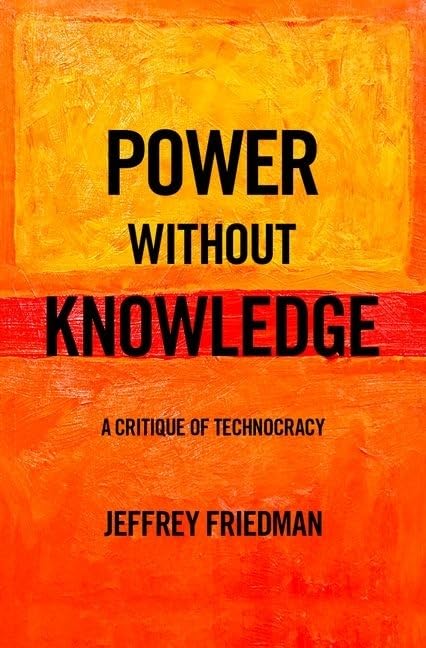
Title
Power without Knowledge: A Critique of Technocracy,Used
Sold by Ergodebooks, an authorized reseller.
Returns accepted within 30 days | support@ergodebooks.com
Shipping Information
- Free Standard Shipping — United States only
- Processing Time: 3–5 business days
- Estimated Delivery: 6–10 business days after dispatch
- Double-boxed, fully insured & discreetly packaged
- Tracking number sent via email once dispatched
Returns & Refund
Returns accepted within 30 days of delivery.
Damaged or Defective Item
Free return shipping + replacement or full refund
Wrong Item Received
Free return shipping + replacement or full refund
Change of Mind
Return shipping at customer's expense · 25% restocking fee applies
Payment Option

Technocrats claim to know how to solve the social and economic problems of complex modern societies. But as Jeffrey Friedman argues in Power without Knowledge, there is a fundamental flaw with technocracy: it requires an ability to predict how the people whom technocrats attempt to control will act in response to technocratic policies. However, the mass public's ideasthe ideas that drive their actionsare far too varied and diverse to be reliably predicted.But that is not the only problem. Friedman reminds us that a large part of contemporary mass politics, even populist mass politics, is essentially technocratic too. Members of the general public often assume that they are competent to decide which policies or politicians will be able to solve social and economic problems. Yet these ordinary "citizentechnocrats" typically regard the solutions to social problems as selfevident, such that politics becomes a matter of vetting public officials for their good intentions and strong wills, not their technocratic expertise.Finally, Friedman argues that technocratic experts themselves drastically oversimplify technocratic realities. Economists, for example, theorize that people respond rationally to the incentives they face. This theory is simplistic, but it gives the appearance of being able to predict people's behavior in response to technocratic policy initiatives. If stripped of such gross oversimplications, though, technocrats themselves would be forced to admit that a rational technocracy is nothing more than an impossible dream.Ranging widely over the philosophy of social science, rational choice theory, and empirical political science, Power without Knowledge is a pathbreaking work that upends traditional assumptions about technocracy and politics, forcing us to rethink our assumptions about the legitimacy of modern governance.
⚠️ WARNING (California Proposition 65):
This product may contain chemicals known to the State of California to cause cancer, birth defects, or other reproductive harm.
For more information, please visit www.P65Warnings.ca.gov.