
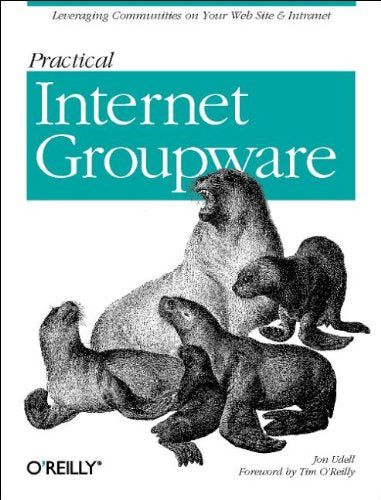
Title
Practical Internet Groupware,Used
Sold by Ergodebooks, an authorized reseller.
Returns accepted within 30 days | support@ergodebooks.com
Shipping Information
- Free Standard Shipping — United States only
- Processing Time: 3–5 business days
- Estimated Delivery: 6–10 business days after dispatch
- Double-boxed, fully insured & discreetly packaged
- Tracking number sent via email once dispatched
Returns & Refund
Returns accepted within 30 days of delivery.
Damaged or Defective Item
Free return shipping + replacement or full refund
Wrong Item Received
Free return shipping + replacement or full refund
Change of Mind
Return shipping at customer's expense · 25% restocking fee applies
Payment Option

Product Description Collaboration. From its academic roots to the bustling commerce sites of today, the Internet has always been about collaboration: providing a means for people to communicate and work together effectively. But how do you build effective tools for collaboration? How do you build tools that are simple enough for people to really use, yet powerful enough to really facilitate collaboration?In 1995 Jon Udell became executive editor for new media at BYTE magazine, taking on the challenge of building an online presence for a traditional print publication. In meeting this challenge, he discovered that he was managing an online community, not just an online publication. He discovered that he was building not just a set of documents, but a suite of Internetbased groupware applications in which editors, writers, and readers all participated.Practical Internet Groupware details the lessons learned from that experience. Drawn from the author's real world experience, Practical Internet Groupware describes the tools and technologies for building and rapidly deploying groupware applications, and also discusses the design philosophy and usability issues that determine the success or failure of any groupware endeavor.The key to success lies in using simple tools, often open source, that effectively blend in established Internet technologies that have always had a collaborative aspect (SMTP, NNTP) with new technologies that enhance our ability to manage collaborative documents (HTTP, XML). The result is an approach that codifies the idea that many web content providers have long suspected: yesterday's online content is fast becoming tomorrow's networkbased applications.In this book you'll learn how to:Base groupware on standard Internet technologies (mail servers, news servers, and web servers)Use simple server and clientside scripts to automate creation, presentation, transmission, and search of electronic documentsCreate a base of documents that contain semistructured data representing much of the intellectual capital of an enterpriseDeploy these solutions in a way that scales from groups of a few collaborators to communities of thousands of usersIf you've ever been disappointed watching a commercial groupware system used as little more than an expensive email client, or if you've ever wondered how to transform simple email, news, or web clients from document viewers into collaboration tools, thenPractical Internet Groupware is for you. Amazon.com Review Drawing on the wealth of experience he accumulated developing internal and external collaboration solutions forBYTE magazine, author Jon Udell provides a thorough guide to building networked tools for collaboration. Unlike many books that are tied to a given language or protocol,Practical Internet Groupware delivers useful code examples in several languages, including Perl (primary language), serverside Java, and XML. Protocols discussed include NNTP, IMAP, HTTP, POP3, and SMTP. The first section covers general use and policies as they relate to groupware. Administrators and end users will benefit from the references to NNTP messages in Collabra and Outlook, scoped discussion groups, and packaging messages and discussion threads. Udell also includes many tips and usability pointers. When discussing how to build, index, and navigate a document database, he delineates ways to create rich navigation that incorporate topicsensitive and sequential navigation using modular Perl examples. Many of the solutions that are presented address custom software that implements open standards. One of the most powerful solutions discusses a lightweight, Perlbased local HTTP server, called dhttp. Creating, using, extending, and integrating this server are capably covered by the author, and it is convincingly presented as a flexible means of distributing information. As a mark of distinction, the book approaches problems from multiple angles. With securi
⚠️ WARNING (California Proposition 65):
This product may contain chemicals known to the State of California to cause cancer, birth defects, or other reproductive harm.
For more information, please visit www.P65Warnings.ca.gov.