If you have any questions, you are always welcome to contact us. We'll get back to you as soon as possible, withing 24 hours on weekdays.
Customer service
All questions about your order, return and delivery must be sent to our customer service team by e-mail at yourstore@yourdomain.com
Sale & Press
If you are interested in selling our products, need more information about our brand or wish to make a collaboration, please contact us at press@yourdomain.com
Help
If you have any questions, you are always welcome to contact us. We'll get back to you as soon as possible, withing 24 hours on weekdays.
Customer service
All questions about your order, return and delivery must be sent to our customer service team by e-mail at yourstore@yourdomain.com
Sale & Press
If you are interested in selling our products, need more information about our brand or wish to make a collaboration, please contact us at press@yourdomain.com
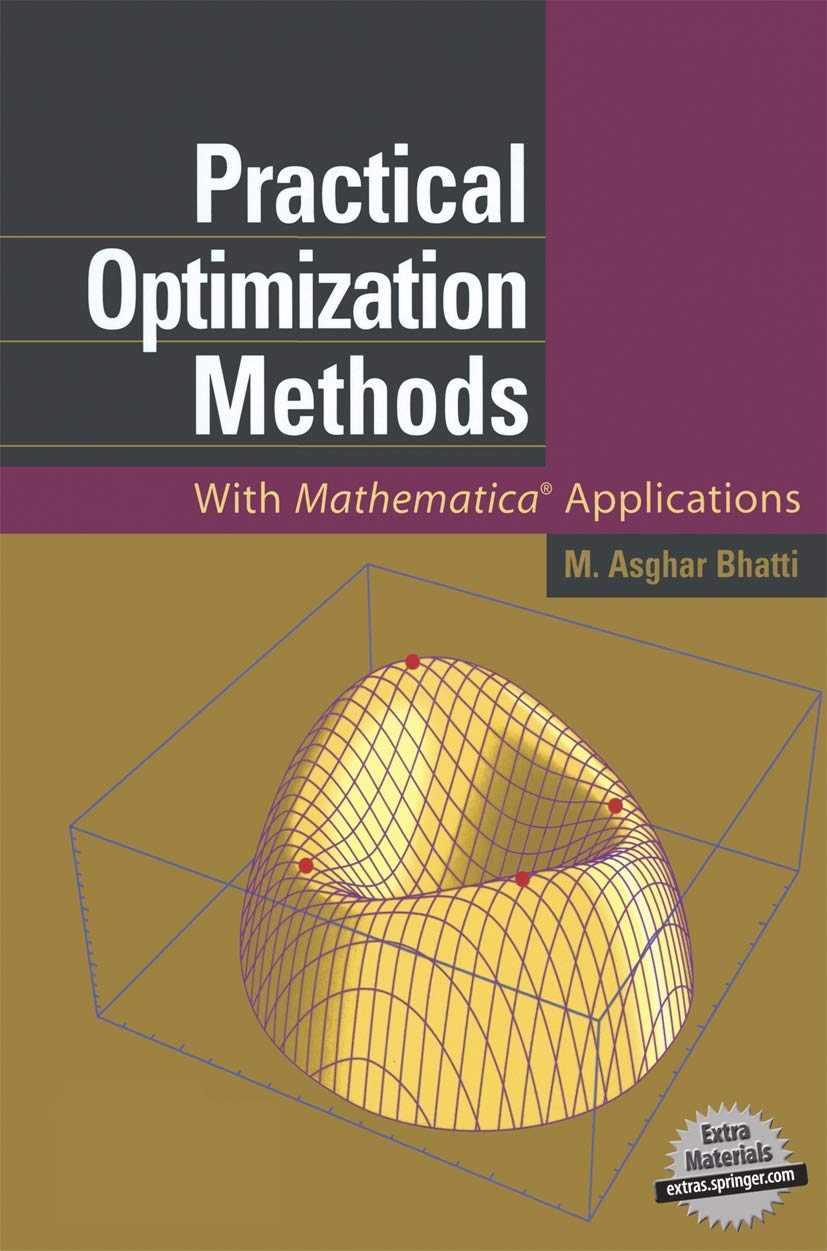
The goal of this book is to present basic optimization theory and modern computational algorithms in a concise manner. The book is suitable for un dergraduate and graduate students in all branches of engineering, operations research, and management information systems. The book should also be use ful for practitioners who are interested in learning optimization and using these techniques on their own. Most available books in the field tend to be either too theoretical or present computational algorithms in a cookbook style. An approach that falls some where in between these two extremes is adopted in this book. Theory is pre sented in an informal style to make sense to most undergraduate and graduate students in engineering and business. Computational algorithms are also de veloped in an informal style by appealing to readers' intuition rather than mathematical rigor. The available, computationally oriented books generally present algorithms alone and expect readers to perform computations by hand or implement these algorithms by themselves. This obviously is unrealistic for a usual introductory optimization course in which a wide variety of optimization algorithms are discussed. There are some books that present programs written in traditional computer languages such as Basic, FORTRAN, or Pascal. These programs help with computations, but are of limited value in developing understanding of the algorithms because very little information about the intermediate steps v ' Preface VI is presented.
⚠️ WARNING (California Proposition 65):
This product may contain chemicals known to the State of California to cause cancer,
birth defects, or other reproductive harm.
For MAP (Minimum Advertised Price) violations and Intellectual Property (IP) or Trademark concerns, please contact:
support@ergodebooks.com
⚠️ California Proposition 65 Warning: Some products sold on this website may expose you to chemicals known to the State of California to cause cancer, birth defects, or other reproductive harm. For more information, visit www.P65Warnings.ca.gov.