
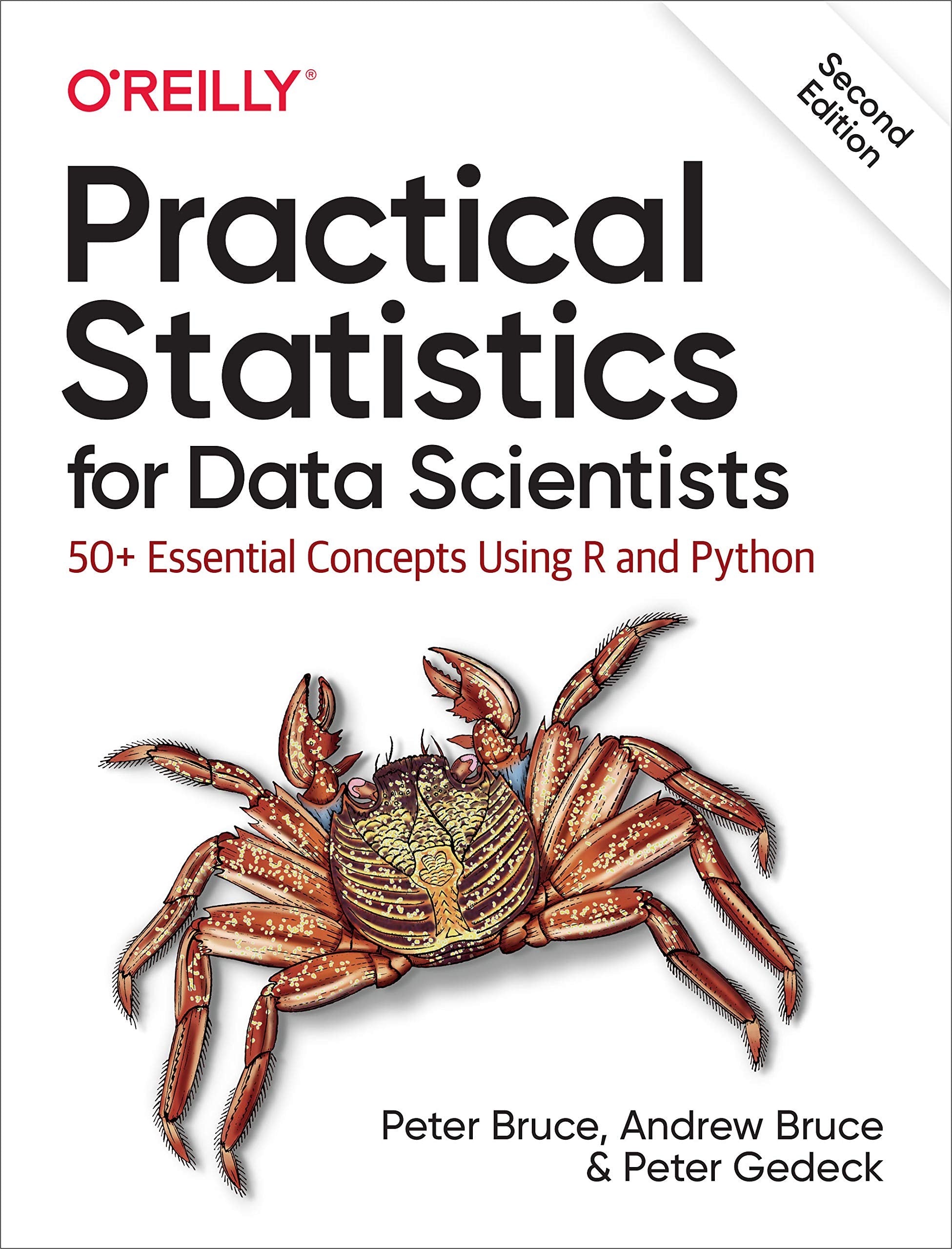
Title
Practical Statistics For Data Scientists: 50+ Essential Concepts Using R And Python,Used
Sold by Ergodebooks, an authorized reseller.
Returns accepted within 30 days | support@ergodebooks.com
Shipping Information
- Free Standard Shipping — United States only
- Processing Time: 3–5 business days
- Estimated Delivery: 6–10 business days after dispatch
- Double-boxed, fully insured & discreetly packaged
- Tracking number sent via email once dispatched
Returns & Refund
Returns accepted within 30 days of delivery.
Damaged or Defective Item
Free return shipping + replacement or full refund
Wrong Item Received
Free return shipping + replacement or full refund
Change of Mind
Return shipping at customer's expense · 25% restocking fee applies
Payment Option

Statistical Methods Are A Key Part Of Data Science, Yet Few Data Scientists Have Formal Statistical Training. Courses And Books On Basic Statistics Rarely Cover The Topic From A Data Science Perspective. The Second Edition Of This Popular Guide Adds Comprehensive Examples In Python, Provides Practical Guidance On Applying Statistical Methods To Data Science, Tells You How To Avoid Their Misuse, And Gives You Advice On Whats Important And Whats Not.Many Data Science Resources Incorporate Statistical Methods But Lack A Deeper Statistical Perspective. If Youre Familiar With The R Or Python Programming Languages And Have Some Exposure To Statistics, This Quick Reference Bridges The Gap In An Accessible, Readable Format.With This Book, Youll Learn: Why Exploratory Data Analysis Is A Key Preliminary Step In Data Science How Random Sampling Can Reduce Bias And Yield A Higherquality Dataset, Even With Big Data How The Principles Of Experimental Design Yield Definitive Answers To Questions How To Use Regression To Estimate Outcomes And Detect Anomalies Key Classification Techniques For Predicting Which Categories A Record Belongs To Statistical Machine Learning Methods That 'Learn' From Data Unsupervised Learning Methods For Extracting Meaning From Unlabeled Data.
⚠️ WARNING (California Proposition 65):
This product may contain chemicals known to the State of California to cause cancer, birth defects, or other reproductive harm.
For more information, please visit www.P65Warnings.ca.gov.
- Q: What is the size of the book? A: The book measures seven point one inches in length, nine point one inches in height, and zero point nine one inches in width.
- Q: How many pages does the book have? A: The book contains three hundred sixty pages, providing substantial content for readers.
- Q: What type of binding does the book use? A: The book is available in paperback binding, making it lightweight and easy to handle.
- Q: Who is the author of the book? A: The author of the book is Peter Bruce, a recognized figure in data science.
- Q: What topics are covered in the book? A: The book covers essential statistical concepts applicable to data science using R and Python.
- Q: Is this book suitable for beginners? A: Yes, the book is suitable for readers with some exposure to statistics and programming in R or Python.
- Q: How can I apply the concepts learned in the book? A: You can apply the concepts through practical guidance on statistical methods in data science projects.
- Q: Is this book a good resource for data scientists? A: Yes, it serves as a quick reference for statistical methods tailored for data science.
- Q: Can I use this book for self-study? A: Yes, the book is designed for self-study, offering accessible explanations and examples.
- Q: What should I do if the book arrives damaged? A: If the book arrives damaged, you should contact the seller for a return or replacement.
- Q: Is there a warranty for the book? A: Typically, books do not come with a warranty, but check the seller's return policy for details.
- Q: What if I have trouble understanding the content? A: If you have trouble, consider supplementary resources like online courses or forums focused on data science.
- Q: Is the book updated with the latest statistical methods? A: Yes, the second edition includes comprehensive examples and updated methods for data science.
- Q: Does the book include examples in both R and Python? A: Yes, it provides examples in both R and Python for a comprehensive understanding.
- Q: Are there practical exercises included in the book? A: While the book emphasizes practical guidance, it does not specifically list exercises.