
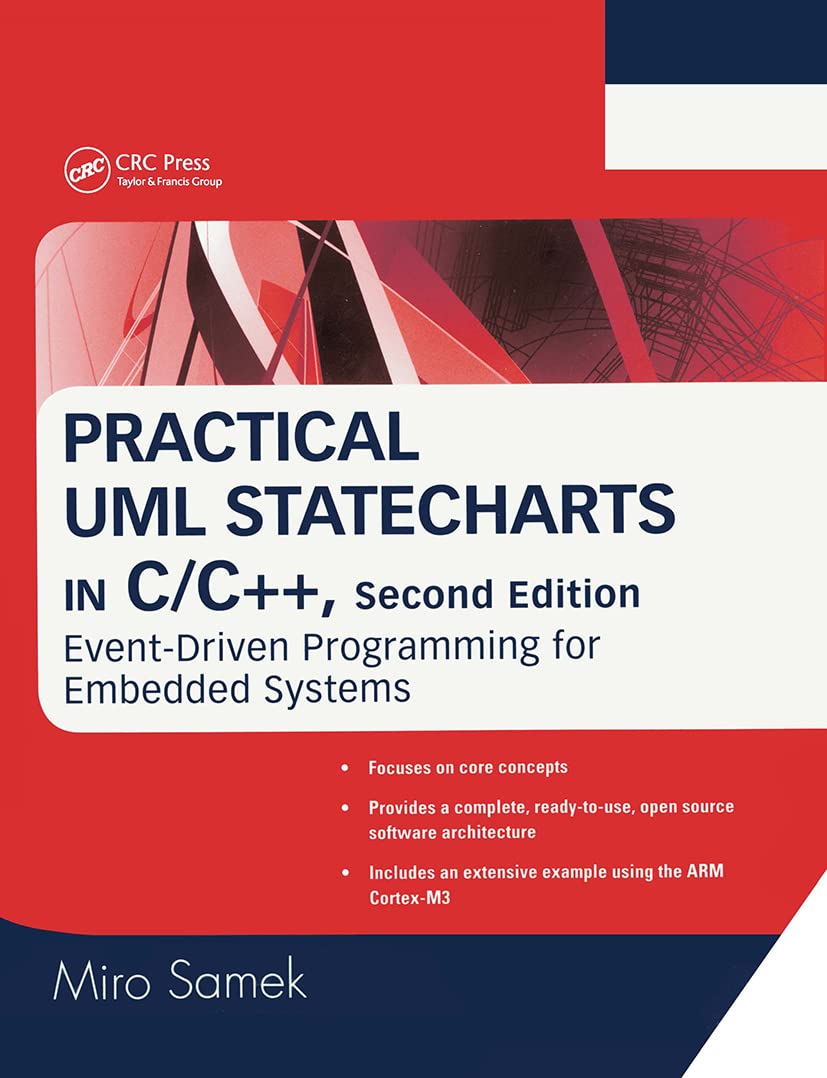
Title
Practical UML Statecharts in C/C++: EventDriven Programming for Embedded Systems,Used
Sold by Ergodebooks, an authorized reseller.
Returns accepted within 30 days | support@ergodebooks.com
Shipping Information
- Free Standard Shipping — United States only
- Processing Time: 3–5 business days
- Estimated Delivery: 6–10 business days after dispatch
- Double-boxed, fully insured & discreetly packaged
- Tracking number sent via email once dispatched
Returns & Refund
Returns accepted within 30 days of delivery.
Damaged or Defective Item
Free return shipping + replacement or full refund
Wrong Item Received
Free return shipping + replacement or full refund
Change of Mind
Return shipping at customer's expense · 25% restocking fee applies
Payment Option

Practical UML Statecharts in C/C++ Second Edition bridges the gap between highlevel abstract concepts of the Unified Modeling Language (UML) and the actual programming aspects of modern hierarchical state machines (UML statecharts). The book describes a lightweight, open source, active object (actor) framework, called QP that enables direct manual coding UML statecharts and concurrent eventdriven applications in C or C++.This book is presented in two parts. In Part I, you get a practical description of the relevant state machine concepts starting from traditional finite state automata to modern UML state machines followed by state machine coding techniques and statemachine design patterns, all illustrated with executable examples. In Part II, you find a detailed design study of a generic realtime framework indispensable for combining concurrent, eventdriven state machines into robust applications. Part II begins with a clear explanation of the key eventdriven programming concepts such as inversion of control (Hollywood Principle), blocking versus nonblocking code, runtocompletion (RTC) execution semantics, the importance of event queues, dealing with time, and the role of state machines to maintain the context from one event to the next. This background is designed to help software developers in making the transition from the traditional sequential to the modern eventdriven programming, which can be one of the trickiest paradigm shifts.The lightweight QP active object framework goes several steps beyond the traditional realtime operating system (RTOS). In the simplest configuration, QP runs on baremetal microcontroller completely replacing the RTOS. QP can also work with almost any OS/RTOS to take advantage of the existing device drivers, communication stacks, and other middleware.The accompanying website to this book (statemachine.com/psicc2) contains complete open source code for QP and the free QM graphical modeling tool for QP, ports to popular processors, including ARM CortexM, ARM7/9, MSP430, AVR/AVR32, PIC24, RX, etc., as well as QP ports to operating systems, such as Linux, Windows, and Android.
⚠️ WARNING (California Proposition 65):
This product may contain chemicals known to the State of California to cause cancer, birth defects, or other reproductive harm.
For more information, please visit www.P65Warnings.ca.gov.