
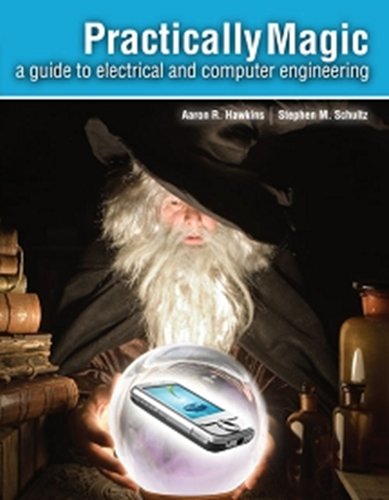
Title
Practically Magic: A Guide to Electrical and Computer Engineering,Used
Sold by Ergodebooks, an authorized reseller.
Returns accepted within 30 days | support@ergodebooks.com
Shipping Information
- Free Standard Shipping — United States only
- Processing Time: 3–5 business days
- Estimated Delivery: 6–10 business days after dispatch
- Double-boxed, fully insured & discreetly packaged
- Tracking number sent via email once dispatched
Returns & Refund
Returns accepted within 30 days of delivery.
Damaged or Defective Item
Free return shipping + replacement or full refund
Wrong Item Received
Free return shipping + replacement or full refund
Change of Mind
Return shipping at customer's expense · 25% restocking fee applies
Payment Option

This book was heavily influenced by a class we began teaching in 2007 at Brigham Young University. The class was designed for freshmen who were interested in pursuing a math/science/engineering major and those who were willing to consider Electrical and Computer Engineering (ECE). Many of the new students we met had little idea what ECE was really about. In fact, when we talked with students graduating with ECE degrees, we discovered that most of them did not appreciate the field's entire scope. Its sheer size, which continues to grow, is partially to blame. Practically Magic is our attempt to summarize all of Electrical and Computer Engineering using an easily readable format. Here is what we hoped to accomplish:1) Readers will realize how electrical and computer engineers impact the world; 2) The book will help new students decide whether ECE is the right major for them; and 3) Students pursuing an ECE degree will be inspired to continue, gain an appreciation for all aspects of the field, and be pointed toward an area of ECE to specialize in.Because it originated from our experiences in the classroom, the book was designed to complement a single semester (or quarter) seminar or survey class. Its 12 chapters are meant to correspond with 12 inclass lectures. But a reader certainly won't need an instructor to explain the book's content. It was meant to be readily understood by anyone with an interest in science and technology, including students still in high school.In addition to an introductory chapter and one on career planning, there are 10 chapters that highlight fundamental Electrical and Computer Engineering concepts. Dissecting the discipline into 10 parts was challenging. A roomful of engineers could argue endlessly about how this division should take place because there is often a lot of overlap between engineering principles. Our chapters represent what we felt were the most relevant topical groupings. In each, you will find intriguing history, concise explanations, and plenty of contemporary examples. We hope, together, they prove enlightening and enjoyable!Aaron R. HawkinsStephen M. Schultz
⚠️ WARNING (California Proposition 65):
This product may contain chemicals known to the State of California to cause cancer, birth defects, or other reproductive harm.
For more information, please visit www.P65Warnings.ca.gov.