If you have any questions, you are always welcome to contact us. We'll get back to you as soon as possible, withing 24 hours on weekdays.
Customer service
All questions about your order, return and delivery must be sent to our customer service team by e-mail at yourstore@yourdomain.com
Sale & Press
If you are interested in selling our products, need more information about our brand or wish to make a collaboration, please contact us at press@yourdomain.com
Help
If you have any questions, you are always welcome to contact us. We'll get back to you as soon as possible, withing 24 hours on weekdays.
Customer service
All questions about your order, return and delivery must be sent to our customer service team by e-mail at yourstore@yourdomain.com
Sale & Press
If you are interested in selling our products, need more information about our brand or wish to make a collaboration, please contact us at press@yourdomain.com
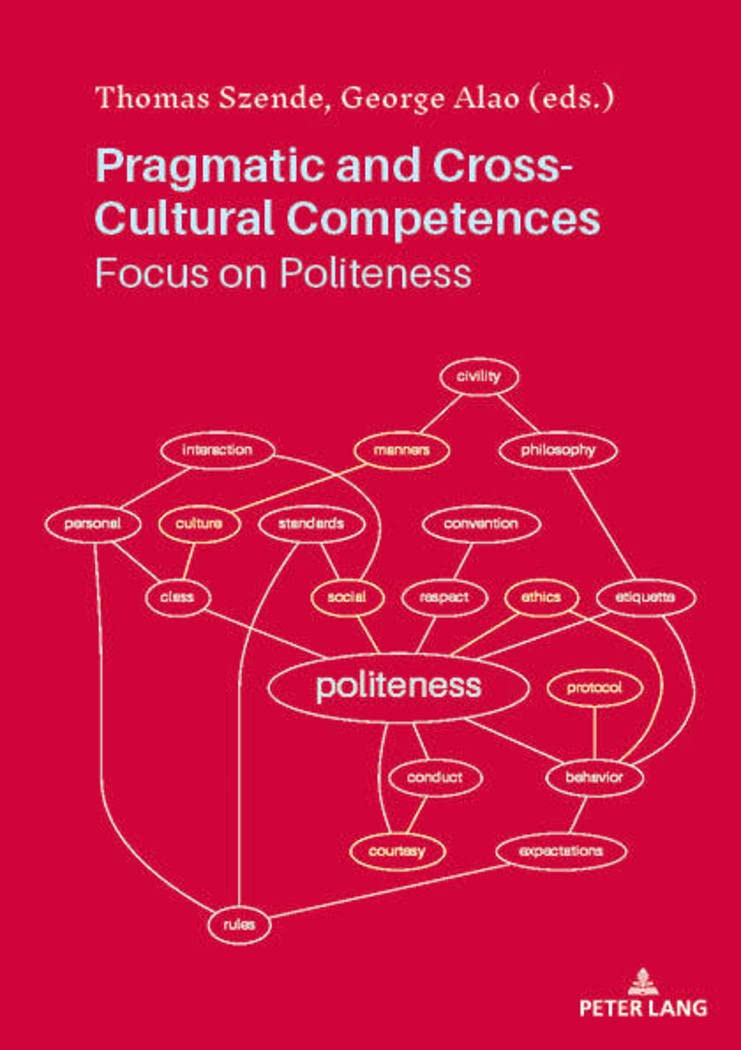
The L2 speaker is able to function in the target culture only when s/he is able to understand, anticipate and produce the choices that the said society makes. Being polite therefore means: knowing how to draw on the conventions of a society, taking into account the expectations of an interlocutor regarding social relations at any given point, and is based on the appropriate language register to the communication situation; being able to balance standard and nonstandard features and to adjust ones speech by moving it towards more or less familiarity, or formality. The learner therefore needs to be aware of the pragmatic flexibility of speakers native and experts who move from one register to another and juggle between respect and caution, first degree meaning and irony, exuberance and excess, with difference in levels, nature and degrees of politeness.This volume contains contributions whose theoretical reflections, field work experiences and authentic data from diverse African, Asian and European languages, literatures and cultures as well as a variety of corpora shed new light on politeness as a central phenomenon in pragmatics, and on what is at stake when teaching or learning the subject. It also opens up a conceptual dialogue with a whole range of domains likely to enrich the debate: sociolinguistics, literature, translation studies, semiotics, cultural anthropology, social psychology, etc.
⚠️ WARNING (California Proposition 65):
This product may contain chemicals known to the State of California to cause cancer,
birth defects, or other reproductive harm.
For MAP (Minimum Advertised Price) violations and Intellectual Property (IP) or Trademark concerns, please contact:
support@ergodebooks.com
⚠️ California Proposition 65 Warning: Some products sold on this website may expose you to chemicals known to the State of California to cause cancer, birth defects, or other reproductive harm. For more information, visit www.P65Warnings.ca.gov.