If you have any questions, you are always welcome to contact us. We'll get back to you as soon as possible, withing 24 hours on weekdays.
Customer service
All questions about your order, return and delivery must be sent to our customer service team by e-mail at yourstore@yourdomain.com
Sale & Press
If you are interested in selling our products, need more information about our brand or wish to make a collaboration, please contact us at press@yourdomain.com
Help
If you have any questions, you are always welcome to contact us. We'll get back to you as soon as possible, withing 24 hours on weekdays.
Customer service
All questions about your order, return and delivery must be sent to our customer service team by e-mail at yourstore@yourdomain.com
Sale & Press
If you are interested in selling our products, need more information about our brand or wish to make a collaboration, please contact us at press@yourdomain.com
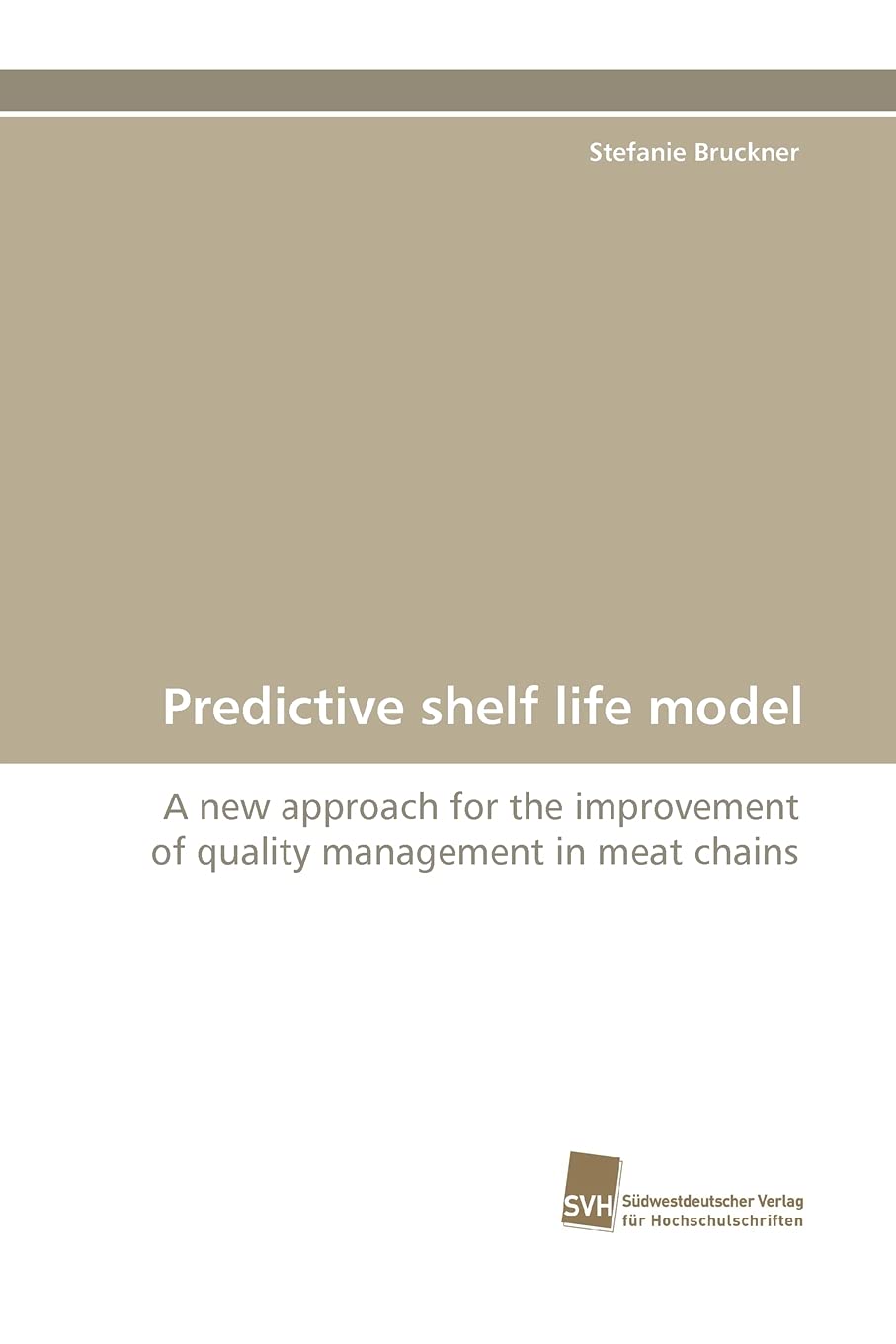
The shelf life of fresh meat is limited by the growth of the specific spoilage organism (SSO) Pseudomonas sp. In the field of predictive microbiology mathematical models are developed to predict the growth of the SSO and thus to determine the shelf life of fresh meat. But until now only a few of the existing models were developed and validated for more than one type of meat and are also applicable under dynamic temperature conditions. In this thesis, the influence of temperature (constant and dynamic) as well as several intrinsic factors on the growth of Pseudomonas sp. was investigated in 638 pork and 600 poultry samples. Based on the collected microbiological growth data, a common predictive shelf life model was developed. Because the investigated intrinsic factors had almost no influence on microbiological growth, only the factor temperature was included in the model. In the validation process, the model delivered reliable shelf life predictions for both meat types. The predictions can be used in specific situations of decision making, e.g. by optimising the storage management from the FIFO (First In, First Out) to the LSFO concept (Least Shelf life, First Out).
⚠️ WARNING (California Proposition 65):
This product may contain chemicals known to the State of California to cause cancer,
birth defects, or other reproductive harm.
For MAP (Minimum Advertised Price) violations and Intellectual Property (IP) or Trademark concerns, please contact:
support@ergodebooks.com
⚠️ California Proposition 65 Warning: Some products sold on this website may expose you to chemicals known to the State of California to cause cancer, birth defects, or other reproductive harm. For more information, visit www.P65Warnings.ca.gov.