
Title
Preferences And Situations: Points Of Intersection Between Historical And Rational Choice In.,Used
Sold by Ergodebooks, an authorized reseller.
Returns accepted within 30 days | support@ergodebooks.com
Shipping Information
- Free Standard Shipping — United States only
- Processing Time: 3–5 business days
- Estimated Delivery: 6–10 business days after dispatch
- Double-boxed, fully insured & discreetly packaged
- Tracking number sent via email once dispatched
Returns & Refund
Returns accepted within 30 days of delivery.
Damaged or Defective Item
Free return shipping + replacement or full refund
Wrong Item Received
Free return shipping + replacement or full refund
Change of Mind
Return shipping at customer's expense · 25% restocking fee applies
Payment Option

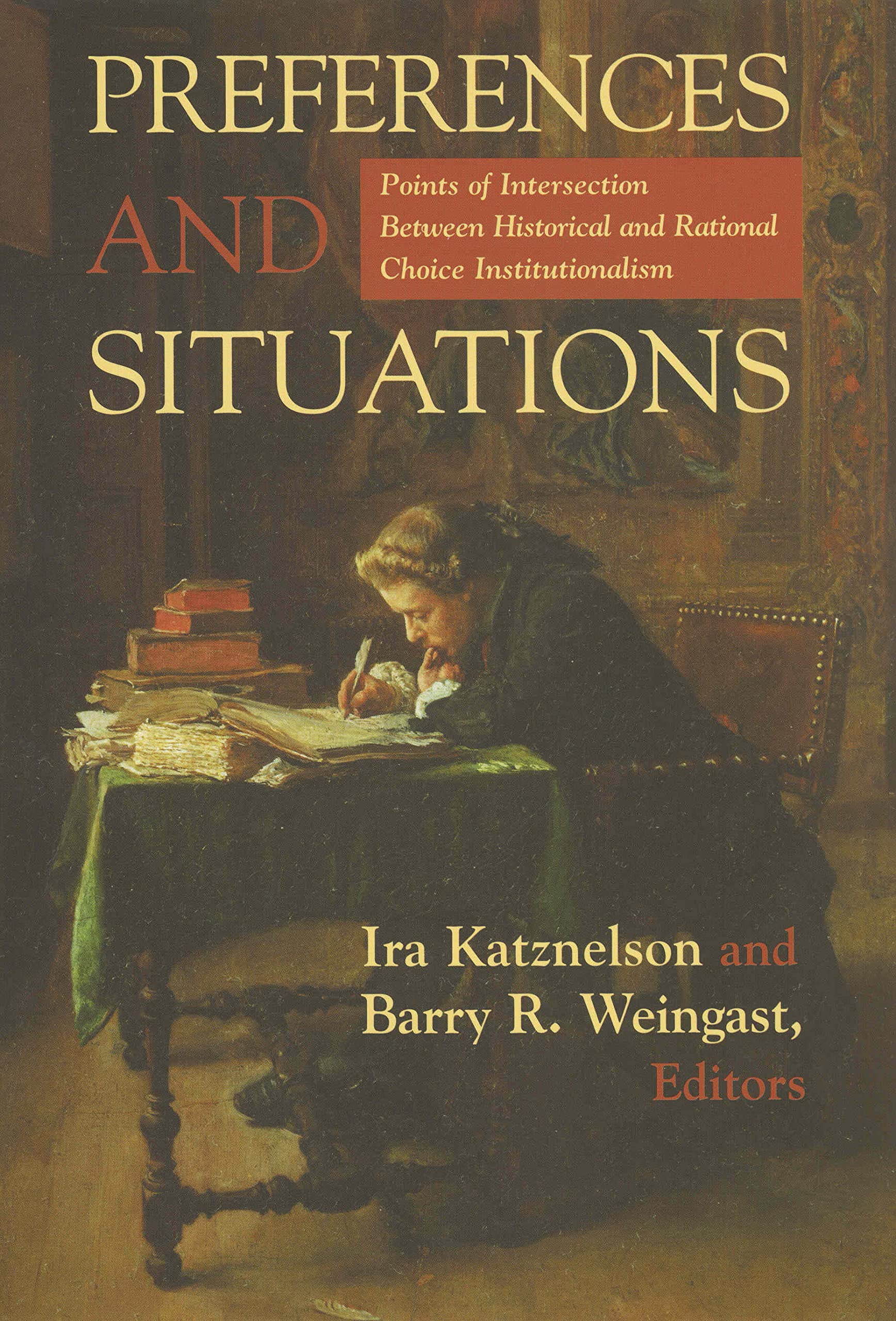
A scholarly gulf has tended to divide historians, political scientists, and social movement theorists on how people develop and act on their preferences. Rational choice scholars assumed that peopleregardless of the time and place in which they livetry to achieve certain goals, like maximizing their personal wealth or power. In contrast, comparative historical scholars have emphasized historical context in explaining people's behavior. Recently, a common emphasis on how institutionssuch as unions or governmentsinfluence people's preferences in particular situations has emerged, promising to narrow the divide between the two intellectual camps. In Preferences and Situations, editors Ira Katnelson and Barry Weingast seek to expand that common ground by bringing together an esteemed group of contributors to address the ways in which institutions, in their wider historical setting, induce people to behave in certain ways and steer the course of history. The contributors examine a diverse group of topics to assess the role that institutions play in shaping people's preferences and decisionmaking. For example, Margaret Levi studies two labor unions to determine how organizational preferences are established. She discusses how the individual preferences of leaders crystallize and become cemented into an institutional culture through formal rules and informal communication. To explore how preferences alter with time, David Brady, John Ferejohn, and Jeremy Pope examine why civil rights legislation that failed to garner sufficient support in previous decades came to pass Congress in 1964. Ira Katznelson reaches back to the 13th century to discuss how the institutional development of Parliament after the signing of the Magna Carta led King Edward I to reframe the view of the British crown toward Jews and expel them in 1290. The essays in this book focus on preference formation and change, revealing a great deal of overlap between two schools of thought that were previously considered mutually exclusive. Though the scholarly debate over the merits of historical versus rational choice institutionalism will surely rage on, Preferences and Situations reveals how each field can be enriched by the other.
⚠️ WARNING (California Proposition 65):
This product may contain chemicals known to the State of California to cause cancer, birth defects, or other reproductive harm.
For more information, please visit www.P65Warnings.ca.gov.