
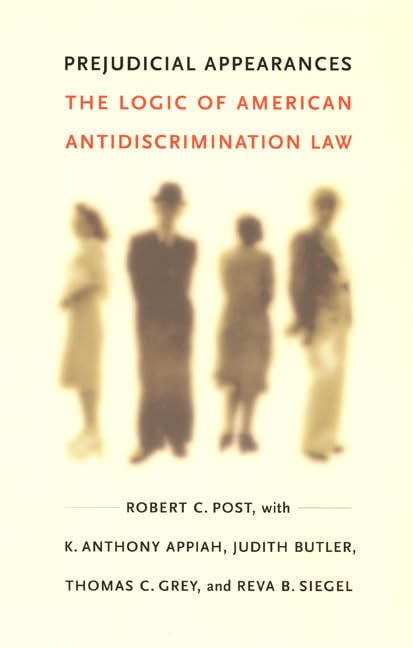
Title
Prejudicial Appearances: The Logic Of American Antidiscrimination Law,Used
Sold by Ergodebooks, an authorized reseller.
Returns accepted within 30 days | support@ergodebooks.com
Shipping Information
- Free Standard Shipping — United States only
- Processing Time: 3–5 business days
- Estimated Delivery: 6–10 business days after dispatch
- Double-boxed, fully insured & discreetly packaged
- Tracking number sent via email once dispatched
Returns & Refund
Returns accepted within 30 days of delivery.
Damaged or Defective Item
Free return shipping + replacement or full refund
Wrong Item Received
Free return shipping + replacement or full refund
Change of Mind
Return shipping at customer's expense · 25% restocking fee applies
Payment Option

In Prejudicial Appearances Noted Legal Scholar Robert C. Post Argues Modern American Antidiscrimination Law Should Not Be Conceived As Protecting The Transcendental Dignity Of Individual Persons But Instead As Transforming Social Practices That Define And Sustain Potentially Oppressive Categories Like Race Or Gender. Arguing That The Prevailing Logic Of American Antidiscrimination Law Is Misleading, Post Lobbies For Deploying Sociological Understandings To Reevaluate The Antidiscrimination Project In Ways That Would Render The Law More Effective And Just.Four Distinguished Commentators Respond To Posts Provocative Essay. Each Adopts A Distinctive Perspective. K. Anthony Appiah Investigates The Philosophical Logic Of Stereotyping And Of Equality. Questioning Whether The Law Ought To Endorse Any Social Practices That Define Persons, Judith Butler Explores The Tension Between Sociological And Postmodern Approaches To Antidiscrimination Law. Thomas C. Grey Examines Whether Posts Proposal Can Be Reconciled With The Values Of The Rule Of Law. And Reva B. Siegel Applies Critical Race Theory To Query Whether Antidiscrimination Laws Reshaping Of Race And Gender Should Best Be Understood In Terms Of Practices Of Subordination And Stratification.By Illuminating The Consequential Rhetorical Maneuvers At The Heart Of Contemporary U.S. Antidiscrimination Law, Prejudical Appearances Forces Readers To Reappraise The Relationship Between Courts Of Law And Social Behavior. As Such, It Will Enrich Scholars Interested In The Relationships Between Law, Rhetoric, Postmodernism, Race, And Gender.
⚠️ WARNING (California Proposition 65):
This product may contain chemicals known to the State of California to cause cancer, birth defects, or other reproductive harm.
For more information, please visit www.P65Warnings.ca.gov.
- Q: What is the page count of this book? A: The book has one hundred sixty-nine pages. It offers an in-depth analysis of American antidiscrimination law.
- Q: What type of binding does this book have? A: This book is published in paperback binding. This makes it lightweight and portable for readers.
- Q: Who is the author of 'Prejudicial Appearances'? A: The author is Robert C. Post. He is a noted legal scholar with expertise in antidiscrimination law.
- Q: What themes are explored in this book? A: The book explores themes of race, gender, and social practices within the context of antidiscrimination law. It challenges conventional understandings of these concepts.
- Q: How do I read this book? A: You can read this book at your own pace. It is suitable for anyone interested in legal studies, sociology, or social justice.
- Q: Is this book suitable for beginners in legal studies? A: Yes, this book is suitable for beginners. It presents complex ideas in an accessible manner.
- Q: How should I store this book? A: You should store this book in a cool, dry place. Keep it upright to prevent bending or damage to the pages.
- Q: Can I lend this book to others? A: Yes, you can lend this book to others. Just ensure it’s returned in good condition to maintain its quality.
- Q: Does this book contain any sensitive content? A: Yes, the book discusses sensitive topics such as race and gender discrimination. Readers should be aware of this context.
- Q: How do I care for this book? A: To care for this book, avoid exposing it to direct sunlight. Clean the cover gently with a damp cloth if needed.
- Q: What if the book arrives damaged? A: If the book arrives damaged, you should contact the seller for a possible return or exchange. Keep all packaging for reference.
- Q: Is there a warranty for this book? A: No, books typically do not come with a warranty. However, check the seller’s return policy for specific terms.
- Q: How does this book compare to other legal texts? A: This book offers a unique sociological perspective on antidiscrimination law, differing from more traditional legal texts.
- Q: What kind of audience is this book intended for? A: This book is intended for scholars, students, and anyone interested in the intersections of law and social behavior.
- Q: Are there any discussion questions included? A: No, the book does not include discussion questions. Readers may consider creating their own for study groups.