
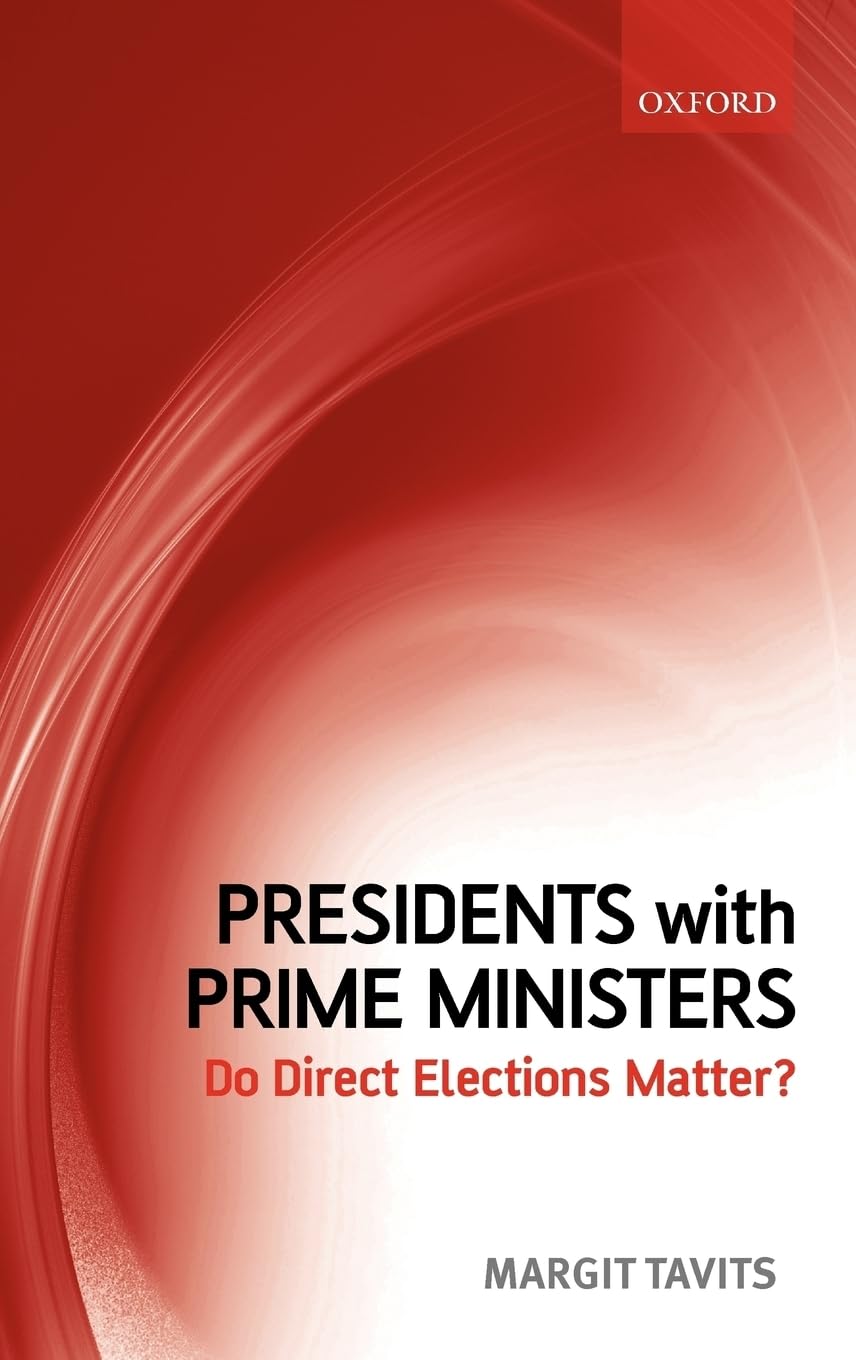
Title
Presidents with Prime Ministers: Do Direct Elections Matter?,Used
Sold by Ergodebooks, an authorized reseller.
Returns accepted within 30 days | support@ergodebooks.com
Shipping Information
- Free Standard Shipping — United States only
- Processing Time: 3–5 business days
- Estimated Delivery: 6–10 business days after dispatch
- Double-boxed, fully insured & discreetly packaged
- Tracking number sent via email once dispatched
Returns & Refund
Returns accepted within 30 days of delivery.
Damaged or Defective Item
Free return shipping + replacement or full refund
Wrong Item Received
Free return shipping + replacement or full refund
Change of Mind
Return shipping at customer's expense · 25% restocking fee applies
Payment Option

This book is about presidents in parliamentary systems. One commonly recurring political debate within parliamentary systems is over whether or not the public should directly elect the head of state. Despite the importance of this topic in practical politics, political scientists have offered little empirical evidence, yet made bold assumptions about the consequences of popular elections for heads of state. A common argument is that direct elections enhance presidents' legitimacy thereby increasing their activism and encouraging authoritarian tendencies. Another popular assumption is that direct presidential elections are more heavily contested and partisan, polarizing and dividing political elites and the electorate. Proponents of direct elections argue that such elections will help decrease voter alienation and apathy. This book challenges the conventional wisdom. Using both quantitative and qualitative empirical evidence from democratic systems across the world, this book demonstrates that compared to indirect selection methods, direct elections do not yield more active and contentious presidents, do not polarize political elites or society, and do not remedy political apathy. Rather, presidential activism in both "semipresidential" and "pure parliamentary" systems is shaped by political opportunity frameworkthe institutional strength and partisan composition of both parliament and government. Further, because holding the presidency provides parties with an electoral asset, direct and indirect presidential elections can be equally contentious and polarizing. Last, but not least, rather than decreasing apathy, direct election is associated with increased voter fatigue and decreased turnout in parliamentary elections by about seven percentage points.
⚠️ WARNING (California Proposition 65):
This product may contain chemicals known to the State of California to cause cancer, birth defects, or other reproductive harm.
For more information, please visit www.P65Warnings.ca.gov.