If you have any questions, you are always welcome to contact us. We'll get back to you as soon as possible, withing 24 hours on weekdays.
Customer service
All questions about your order, return and delivery must be sent to our customer service team by e-mail at yourstore@yourdomain.com
Sale & Press
If you are interested in selling our products, need more information about our brand or wish to make a collaboration, please contact us at press@yourdomain.com
Help
If you have any questions, you are always welcome to contact us. We'll get back to you as soon as possible, withing 24 hours on weekdays.
Customer service
All questions about your order, return and delivery must be sent to our customer service team by e-mail at yourstore@yourdomain.com
Sale & Press
If you are interested in selling our products, need more information about our brand or wish to make a collaboration, please contact us at press@yourdomain.com
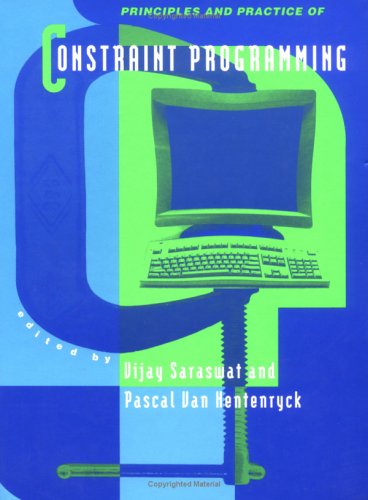
This collection of twentythree original papers represents the first effort to bring together the work of constraint programming researchers scattered across multiple disciplines and across the world. The collection contributes to the understanding of the common principles of this emerging general paradigm, the investigation of its theoretical foundations as well as applications to realworld computing problems. It is organized around themes of concurrency and reactive systems, languages and environments, algorithms, computer graphics, and artificial intelligence.Constraint programming aims at supporting a wide range of complex applications which are often modeled naturally in terms of constraints. Early work, in the 1960s and 1970s, made use of constraints in computer graphics, user interfaces, and artificial intelligence. Such work introduced a declarative component in otherwiseprocedural systems to reduce the development effort. The mid1980s have witnessed the emergence of generalpurpose programming languages based on constraints, such as constraint logic programming and concurrent constraint programming, with significant applications in academia and industry. Today, an increasing number of researchers from all over the map of computing are looking at different aspects of this new computational paradigm.
⚠️ WARNING (California Proposition 65):
This product may contain chemicals known to the State of California to cause cancer,
birth defects, or other reproductive harm.
For MAP (Minimum Advertised Price) violations and Intellectual Property (IP) or Trademark concerns, please contact:
support@ergodebooks.com
⚠️ California Proposition 65 Warning: Some products sold on this website may expose you to chemicals known to the State of California to cause cancer, birth defects, or other reproductive harm. For more information, visit www.P65Warnings.ca.gov.