If you have any questions, you are always welcome to contact us. We'll get back to you as soon as possible, withing 24 hours on weekdays.
Customer service
All questions about your order, return and delivery must be sent to our customer service team by e-mail at yourstore@yourdomain.com
Sale & Press
If you are interested in selling our products, need more information about our brand or wish to make a collaboration, please contact us at press@yourdomain.com
Help
If you have any questions, you are always welcome to contact us. We'll get back to you as soon as possible, withing 24 hours on weekdays.
Customer service
All questions about your order, return and delivery must be sent to our customer service team by e-mail at yourstore@yourdomain.com
Sale & Press
If you are interested in selling our products, need more information about our brand or wish to make a collaboration, please contact us at press@yourdomain.com
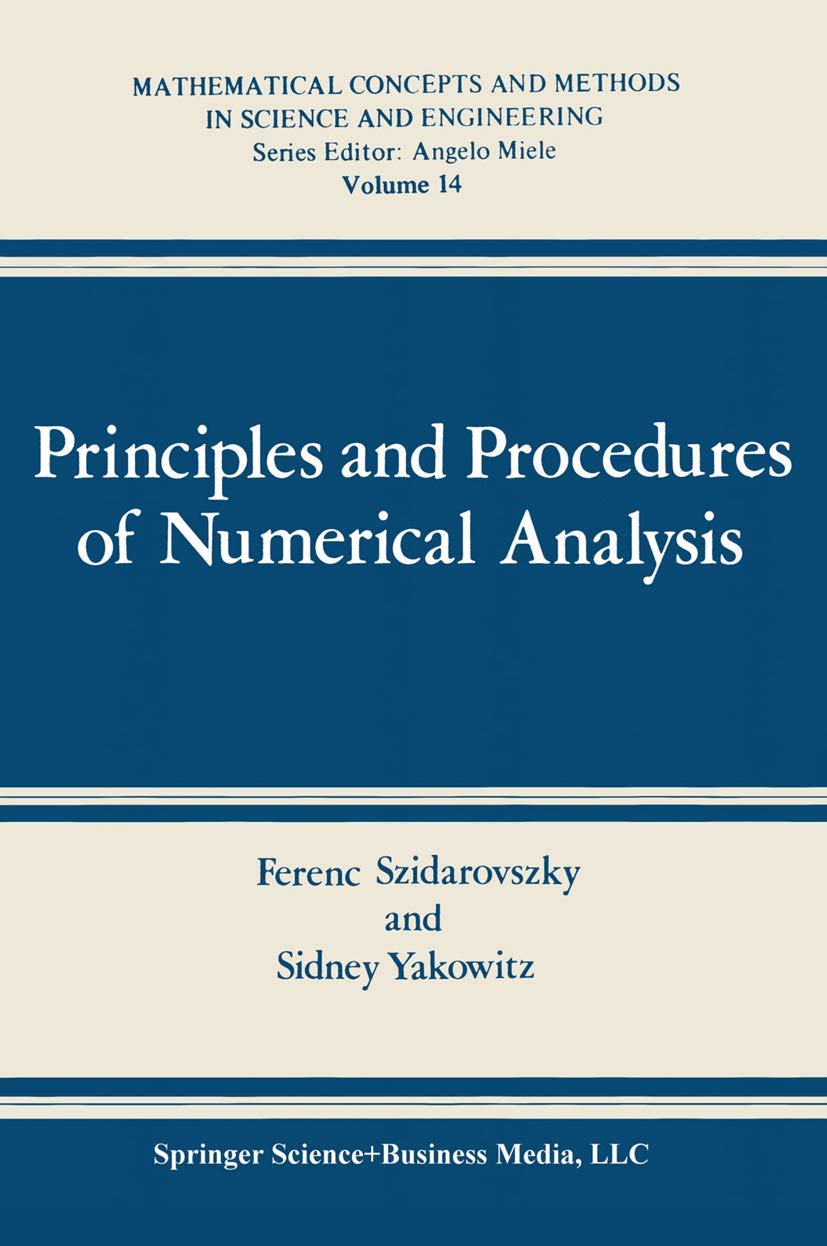
It is an incontestable fact that numerical analysis techniques are used rou tinely (although not always effectively) in virtually every quantitative field of scientific endeavor. In this book, which is directed toward upperdivision and graduate level students in engineering and mathematics, we have selected for discussion subjects that are traditionally found in numerical analysis texts. But our choice of methodology rejects the traditional where analysis and experience clearly warrant such a departure, and one of our primary aspirations in this work is to equip the reader with the wherewithal to apply numerical analysis thinking to nontraditional subjects. For there is a plethora of computeroriented sciences such as optimization, statistics, and system analysis and identification that are sorely in need of methods comparable to those related here for classical numerical analysis problems. Toward uncovering for the reader the structure of numerical methods we have, for example, devoted a chapter to a metric space theory for iter ative application of operators. In this chapter, we have collected those definitions and concepts of real and functional analysis that are requisite to a modern intermediatelevel exposition of the principles of numerical anal ysis. Further, we derive the abstract theory (most notably, the contraction mapping theorem) for iteration processes.
⚠️ WARNING (California Proposition 65):
This product may contain chemicals known to the State of California to cause cancer,
birth defects, or other reproductive harm.
For MAP (Minimum Advertised Price) violations and Intellectual Property (IP) or Trademark concerns, please contact:
support@ergodebooks.com
⚠️ California Proposition 65 Warning: Some products sold on this website may expose you to chemicals known to the State of California to cause cancer, birth defects, or other reproductive harm. For more information, visit www.P65Warnings.ca.gov.