
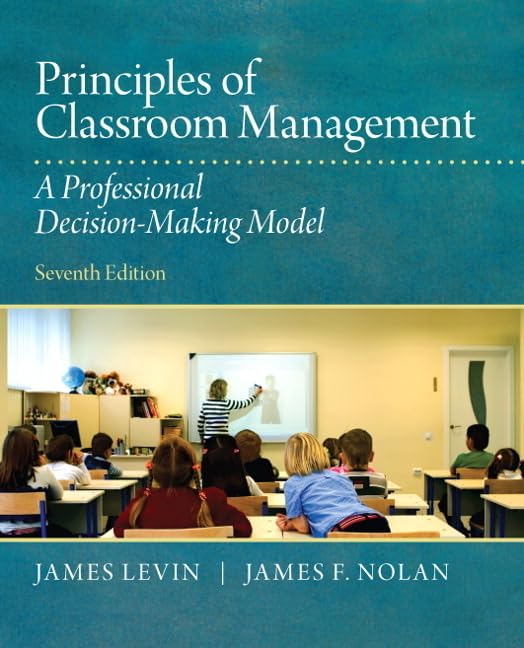
Title
Principles of Classroom Management: A Professional DecisionMaking Model,New
Sold by Ergodebooks, an authorized reseller.
Returns accepted within 30 days | support@ergodebooks.com
Shipping Information
- Free Standard Shipping — United States only
- Processing Time: 3–5 business days
- Estimated Delivery: 6–10 business days after dispatch
- Double-boxed, fully insured & discreetly packaged
- Tracking number sent via email once dispatched
Returns & Refund
Returns accepted within 30 days of delivery.
Damaged or Defective Item
Free return shipping + replacement or full refund
Wrong Item Received
Free return shipping + replacement or full refund
Change of Mind
Return shipping at customer's expense · 25% restocking fee applies
Payment Option

The only text that takes a decisionmaking model approach to classroom management. It provides teachers with a very practical system to influence students to choose to behave productively and to strive for academic success. This widely used text presents an array of decisionmaking options that guide teachers in developing positive, prosocial classroom learning environments through relationship building, effective teaching strategies, and deliberate structuring of the classroom environment. The text also provides sets of principles to intervene when students are not focused in they way should be and to help them choose more productive behaviors. The text also addresses working within the classroom and with families and other school resources to help students who exhibit chronic behavior problems.Thoroughly revised and updated, Principles of Classroom Management: A Professional DecisionMaking Model, 7th Edition, includes a much stronger focus on relationship building as a core activity in all phases of teaching(See new Chapter 7 as well as Chapters 3, 4, 5, 10, and 11) increased attention to the principles of motivation and their application in helping students to set high expectations for themselves and to believe they can achieve them(See new Chapter 7 as well as Chapters 3, 4, 5, 10, and 11) greater coverage of the knowledge teachers need to develop about cultural differences (Throughout the text) much more coverage of the challenges posed by new technologies, including cyberbullying, cybercheating, and sexting (See Chapters 2 and 3) a variety of new cases as well as pre and postchapter reflective activities (New iterative cases are included at the end of Chapters 1, 4, 7, and 11 and new cases are also embedded in Chapters 3, 4, 5, 6, 7, and 10.)From reviews of the book:The text provides a very comprehensive view of classroom management that builds hierarchically, logically, and strategically. . . . The text provides not only the skills for effective classroom management . . ., but [it] includes a conceptual and theoretical perspective that is comprehensive and coupled with numerous examples and case studies that clarify and strengthen.Marilyn Howe, Clarion University of PennsylvaniaI really like the way in which the authors engage readers from the beginning in a realistic conversation about the influence and importance of handling behaviour problems at all levels.Eleanor Wilson, University of Virginia
⚠️ WARNING (California Proposition 65):
This product may contain chemicals known to the State of California to cause cancer, birth defects, or other reproductive harm.
For more information, please visit www.P65Warnings.ca.gov.
- Q: What is the main focus of 'Principles of Classroom Management'? A: The book emphasizes a decision-making model approach to classroom management, providing practical strategies for teachers to foster productive student behavior and academic success.
- Q: How many pages does the book contain? A: The book has a total of 360 pages.
- Q: Who is the author of this book? A: The author of 'Principles of Classroom Management' is James Levin.
- Q: What edition is currently available? A: The book is available in its 7th edition.
- Q: What are some key topics covered in the book? A: Key topics include relationship building, motivation principles, cultural differences in the classroom, and challenges related to new technologies like cyber-bullying.
- Q: Is the book suitable for new teachers? A: Yes, the book provides comprehensive strategies and insights that can benefit both new and experienced teachers.
- Q: What type of binding does the book have? A: The book is available in a paperback binding.
- Q: When was the book published? A: The book was published on January 11, 2013.
- Q: Does the book include real-life case studies? A: Yes, the text includes various new case studies and reflective activities to enhance learning.
- Q: How does the book help with chronic behavior problems in students? A: The book provides principles and strategies for teachers to effectively intervene and support students exhibiting chronic behavior issues.