
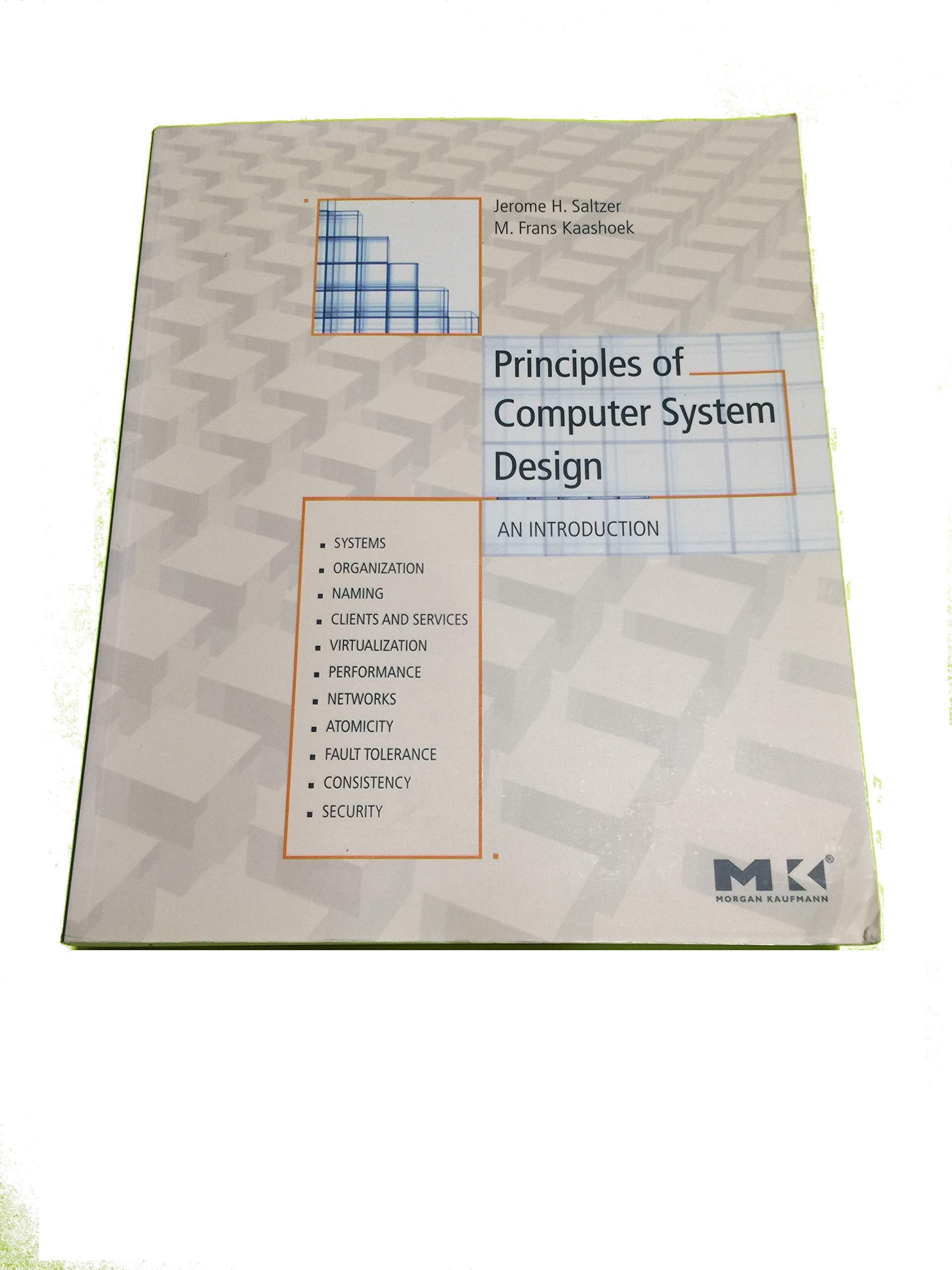
Title
Principles of Computer System Design: An Introduction,Used
Sold by Ergodebooks, an authorized reseller.
Returns accepted within 30 days | support@ergodebooks.com
Shipping Information
- Free Standard Shipping — United States only
- Processing Time: 3–5 business days
- Estimated Delivery: 6–10 business days after dispatch
- Double-boxed, fully insured & discreetly packaged
- Tracking number sent via email once dispatched
Returns & Refund
Returns accepted within 30 days of delivery.
Damaged or Defective Item
Free return shipping + replacement or full refund
Wrong Item Received
Free return shipping + replacement or full refund
Change of Mind
Return shipping at customer's expense · 25% restocking fee applies
Payment Option

Principles of Computer System Design is the first textbook to take a principlesbased approach to the computer system design. It identifies, examines, and illustrates fundamental concepts in computer system design that are common across operating systems, networks, database systems, distributed systems, programming languages, software engineering, security, fault tolerance, and architecture.Through carefully analyzed case studies from each of these disciplines, it demonstrates how to apply these concepts to tackle practical system design problems. To support the focus on design, the text identifies and explains abstractions that have proven successful in practice such as remote procedure call, client/service organization, file systems, data integrity, consistency, and authenticated messages. Most computer systems are built using a handful of such abstractions. The text describes how these abstractions are implemented, demonstrates how they are used in different systems, and prepares the reader to apply them in future designs.The book is recommended for junior and senior undergraduate students in Operating Systems, Distributed Systems, Distributed Operating Systems and/or Computer Systems Design courses; and professional computer systems designers. Concepts of computer system design guided by fundamental principles Crosscutting approach that identifies abstractions common to networking, operating systems, transaction systems, distributed systems, architecture, and software engineering Case studies that make the abstractions real: naming (DNS and the URL); file systems (the UNIX file system); clients and services (NFS); virtualization (virtual machines); scheduling (disk arms); security (TLS) Numerous pseudocode fragments that provide concrete examples of abstract concepts Extensive support. The authors and MIT OpenCourseWare provide online, free of charge, open educational resources, including additional chapters, course syllabi, board layouts and slides, lecture videos, and an archive of lecture schedules, class assignments, and design projects
⚠️ WARNING (California Proposition 65):
This product may contain chemicals known to the State of California to cause cancer, birth defects, or other reproductive harm.
For more information, please visit www.P65Warnings.ca.gov.