
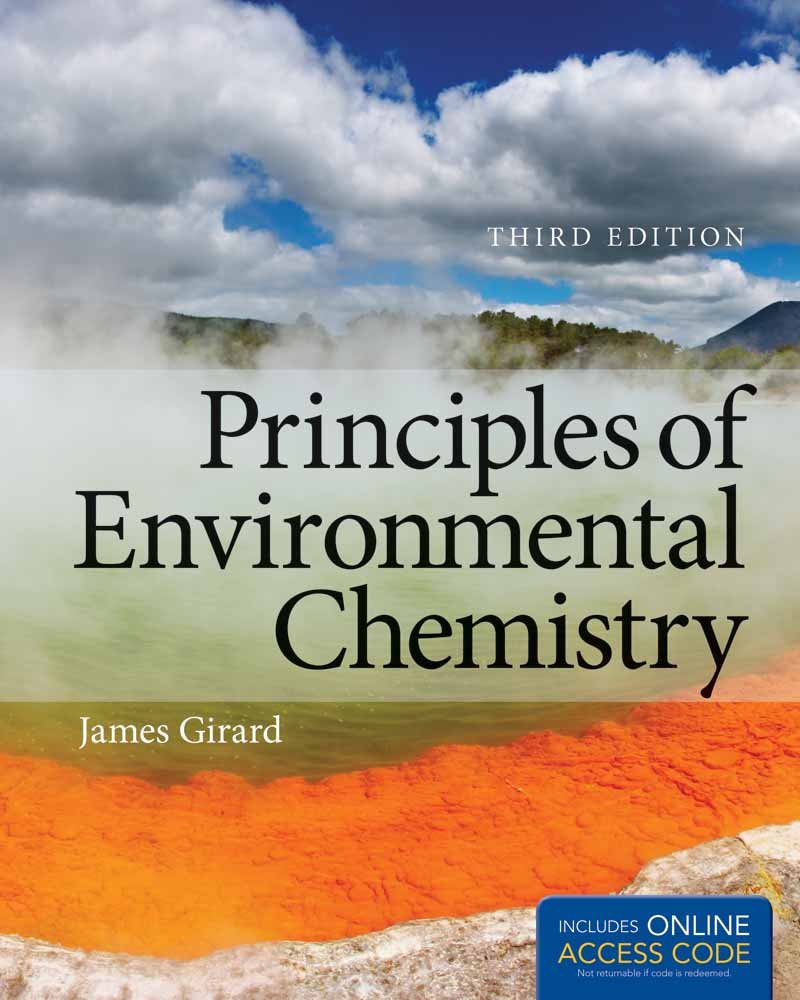
Title

Principles of Environmental Chemistry,Used
Sold by Ergodebooks, an authorized reseller.
Returns accepted within 30 days | support@ergodebooks.com
Shipping Information
- Free Standard Shipping — United States only
- Processing Time: 3–5 business days
- Estimated Delivery: 6–10 business days after dispatch
- Double-boxed, fully insured & discreetly packaged
- Tracking number sent via email once dispatched
Returns & Refund
Returns accepted within 30 days of delivery.
Damaged or Defective Item
Free return shipping + replacement or full refund
Wrong Item Received
Free return shipping + replacement or full refund
Change of Mind
Return shipping at customer's expense · 25% restocking fee applies
Payment Option

Includes access to the Student Companion Website Appropriate for students with a general chemistry background, Principles of Environmental Chemistry helps students understand the underlying chemical processes that are operating in the environment while demonstrating how difficult it is to measure these systems. The author emphasizes that all living and nonliving parts of our environment are comprised of chemicals and that all of the natural processes continuously occurring in the environment involve chemical reactions. With this concept of interdependence, students begin to see that without some understanding of chemistry, it is impossible to fully understand environmental issues such as ozone depletion, global warming, air and water pollution, and the hazards of radioactivity. The Third Edition includes a new chapter on Green Chemistry as well as numerous updates throughout to address the changes in the field. Key Features: Includes a new chapter on Green Chemistry. A new key term glossary is now included at the end of the text. New feature boxes assess students understanding of chapter material with analytical questions and problems. Includes additional chemical equations throughout the text reinforce important concepts. Available with a new electronic student study guide and solutions manual Instructors resources include PowerPoint Lecture Outlines, answers to end of chapter problems, and a testbank. A student companion website includes chapter outlines, interactive glossary, flashcards, and weblinks.
⚠️ WARNING (California Proposition 65):
This product may contain chemicals known to the State of California to cause cancer, birth defects, or other reproductive harm.
For more information, please visit www.P65Warnings.ca.gov.
- Q: How many pages does this book have? A: This book has seven hundred twelve pages. It provides an in-depth exploration of environmental chemistry concepts.
- Q: What is the binding type of this book? A: The binding type is paperback. This makes it lightweight and easy to handle for students.
- Q: What are the dimensions of the book? A: The dimensions are eight inches in length, one point five five inches in width, and ten inches in height. This size is standard for textbooks.
- Q: What is the recommended reading level for this book? A: This book is suitable for college students with a general chemistry background. It covers complex environmental chemistry topics.
- Q: Is there a companion website for this book? A: Yes, there is a companion website included. It offers chapter outlines, interactive glossary, and additional study resources.
- Q: What topics does the book cover? A: The book covers topics such as chemical reactions in the environment, ozone depletion, and global warming. It also includes a new chapter on Green Chemistry.
- Q: How should I store this book? A: Store the book in a cool, dry place to prevent damage. Avoid exposing it to direct sunlight to maintain the integrity of the pages.
- Q: Can I clean the book if it gets dirty? A: Yes, you can gently wipe the book cover with a soft, dry cloth. Avoid using water or cleaning solutions on the pages.
- Q: Is this book suitable for high school students? A: This book is primarily aimed at college students. However, advanced high school students with a chemistry background may find it useful.
- Q: What if the book arrives damaged? A: If the book arrives damaged, you should contact the seller for a return or exchange. Most sellers offer a return policy for such cases.
- Q: Does the book include a glossary? A: Yes, the book includes a key term glossary at the end. This helps students understand important terminology.
- Q: Are there any instructor resources available? A: Yes, instructor resources include PowerPoint Lecture Outlines and a test bank. These resources support teaching efforts.
- Q: Does the book have practice problems? A: Yes, there are numerous feature boxes with analytical questions and problems throughout the text. These assess student understanding.
- Q: What is the focus of the new chapter on Green Chemistry? A: The new chapter on Green Chemistry focuses on sustainable chemical practices and their importance in environmental chemistry.
- Q: Is this book good for self-study? A: Yes, this book is suitable for self-study. The included companion website enhances the learning experience with interactive resources.