
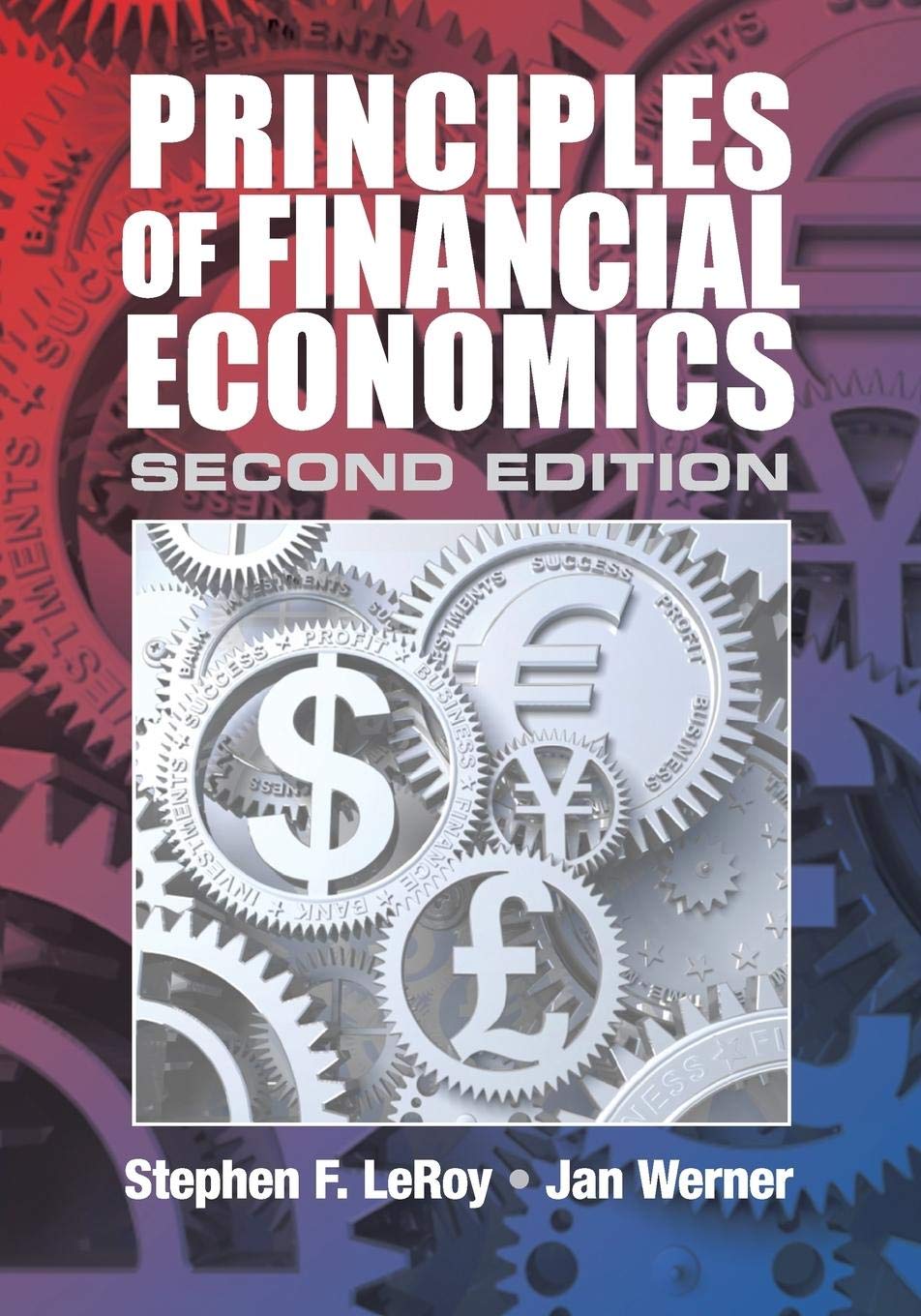
Title
Principles Of Financial Economics
Sold by Ergodebooks, an authorized reseller.
Returns accepted within 30 days | support@ergodebooks.com
Shipping Information
- Free Standard Shipping — United States only
- Processing Time: 3–5 business days
- Estimated Delivery: 6–10 business days after dispatch
- Double-boxed, fully insured & discreetly packaged
- Tracking number sent via email once dispatched
Returns & Refund
Returns accepted within 30 days of delivery.
Damaged or Defective Item
Free return shipping + replacement or full refund
Wrong Item Received
Free return shipping + replacement or full refund
Change of Mind
Return shipping at customer's expense · 25% restocking fee applies
Payment Option

This New Edition Provides A Rigorous Yet Accessible Graduatelevel Introduction To Financial Economics. Since Students Often Find The Link Between Financial Economics And Equilibrium Theory Hard To Grasp, Less Attention Is Given To Purely Financial Topics, Such As Valuation Of Derivatives, And More Emphasis Is Placed On Making The Connection With Equilibrium Theory Explicit And Clear. This Book Also Provides A Detailed Study Of Twodate Models Because Almost All Of The Key Ideas In Financial Economics Can Be Developed In The Twodate Setting. Substantial Discussions And Examples Are Included To Make The Ideas Readily Understandable. Several Chapters In This New Edition Have Been Reordered And Revised To Deal With Portfolio Restrictions Sequentially And More Clearly, And An Extended Discussion On Portfolio Choice And Optimal Allocation Of Risk Is Available. The Most Important Additions Are New Chapters On Infinitetime Security Markets, Exploring, Among Other Topics, The Possibility Of Price Bubbles.
⚠️ WARNING (California Proposition 65):
This product may contain chemicals known to the State of California to cause cancer, birth defects, or other reproductive harm.
For more information, please visit www.P65Warnings.ca.gov.
- Q: What is the page count of 'Principles of Financial Economics'? A: This book contains three hundred seventy pages. It provides a thorough exploration of financial economics and its theoretical foundations.
- Q: What are the dimensions of this book? A: The book measures seven point zero one inches in length, zero point eight four inches in width, and ten inches in height. These dimensions make it a standard paperback size.
- Q: Who is the author of 'Principles of Financial Economics'? A: The author is Stephen F. LeRoy. He presents complex economic concepts in an accessible manner.
- Q: How do I use this book for studying? A: You can use this book as a graduate-level textbook for courses in financial economics. It includes discussions and examples to aid understanding.
- Q: Is this book suitable for beginners in economics? A: No, this book is designed for graduate-level students. It assumes familiarity with economic theories and concepts.
- Q: Can I use this book for reference in my financial economics class? A: Yes, it's a suitable reference for advanced financial economics courses. Its detailed explanations help clarify complex topics.
- Q: How should I store this book to maintain its condition? A: Store the book upright in a cool, dry place. Avoid exposure to direct sunlight and moisture to prevent damage.
- Q: Are there any specific care instructions for this book? A: Keep the book clean by avoiding food or drinks while reading. Handle it gently to prevent wear and tear.
- Q: What if my copy of the book arrives damaged? A: Contact the retailer for information on their return policy. Most retailers offer replacements for damaged items.
- Q: Does this book include practical applications of financial economics? A: Yes, it includes substantial discussions and examples that illustrate practical applications. This enhances comprehension of the subject.
- Q: Is there a chapter focusing on portfolio choice? A: Yes, there is an extended discussion on portfolio choice and optimal allocation of risk in the book. This topic is crucial for understanding financial decision-making.
- Q: Can I find information about price bubbles in this book? A: Yes, the book includes new chapters on infinite-time security markets that specifically explore price bubbles and related concepts.
- Q: Does the book cover valuation of derivatives? A: Yes, while it emphasizes equilibrium theory, it also addresses the valuation of derivatives as part of the broader financial economics discussion.
- Q: Are the chapters in this edition revised from previous editions? A: Yes, several chapters have been reordered and revised for clarity in this new edition. This improves the overall flow and understanding.
- Q: Is this book published by a reputable publisher? A: Yes, it is published by Cambridge University Press, known for its high-quality academic publications.