
Title
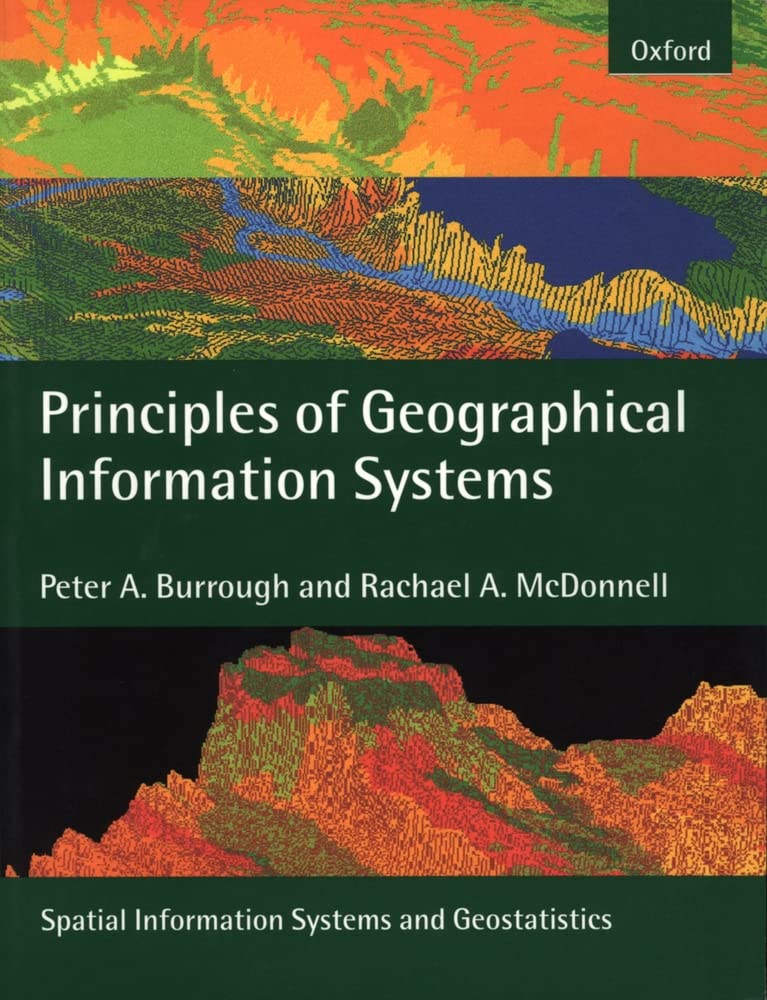
Principles of Geographical Information Systems (Spatial Information Systems),Used
Sold by Ergodebooks, an authorized reseller.
Returns accepted within 30 days | support@ergodebooks.com
Shipping Information
- Free Standard Shipping — United States only
- Processing Time: 3–5 business days
- Estimated Delivery: 6–10 business days after dispatch
- Double-boxed, fully insured & discreetly packaged
- Tracking number sent via email once dispatched
Returns & Refund
Returns accepted within 30 days of delivery.
Damaged or Defective Item
Free return shipping + replacement or full refund
Wrong Item Received
Free return shipping + replacement or full refund
Change of Mind
Return shipping at customer's expense · 25% restocking fee applies
Payment Option

This book is a completely new version of the highly successful Principles of Geographical Information Systems for Land Resources Assessment which was first published in 1986.GIS are not just used for electronic mapmaking but today are major tools for the management of our physical and social environment. GIS are used to assist political decisions and play a part in market research, in the management of utility services, in automated navigation systems and in many other fields.This book presents a strong theoretical basis for GIS, which is often lacking in other texts. Spatial data are usually based on two, dichotomous paradigms, exactly defined entities in space, such as land parcels, or the continuous variation of single attributes, such as temperature or rainfall. Methods for modelling both kinds of phenomena and storing them in spatial databases are described in detail, including the use of geostatistics for interpolating from points to continuous fields. Examples of how spatial data and an analysis of their spatial interactions are used to solve a wide range of practical problems ranging from sitelocation analysis through land degradation, the optimizing of timber extraction from forests and the redistribution of Chernobyl radioactivity by floods are explained clearly and in detail.Much attention is paid to the problems of data quality and how statistical errors in spatial data can affect the results of spatial modelling based on the two paradigms of space. Fuzzy logic and continuous classification methods are presented as methods for linking the two spatial paradigms. The book concludes with an investigation of current developments in providing spatial data for the whole world over the Internet.As such the new volume provides a comprehensive and concise introduction to the theory and practice of Geographical Information Systems (GIS). Targeted at undergraduates, graduates, and professionals in disciplines such as physical and human geography, hydrology, geology, environmental science, cartography, epidemiology, radioecology, agriculture, spatial planning, land tenure, and land evaluation the book explains why spatial data and the information systems based on them are important in the modern world.
⚠️ WARNING (California Proposition 65):
This product may contain chemicals known to the State of California to cause cancer, birth defects, or other reproductive harm.
For more information, please visit www.P65Warnings.ca.gov.