
Title
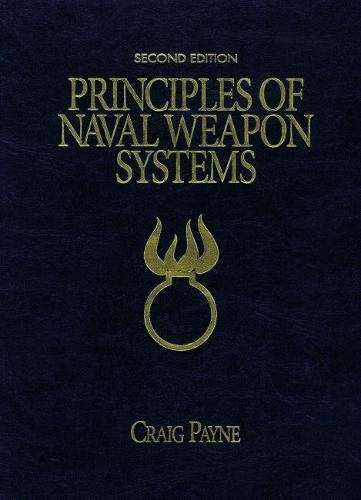
Principles of Naval Weapons Systems: Second Edition,Used
Sold by Ergodebooks, an authorized reseller.
Returns accepted within 30 days | support@ergodebooks.com
Shipping Information
- Free Standard Shipping — United States only
- Processing Time: 3–5 business days
- Estimated Delivery: 6–10 business days after dispatch
- Double-boxed, fully insured & discreetly packaged
- Tracking number sent via email once dispatched
Returns & Refund
Returns accepted within 30 days of delivery.
Damaged or Defective Item
Free return shipping + replacement or full refund
Wrong Item Received
Free return shipping + replacement or full refund
Change of Mind
Return shipping at customer's expense · 25% restocking fee applies
Payment Option

This textbook is intended to serve as an introduction to the underlying science and engineering of weapons used in the naval service. The philosophy used in the material selected for this text is that individual weapons come and go, but the principles of their operation largely remain the same. Some subjects are covered in greater detail than needed for an introductory course to allow this text to serve as a basic reference to take into professional life.The text was written to be inclusive of all college majors; as such a conscious effort was made when possible to apply algebra, geometry, trigonometry, and avoid calculus. Therefore, many of the equations derived are 1st order, and provide approximations that are sufficient to illustrate the relative performance parameters of variables used in weapon system design. These same theories and principles can then be applied to actual sensors and weapons using operational parameters and specifications determined from technical manuals and warfare publications.Material has been drawn from pervious texts of the same title that have explained the principles for the last 40 years. Much of the work can be traced to the work completed by the Bureau of Naval Weapons in the 1960's. It was updated and expanded in the 1980's version and incorporated in this text. In some cases, principles of systems that the U.S. Navy no longer uses are described in a belief that sometimes it is good to know where you have been to know where you are going. In addition, many countries and organizations still employ some of these lower technology systems. Therefore, it is necessary to understand their basic capabilities. With advent of new technologies and methods, this text will require periodic updating.
⚠️ WARNING (California Proposition 65):
This product may contain chemicals known to the State of California to cause cancer, birth defects, or other reproductive harm.
For more information, please visit www.P65Warnings.ca.gov.
- Q: What is the main focus of 'Principles of Naval Weapons Systems: Second Edition'? A: The textbook serves as an introduction to the science and engineering of naval weapons, emphasizing the enduring principles of operation despite changes in individual weapons.
- Q: Who is the author of this textbook? A: The author of 'Principles of Naval Weapons Systems: Second Edition' is Craig Payne.
- Q: What topics are covered in the book? A: The book covers the principles of weapon system design, including algebra, geometry, and trigonometry, avoiding calculus to make it accessible to all college majors.
- Q: How many pages does this textbook have? A: The textbook contains 412 pages.
- Q: What is the condition of the book? A: The book is listed as 'New', ensuring it is in excellent condition for readers.
- Q: When was 'Principles of Naval Weapons Systems: Second Edition' published? A: The textbook was published on January 10, 2010.
- Q: What type of binding does the book have? A: The textbook is bound in hardcover, providing durability for frequent use.
- Q: Is this book suitable for beginners? A: Yes, the book is designed to be inclusive of all college majors and serves as a basic reference for those new to naval weapons systems.
- Q: Does the book include historical context on naval systems? A: Yes, it includes information on systems previously used by the U.S. Navy and discusses their relevance in understanding current technologies.
- Q: Will this textbook require updates in the future? A: Yes, due to advancements in technology and methods, periodic updates to the text are anticipated.