
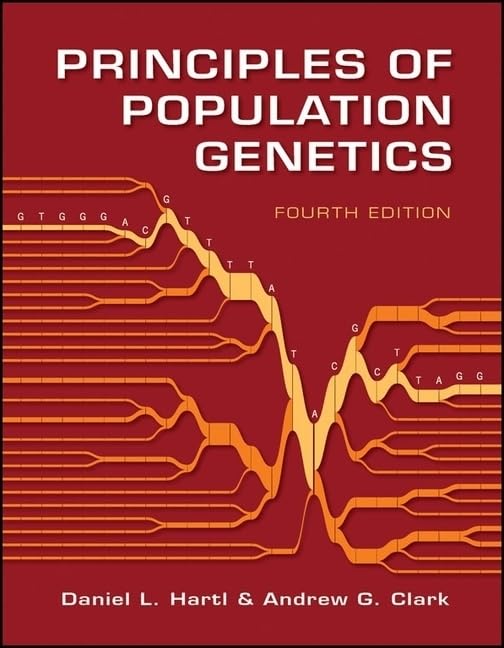
Title
Principles Of Population Genetics
Sold by Ergodebooks, an authorized reseller.
Returns accepted within 30 days | support@ergodebooks.com
Shipping Information
- Free Standard Shipping — United States only
- Processing Time: 3–5 business days
- Estimated Delivery: 6–10 business days after dispatch
- Double-boxed, fully insured & discreetly packaged
- Tracking number sent via email once dispatched
Returns & Refund
Returns accepted within 30 days of delivery.
Damaged or Defective Item
Free return shipping + replacement or full refund
Wrong Item Received
Free return shipping + replacement or full refund
Change of Mind
Return shipping at customer's expense · 25% restocking fee applies
Payment Option

Principles Of Population Genetics, Fourth Edition, Is A Thoroughly Updated Introduction To The Field That Is At Last Ascending To Its Rightful Position Of Centrality To Evolutionary Genomics And Human Genetics. Rapid And Inexpensive Genotyping And Sequencing Have Produced A Profusion Of Data On Genetic Variation, Along With A Pressing Need To Inform Students From Many Fields About The Models That Describe The Underlying Processes That Give Rise To Observed Patterns Of Genetic Variation. This Book Provides A Balanced Presentation Of Theory And Observation For Students At The Undergraduate And Graduate Levels As Well As Newcomers From Fields Like Human Genetics. The Logical Development Of The Models Of Population Genetics Encourages A Deeper Understanding Of The Principles, And The Text Has Been Rewritten With The Goal To Optimize Its Use As A Teaching Aid. It Introduces The Principles Of Genetics And Statistics That Are Relevant To Population Studies, And Examines The Forces Affecting Genetic Variation From The Molecular To The Organismic Level. Integrated Throughout The Book Are Descriptions Of Molecular Methods Used To Study Variation In Natural Populations, As Well As Explanations Of The Relevant Estimation Theory Using Actual Data.Chapter 1 Presents The Fundamental Observations And Means For Quantifying Amounts And Structure Of Genetic Variation In Natural Populations. Chapter 2 Gives A Detailed Examination Of The Implications Of Random Mating For One Locus And Multiple Loci And Establishes The Basic Principles For Thinking About Mathematical Models Of Variation. Chapter 3 Presents The Classic Wrightfisher Model As Well As The Coalescent Approaches To Random Genetic Drift. Chapter 4 Adds Mutation To Models Of Drift And Lays Down The Foundations For The Neutral Theory Of Molecular Evolution. Natural Selection In Its Many Guises Gets A Thorough Coverage In Chapter 5. Chapter 6 Examines Population Subdivision And Its Consequences For The Distribution Of Genetic Variation Among Subpopulations, Including The Hierarchical F Statistics Used In Estimating These Effects. Molecular Population Genetics, Including Applications Of Coalescent Theory, Is The Subject Of Chapter 7. Evolutionary Quantitative Genetics Is Covered In Chapter 8, Including An Uptodate Treatment Of The Use Of Molecular Markers For Mapping And Assisting In Selection Of Quantitative Characters. Chapter 9 Is A New Addition And Covers The Exciting Field Of Population Genomics, Or The Analysis Of Population Genetic Principles At A Genomewide Scale. Finally, Because Of The Explosion In Genomewide Polymorphism Data In Humans And The Realization That Many Problems In Empirical Population Genetics Need To Be Tuned To Special, Nonequilibrium Circumstances Of Human Populations, The Authors Devote Chapter 10 To Human Population Genetics.Applications Of Principles Discussed In The Text Are Illustrated With Numerous Examples Of Worked Problems, Using Actual Data. Many Vital Web Links Are Scattered Throughout The Text To Connect The Material To Uptotheminute Progress In This Exciting Field. Each Chapter Ends With A Complete Summary And Offers Several Problems For Solution, To Reinforce And Further Develop The Concepts.
⚠️ WARNING (California Proposition 65):
This product may contain chemicals known to the State of California to cause cancer, birth defects, or other reproductive harm.
For more information, please visit www.P65Warnings.ca.gov.
- Q: How many pages does this book have? A: This book has six hundred seventy-two pages. It provides a comprehensive overview of population genetics and its applications.
- Q: What is the binding type of this book? A: This book is hardcover bound. This type of binding ensures durability for frequent use and handling.
- Q: Who is the author of 'Principles of Population Genetics'? A: The author is Daniel L. Hartl. He is well-known in the field of genetics and has authored several significant texts.
- Q: What is the recommended reading level for this book? A: This book is suitable for undergraduate and graduate students. It also serves as a valuable resource for newcomers to the field.
- Q: What subjects does this book cover? A: The book covers population genetics, evolutionary genomics, and human genetics. It includes both theoretical concepts and practical applications.
- Q: How do I use this book for studying? A: Use this book as a primary textbook or reference guide. It includes worked problems and summaries to reinforce learning.
- Q: Is this book suitable for beginners in genetics? A: Yes, the book is suitable for beginners. It provides foundational concepts while also covering advanced topics in population genetics.
- Q: Are there exercises or problems in the book? A: Yes, each chapter includes several problems for solution. These are designed to help reinforce and develop the concepts discussed.
- Q: What are the dimensions of this book? A: The book measures nine point four one inches in length, one point five inches in width, and seven point zero one inches in height.
- Q: Can I return this book if I don't like it? A: Yes, there is a no quibbles return policy. You can return the book if it doesn't meet your expectations.
- Q: What if my book arrives damaged? A: If your book arrives damaged, you should contact customer support for assistance. They will guide you through the return or replacement process.
- Q: How should I care for this book? A: To care for this book, keep it in a dry place and avoid exposure to direct sunlight. This will help preserve the quality of the binding and pages.
- Q: Is this book suitable for self-study? A: Yes, this book is suitable for self-study. Its logical structure and summaries make it easy to follow and understand.
- Q: Does this book include online resources? A: Yes, the book includes vital web links throughout the text. These links connect readers to up-to-date research and information.
- Q: Are there any illustrations or figures in the book? A: Yes, the book contains numerous illustrations and figures. These help clarify complex concepts and enhance understanding.
- Q: Is this book part of a series? A: No, this book is a standalone text. However, it complements other works in the field of genetics and evolutionary biology.