
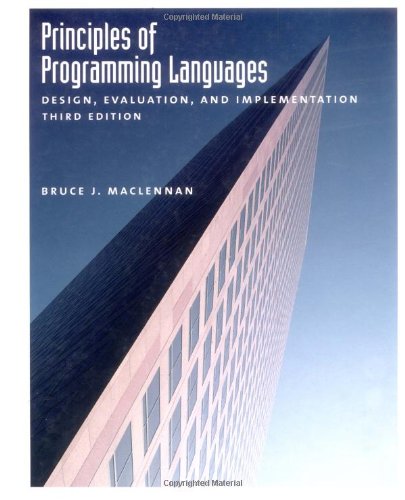
Title
Principles Of Programming Languages: Design, Evaluation, And Implementation
Sold by Ergodebooks, an authorized reseller.
Returns accepted within 30 days | support@ergodebooks.com
Shipping Information
- Free Standard Shipping — United States only
- Processing Time: 3–5 business days
- Estimated Delivery: 6–10 business days after dispatch
- Double-boxed, fully insured & discreetly packaged
- Tracking number sent via email once dispatched
Returns & Refund
Returns accepted within 30 days of delivery.
Damaged or Defective Item
Free return shipping + replacement or full refund
Wrong Item Received
Free return shipping + replacement or full refund
Change of Mind
Return shipping at customer's expense · 25% restocking fee applies
Payment Option

Completely Revised And Updated, The Third Edition Of Principles Of Programming Languages: Design, Evaluation, And Implementation Teaches Key Design And Implementation Skills Essential For Language Designers, Compiler Writers, And Other Computer Scientists. It Also Covers Descriptive Tools And Historical Precedents So That Students Can Understand Design Issues In Their Historical Context. Ideal For Advanced Undergraduate And Graduate Courses In Programming Languages And Comparative Languages, This Text Uses A Unique Horizontal Organization That Analyzes Individual Languages In Their Entirety, Facilitating Discussion Of The Interrelationships Between The Parts Of A Language. It Teaches Design Skills By Emphasizing Basic Principles More Than Details, Focuses On Methods Of Implementation Over Specific Techniques, And Presents Concepts Inductively. Indepth Case Studies Of Representative Languages From Five Generations Of Programming Language Design (Fortran, Algol60, Pascal, Ada, Lisp, Smalltalk, And Prolog) Are Used To Illustrate Larger Themes.This Third Edition Adds Discussions Of The Phenomenology Of Programming Languages, The Role Of Conceptual Models In Language Design, Language Size And Complexity, And System Implementation Languages (With An Emphasis On C). It Covers Programming Environments (As Illustrated By The Interlisp System) And Recent Developments In Objectoriented Programming (Including C++, Ada 95, Clos, And Java), And Expands The Discussion Of Multiple Inheritance. Historical Information Has Been Updated To Reflect New Developments In The Industry And Many New Exercises Have Been Added As Well.
⚠️ WARNING (California Proposition 65):
This product may contain chemicals known to the State of California to cause cancer, birth defects, or other reproductive harm.
For more information, please visit www.P65Warnings.ca.gov.
- Q: How many pages are in this book? A: This book contains five hundred twenty-eight pages. It provides comprehensive coverage of programming language design and implementation.
- Q: What is the binding type of this book? A: The binding type is hardcover. This ensures durability and longevity for frequent use.
- Q: What are the dimensions of this book? A: The dimensions are seven point seven two inches in length, one point two inches in width, and nine point three inches in height. This makes it a manageable size for reading and reference.
- Q: Who is the author of this book? A: The author is Bruce J. MacLennan. He is recognized for his expertise in programming languages and computer science.
- Q: What edition is this book? A: This is the third edition of the book. It has been completely revised and updated to reflect new developments in the field.
- Q: What is the primary focus of this book? A: The primary focus is on teaching design and implementation skills for programming languages. It emphasizes principles over specific details.
- Q: Is this book suitable for beginners? A: No, this book is ideal for advanced undergraduate and graduate students. It assumes prior knowledge of programming concepts.
- Q: Are there practical exercises in this book? A: Yes, many new exercises have been added in this edition. These exercises help reinforce the concepts discussed in the text.
- Q: Can this book help with understanding historical programming languages? A: Yes, it covers historical precedents and descriptive tools. This helps students understand design issues in their historical context.
- Q: Is there a focus on object-oriented programming? A: Yes, the book discusses recent developments in object-oriented programming, including languages like C++, Ada ninety-five, and Java.
- Q: What type of audience is this book intended for? A: This book is intended for computer scientists, language designers, and compiler writers. It's also suitable for students in advanced courses.
- Q: Does the book cover programming environments? A: Yes, it covers programming environments, particularly the Interlisp system. This provides context for language implementation.
- Q: What historical languages are discussed in this book? A: The book discusses Fortran, Algol-sixty, Pascal, Ada, LISP, Smalltalk, and Prolog. These languages represent five generations of programming design.
- Q: Is there a digital version of this book available? A: Availability of a digital version may vary. It's best to check with retailers for options like eBooks.
- Q: What is the publisher of this book? A: The publisher is Oxford University Press. They are known for their academic and educational publications.