If you have any questions, you are always welcome to contact us. We'll get back to you as soon as possible, withing 24 hours on weekdays.
Customer service
All questions about your order, return and delivery must be sent to our customer service team by e-mail at yourstore@yourdomain.com
Sale & Press
If you are interested in selling our products, need more information about our brand or wish to make a collaboration, please contact us at press@yourdomain.com
Help
If you have any questions, you are always welcome to contact us. We'll get back to you as soon as possible, withing 24 hours on weekdays.
Customer service
All questions about your order, return and delivery must be sent to our customer service team by e-mail at yourstore@yourdomain.com
Sale & Press
If you are interested in selling our products, need more information about our brand or wish to make a collaboration, please contact us at press@yourdomain.com
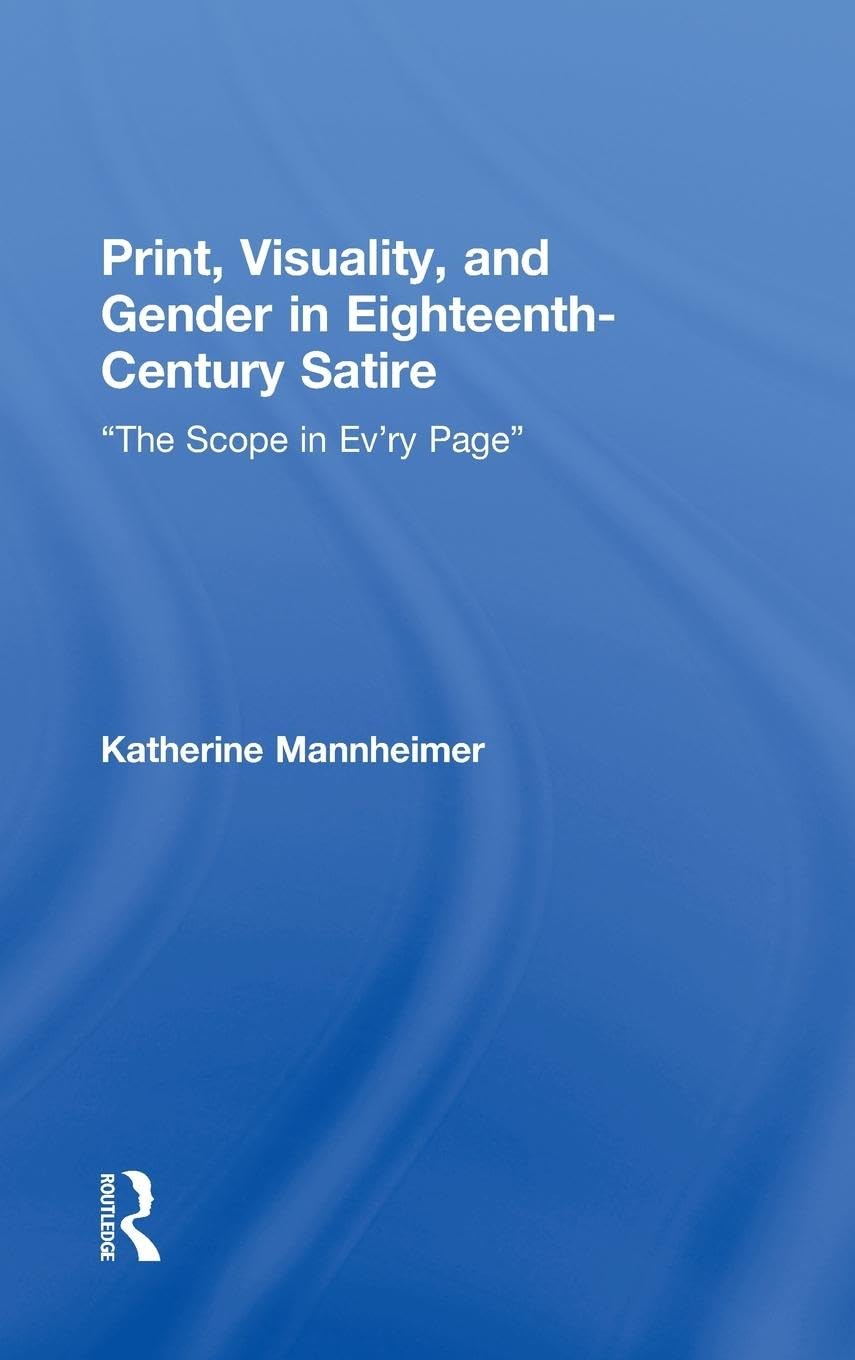
This study interprets eighteenthcentury satires famous typographical obsession as a fraught response to the Enlightenments 'ocularcentric' epistemological paradigms, as well as to a printcultural moment identified by bookhistorians as increasingly 'visual' a moment at which widespread attention was being paid, for the first time, to format, layout, and eyecatching advertising strategies. On the one hand, the Augustans were convinced of the ability of their elaborately printed texts to function as a kind of optical machinery rivaling that of the New Science, enhancing readers physical but also moral vision. On the other hand, they feared that an overly scrutinizing gaze might undermine the viewers natural faculty for candor and sympathy, delight and desire. In readings of Pope, Swift, and Montagu, Mannheimer shows how this distrust of the empirical gaze led to a reconsideration of the ethics, and most specifically the gender politics, of ocularcentrism. Whereas Montagu effected this reconsideration by directly satirizing both the eras faith in the visual and its attendant publishing strategies, Pope and Swift pursued their critique via print itself: thus whether via facingpage translations, fictional editors, or disingenuous footnotes, these writers sought to ensure that typography never became either a mere tool of (or target for) the objectifying gaze, but rather that it remained a dynamic and interactive medium by which readers could learn both to see and to see themselves seeing.
⚠️ WARNING (California Proposition 65):
This product may contain chemicals known to the State of California to cause cancer,
birth defects, or other reproductive harm.
For MAP (Minimum Advertised Price) violations and Intellectual Property (IP) or Trademark concerns, please contact:
support@ergodebooks.com
⚠️ California Proposition 65 Warning: Some products sold on this website may expose you to chemicals known to the State of California to cause cancer, birth defects, or other reproductive harm. For more information, visit www.P65Warnings.ca.gov.