
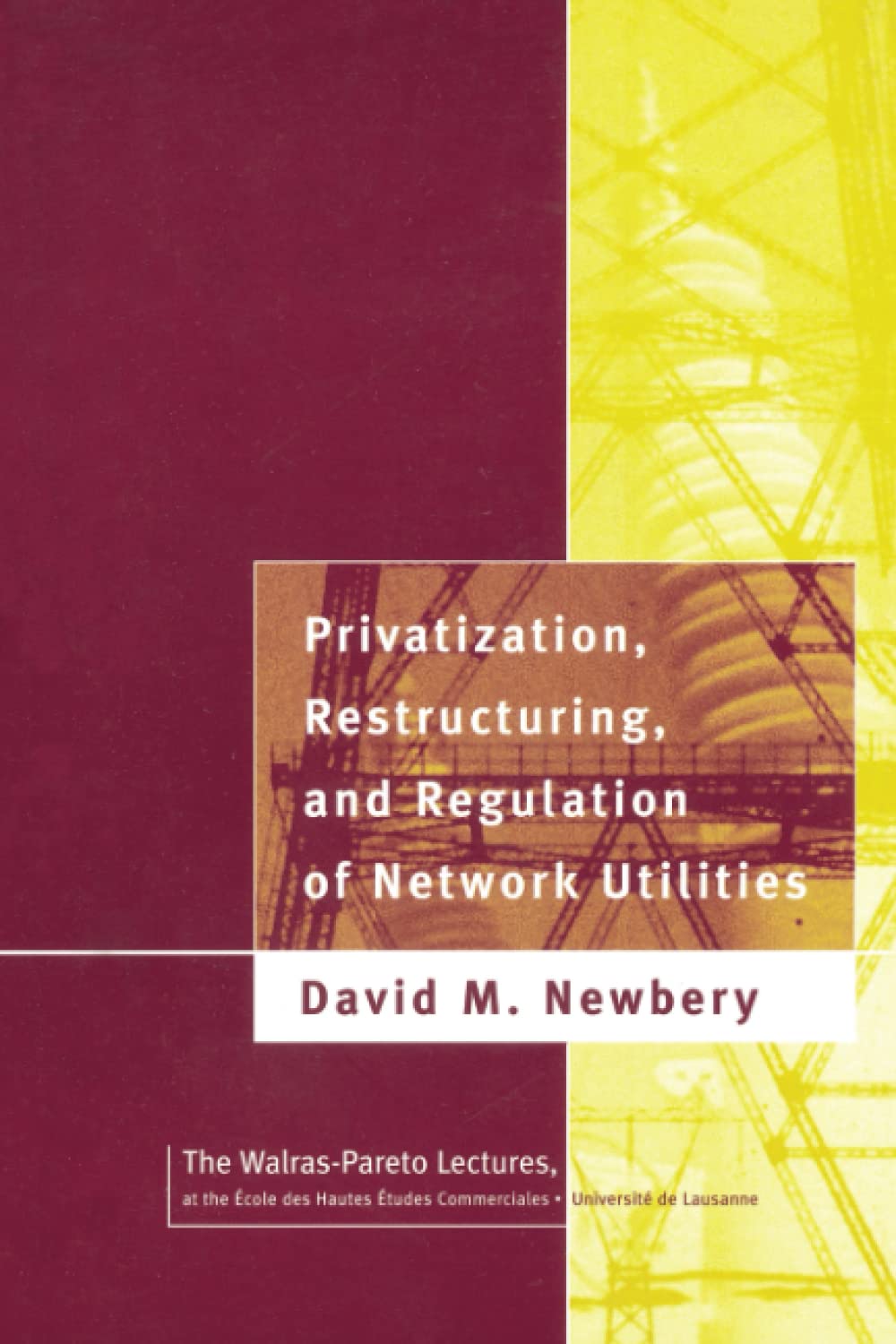
Title
Privatization, Restructuring, And Regulation Of Network Utilities (Walraspareto Lectures) (Walraspareto Lecture Series),New
Sold by Ergodebooks, an authorized reseller.
Returns accepted within 30 days | support@ergodebooks.com
Shipping Information
- Free Standard Shipping — United States only
- Processing Time: 3–5 business days
- Estimated Delivery: 6–10 business days after dispatch
- Double-boxed, fully insured & discreetly packaged
- Tracking number sent via email once dispatched
Returns & Refund
Returns accepted within 30 days of delivery.
Damaged or Defective Item
Free return shipping + replacement or full refund
Wrong Item Received
Free return shipping + replacement or full refund
Change of Mind
Return shipping at customer's expense · 25% restocking fee applies
Payment Option

Review , EndorsementProduct DescriptionNetwork utilities, such as electricity, telephones, and gas, are public utilities that require a fixed network to deliver their services. Because consumers have no choice of network, they risk exploitation by network owners. Once invested, however, a network's capital is sunk, and the bargaining advantage shifts from investor to consumer. The investor, fearing expropriation, may be reluctant to invest. The tension between consumer and investor can be sidestepped by state ownership. Alternatively, private ownership and consumers' political power can be reconciled through regulation. Either way, network utilities operate under terms set by the state. David Newbery argues that pricesetting rules comprise only part of the policy agenda. Network utilities pose special problems of ownership and regulation. He discusses the history of ownership and regulation, privatization, and theories of regulation. Examining three network utilities in detailtelecoms, electricity, and gashe contrasts the regulatory approaches of Britain and the United States. He also looks at liberalization in a variety of other countries. History shows that the mature forms of regulatory institutions are emarkably similar under both public and private ownership. This raises obvious questions such as: Will the forces that caused convergence to regulated vertical integration in the past reassert themselves? Can the benefits of competition be protected against the pressure to reintegrate? Will different utilities differ in their form and structure? A full understanding of the forces shaping regulatory institutions is necessary to answer these important questions.ReviewAbout the AuthorDavid M. Newbery is Director of the Department of Applied Economics at Cambridge University. He has been an advisor to the electricity, gas, and rail regulators in various countries.
⚠️ WARNING (California Proposition 65):
This product may contain chemicals known to the State of California to cause cancer, birth defects, or other reproductive harm.
For more information, please visit www.P65Warnings.ca.gov.