
Title
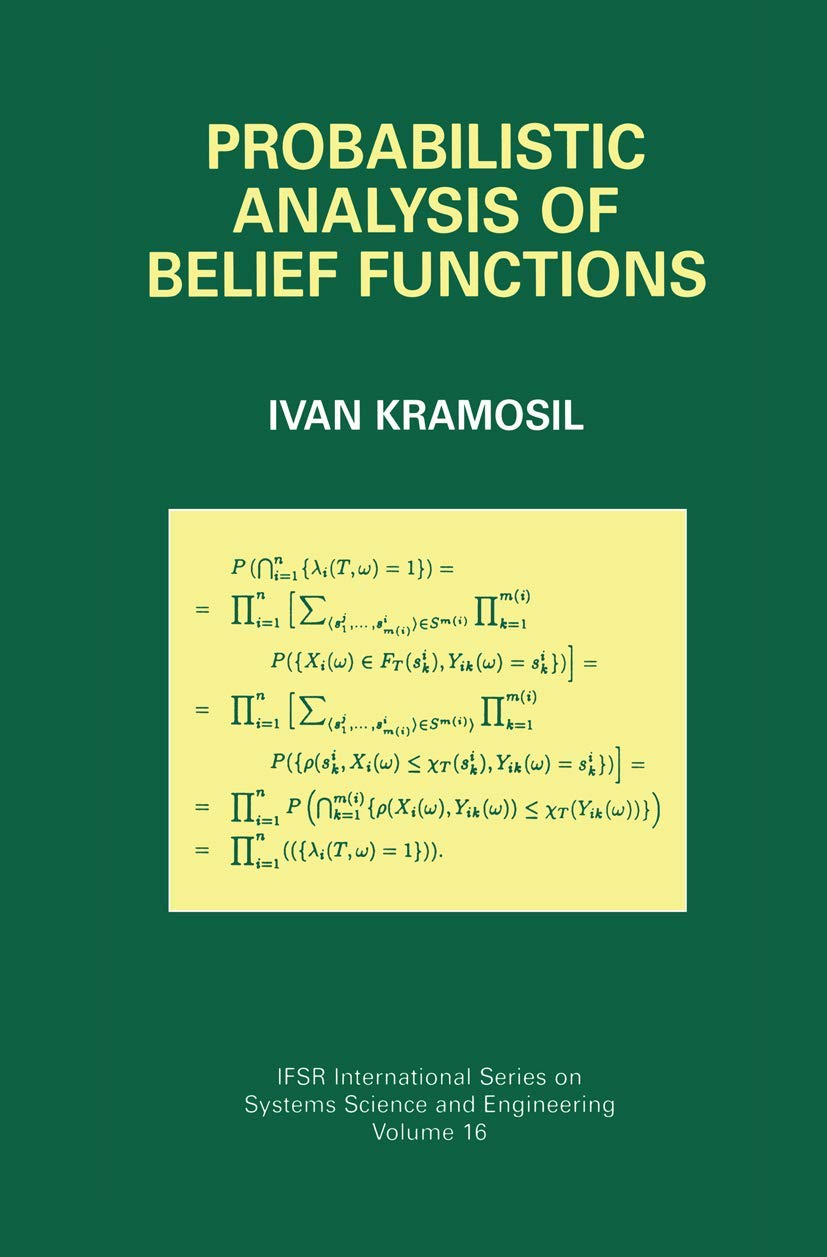
Probabilistic Analysis of Belief Functions (IFSR International Series in Systems Science and Systems Engineering, 16),Used
Sold by Ergodebooks, an authorized reseller.
Returns accepted within 30 days | support@ergodebooks.com
Shipping Information
- Free Standard Shipping — United States only
- Processing Time: 3–5 business days
- Estimated Delivery: 6–10 business days after dispatch
- Double-boxed, fully insured & discreetly packaged
- Tracking number sent via email once dispatched
Returns & Refund
Returns accepted within 30 days of delivery.
Damaged or Defective Item
Free return shipping + replacement or full refund
Wrong Item Received
Free return shipping + replacement or full refund
Change of Mind
Return shipping at customer's expense · 25% restocking fee applies
Payment Option

Inspired by the eternal beauty and truth of the laws governing the run of stars on heavens over his head, and spurred by the idea to catch, perhaps for the smallest fraction of the shortest instant, the Eternity itself, man created such masterpieces of human intellect like the Platon's world of ideas manifesting eternal truths, like the Euclidean geometry, or like the Newtonian celestial me chanics. However, turning his look to the sublunar world of our everyday efforts, troubles, sorrows and, from time to time but very, very seldom, also our successes, he saw nothing else than a world full of uncertainty and tem porariness. One remedy or rather consolation was that of the deep and sage resignation offered by Socrates: I know, that I know nothing. But, happy or unhappy enough, the temptation to see and to touch at least a very small por tion of eternal truth also under these circumstances and behind phenomena charged by uncertainty was too strong. Probability theory in its most sim ple elementary setting entered the scene. It happened in the same, 17th and 18th centuries, when celestial mechanics with its classical Platonist paradigma achieved its greatest triumphs. The origins of probability theory were inspired by games of chance like roulettes, lotteries, dices, urn schemata, etc. and probability values were simply defined by the ratio of successful or winning results relative to the total number of possible outcomes.
⚠️ WARNING (California Proposition 65):
This product may contain chemicals known to the State of California to cause cancer, birth defects, or other reproductive harm.
For more information, please visit www.P65Warnings.ca.gov.