
Title
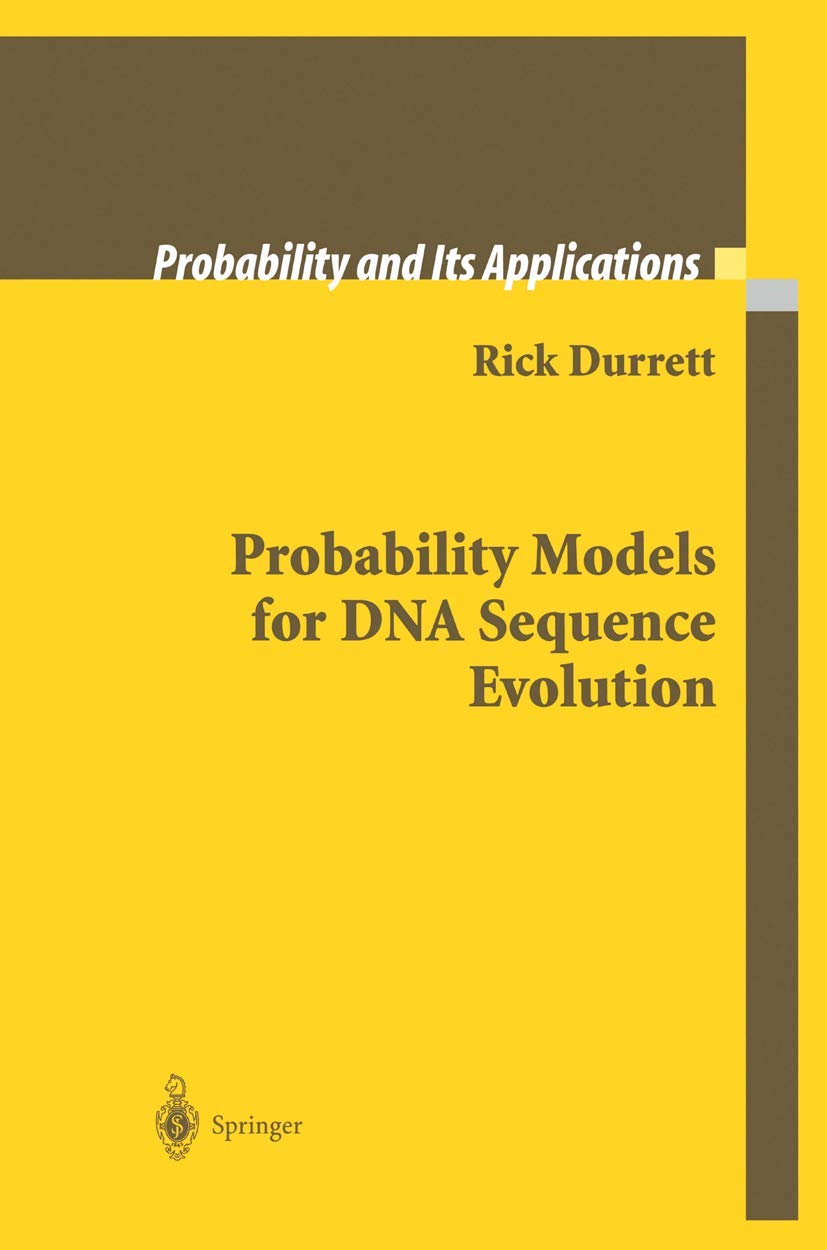
Probability Models for DNA Sequence Evolution (Probability and Its Applications),Used
Sold by Ergodebooks, an authorized reseller.
Returns accepted within 30 days | support@ergodebooks.com
Shipping Information
- Free Standard Shipping — United States only
- Processing Time: 3–5 business days
- Estimated Delivery: 6–10 business days after dispatch
- Double-boxed, fully insured & discreetly packaged
- Tracking number sent via email once dispatched
Returns & Refund
Returns accepted within 30 days of delivery.
Damaged or Defective Item
Free return shipping + replacement or full refund
Wrong Item Received
Free return shipping + replacement or full refund
Change of Mind
Return shipping at customer's expense · 25% restocking fee applies
Payment Option

Our basic question is: Given a collection of DNA sequences, what underlying forces are responsible for the observed patterns of variability? To approach this question we introduce and analyze a number of probability models: the WrightFisher model, the coalescent, the infinite alleles model, and the infinite sites model. We study the complications that come from nonconstant population size, recombination, population subdivision, and three forms of natural selection: directional selection, balancing selection, and background selection. These theoretical results set the stage for the investigation of various statistical tests to detect departures from "neutral evolution." The final chapter studies the evolution of whole genomes by chromosomal inversions, reciprocal translocations, and genome duplication. Throughout the book, the theory is developed in close connection with data from more than 60 experimental studies from the biology literature that illustrate the use of these results. This book is written for mathematicians and for biologists alike. We assume no previous knowledge of concepts from biology and only a basic knowledge of probability: a one semester undergraduate course and some familiarity with Markov chains and Poisson processes. Rick Durrett received his Ph.D. in operations research from Stanford University in 1976. He taught in the UCLA mathematics department before coming to Cornell in 1985. He is the author of six books and 125 research papers, and is the academic father of more than 30 Ph.D. students. His current interests are the use of probability models in genetics and ecology, and decreasing the mean and variance of his golf score.
⚠️ WARNING (California Proposition 65):
This product may contain chemicals known to the State of California to cause cancer, birth defects, or other reproductive harm.
For more information, please visit www.P65Warnings.ca.gov.