
Title
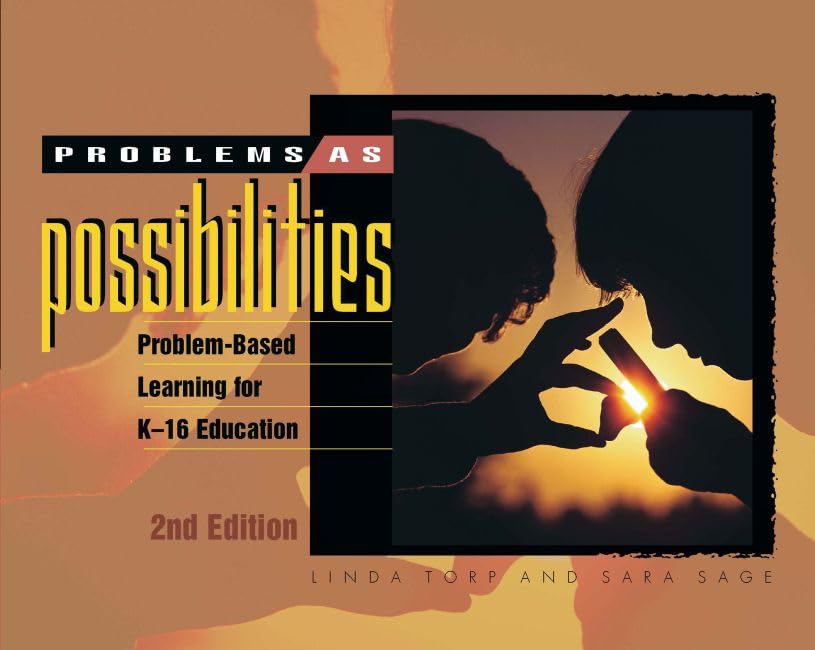
Problems as Possibilities: ProblemBased Learning for K16 Education (2nd Edition),New
Sold by Ergodebooks, an authorized reseller.
Returns accepted within 30 days | support@ergodebooks.com
Shipping Information
- Free Standard Shipping — United States only
- Processing Time: 3–5 business days
- Estimated Delivery: 6–10 business days after dispatch
- Double-boxed, fully insured & discreetly packaged
- Tracking number sent via email once dispatched
Returns & Refund
Returns accepted within 30 days of delivery.
Damaged or Defective Item
Free return shipping + replacement or full refund
Wrong Item Received
Free return shipping + replacement or full refund
Change of Mind
Return shipping at customer's expense · 25% restocking fee applies
Payment Option

We're all learners on life's journey, and often the messy problems we encounter present us with the best education. Researchers are finding that the same concept holds true for students in our classrooms.Problembased learning (PBL) is an authentic, experiential form of learning centered around the collaborative investigation and resolution of realworld problems. In PBL, students address a problematic situation from the perspective of a stakeholder in the situation. As both a curriculum organizer and instructional strategy, PBL fosters active learning, supports knowledge construction, integrates disciplines, and naturally combines school learning with real life.In this second edition of their book, Torp and Sage offer opportunities to learn about PBL from a variety of perspectives. New to this edition is an indepth look at assessing education in and through problembased learninghow to use assessment not only to see what students have learned during the PBL experience, but also how to use assessment to enhance PBL itself. New examplesfrom elementary, secondary, and university levelsnew charts, and expanded graphics enhance every chapter of this new edition.
⚠️ WARNING (California Proposition 65):
This product may contain chemicals known to the State of California to cause cancer, birth defects, or other reproductive harm.
For more information, please visit www.P65Warnings.ca.gov.
- Q: What is problem-based learning (PBL)? A: Problem-based learning (PBL) is an educational approach that engages students in learning through the investigation and resolution of real-world problems, fostering active collaboration and knowledge construction.
- Q: Who are the authors of 'Problems as Possibilities'? A: The book 'Problems as Possibilities: Problem-Based Learning for K-16 Education' is authored by Linda Torp and Sage.
- Q: What editions of the book are available? A: This product listing is for the second edition of the book, which offers updated insights and examples related to problem-based learning.
- Q: How many pages does the book contain? A: The book contains 129 pages, providing a comprehensive overview of problem-based learning techniques and strategies.
- Q: What is the condition of the book? A: The book is in new condition, ensuring that you receive it in perfect shape for your educational needs.
- Q: When was this edition of the book published? A: The second edition of 'Problems as Possibilities' was published on January 15, 2002.
- Q: What topics are covered in the book? A: The book covers various aspects of problem-based learning, including curriculum organization, instructional strategies, assessment methods, and real-world applications across different educational levels.
- Q: Is this book suitable for K-12 educators? A: Yes, the book is designed for K-16 educators, making it suitable for teachers at both elementary and secondary levels.
- Q: What format is the book available in? A: The book is available in a paperback binding format, making it easy to handle and read.
- Q: Can I find real-life examples in the book? A: Yes, the second edition includes new examples from various educational levels, enhancing the understanding of problem-based learning in practice.