
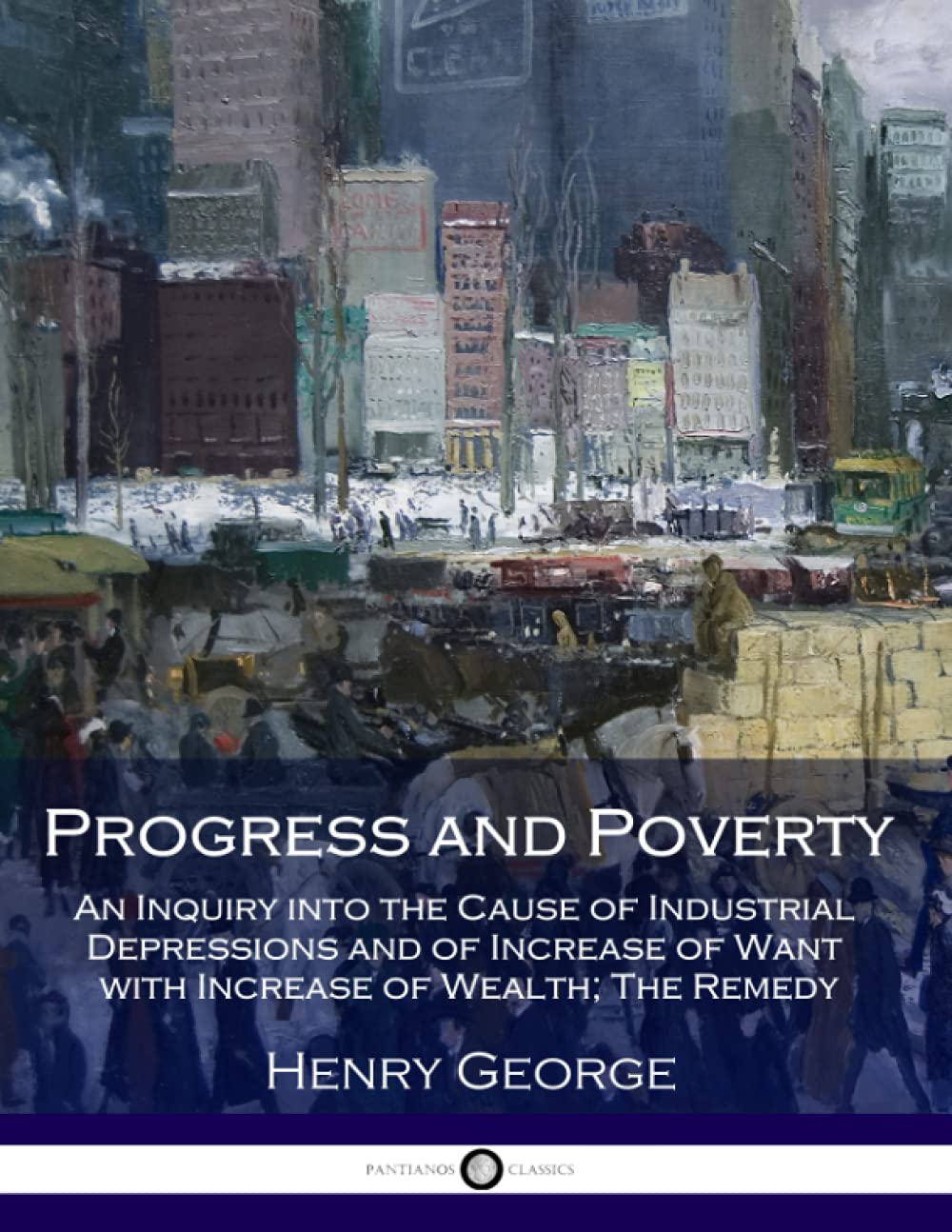
Title

Progress and Poverty: An Inquiry into the Cause of Industrial Depressions and of Increase of Want with Increase of Wealth; The R,Used
Sold by Ergodebooks, an authorized reseller.
Returns accepted within 30 days | support@ergodebooks.com
Shipping Information
- Free Standard Shipping — United States only
- Processing Time: 3–5 business days
- Estimated Delivery: 6–10 business days after dispatch
- Double-boxed, fully insured & discreetly packaged
- Tracking number sent via email once dispatched
Returns & Refund
Returns accepted within 30 days of delivery.
Damaged or Defective Item
Free return shipping + replacement or full refund
Wrong Item Received
Free return shipping + replacement or full refund
Change of Mind
Return shipping at customer's expense · 25% restocking fee applies
Payment Option

In Progress and Poverty, economist Henry George scrutinizes the connection between population growth and distribution of wealth in the economy of the late nineteenth century.The initial portions of the book are occupied with refuting the demographic theories of Thomas Malthus, who asserted that the vast abundance of goods generated by an economy's growth was spent on food. Consequently the population rises, keeping living standards low, poverty widespread, and starvation and disease common.Henry George had a different attitude: that poverty could be solved and economic progress preserved. To prove this, he draws upon decades of data which show that the increase in land prices restrains the amount of production on said land; business owners thus have less to pay their workers, with the result being mass poverty especially within cities.The radical solution George proposes is a land value tax, whereby owners of land must pay a levy on their holdings. Thus money is diverted directly from landowners, to be spent on alleviating the poverty of workers, improving the infrastructure and environment of urban and rural areas, and even giving every citizen a basic income to cover their necessities.George is also concerned with the cyclical nature of the economy, which by the latter part of the 19th century clearly followed cycles of boom and bust. This instability is further aggravated by spikes in land prices and consequently rents, whereby both producers such as factory builders and farmers and workers are displaced. Thus, Henry George doubles down on his idea for the land value tax, highlighting its efficiency and the fact that land unlike resources or labor is a fixed and easily quantified thing.Divided into ten books, which in turn comprise between two and five chapters each, Progress and Poverty sequentially proposes, and discusses the implementations, of this economic reform. The book was enormously popular with the American public; written in a plain but engaging style, the powerful argument George makes would impact economists and the public consciousness alike for decades to follow.
⚠️ WARNING (California Proposition 65):
This product may contain chemicals known to the State of California to cause cancer, birth defects, or other reproductive harm.
For more information, please visit www.P65Warnings.ca.gov.
- Q: What is the main theme of 'Progress and Poverty'? A: The main theme of 'Progress and Poverty' by Henry George is the relationship between wealth distribution and population growth, emphasizing how land value taxation can alleviate poverty while promoting economic progress.
- Q: Who is the author of 'Progress and Poverty'? A: The author of 'Progress and Poverty' is Henry George, an economist known for his views on land value tax and economic reform.
- Q: What year was 'Progress and Poverty' published? A: 'Progress and Poverty' was published in 2017, although the original work was first released in 1879.
- Q: How many pages are in 'Progress and Poverty'? A: 'Progress and Poverty' contains 202 pages.
- Q: What is the format of this book? A: 'Progress and Poverty' is available in paperback format.
- Q: What economic issue does Henry George focus on in this book? A: Henry George focuses on the issue of industrial depressions and the increasing disparity between wealth and poverty, advocating for a land value tax as a solution.
- Q: Is 'Progress and Poverty' suitable for readers without an economic background? A: Yes, 'Progress and Poverty' is written in a plain and engaging style, making it accessible to readers without a formal economic background.
- Q: What solution does Henry George propose for poverty? A: Henry George proposes a land value tax as a solution to poverty, suggesting that taxing land can redistribute wealth and fund public goods.
- Q: How does 'Progress and Poverty' address the cyclical nature of the economy? A: 'Progress and Poverty' discusses how land price fluctuations contribute to economic cycles of boom and bust, advocating for reforms to stabilize these cycles.
- Q: What is the historical significance of 'Progress and Poverty'? A: 'Progress and Poverty' has historically influenced economic thought and public policy discussions, particularly regarding taxation and social justice.