If you have any questions, you are always welcome to contact us. We'll get back to you as soon as possible, withing 24 hours on weekdays.
Customer service
All questions about your order, return and delivery must be sent to our customer service team by e-mail at yourstore@yourdomain.com
Sale & Press
If you are interested in selling our products, need more information about our brand or wish to make a collaboration, please contact us at press@yourdomain.com
Help
If you have any questions, you are always welcome to contact us. We'll get back to you as soon as possible, withing 24 hours on weekdays.
Customer service
All questions about your order, return and delivery must be sent to our customer service team by e-mail at yourstore@yourdomain.com
Sale & Press
If you are interested in selling our products, need more information about our brand or wish to make a collaboration, please contact us at press@yourdomain.com
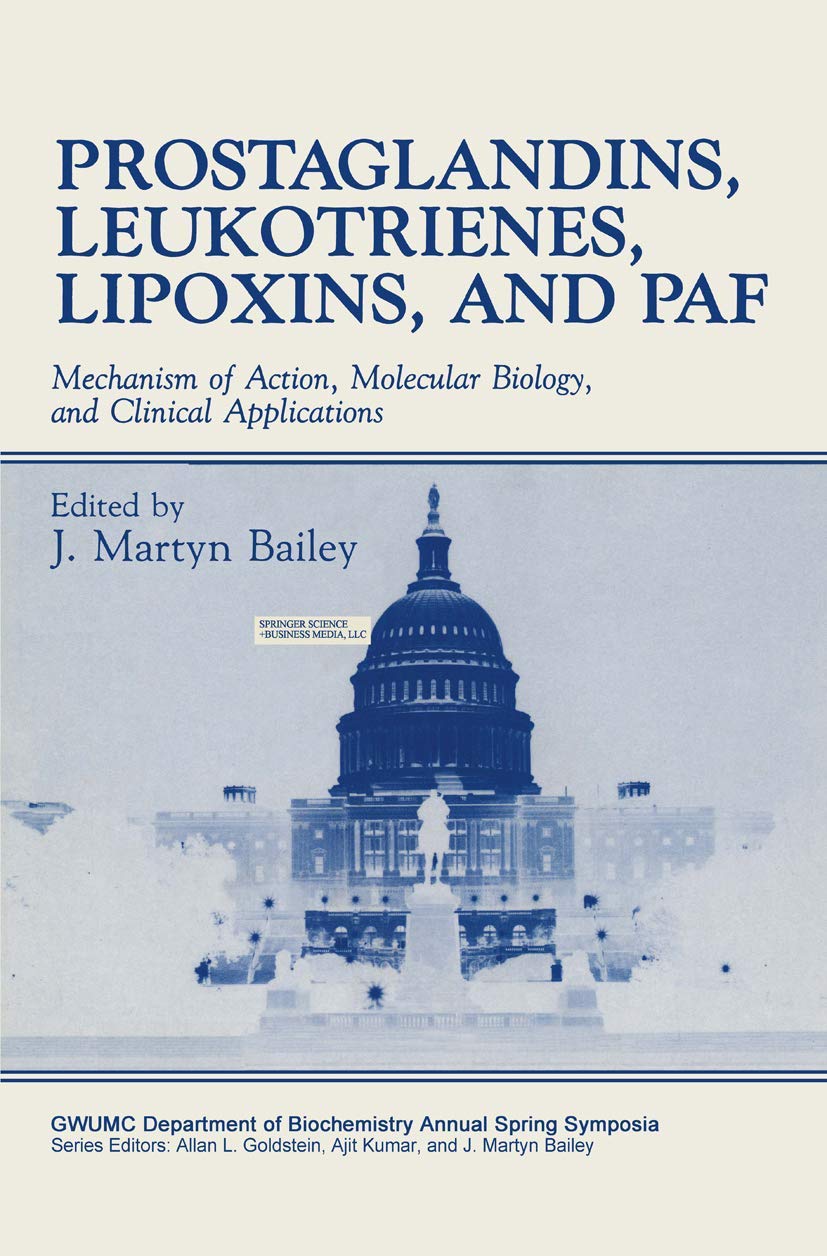
The field of eicosanoid metabolism and function continues to grow. Synthesis of the prostaglandins from essential fatty acids was first described by Bergstrom and Sarnuelsson in 1964. The thromboxanes were discovered in 1975, the prostacyclins, by Moncada and Vane, in 1976, and the leukotrienes by Samuelsson in 1979. A new class of biologically active arachidonic acid metabolites named lipoxins was announced by Bengt Samuelsson in May 1984. Since that time major advances have been made in the molecular biology of the eicosanoids including the cloning of prostaglandin synthases and 5, 12, and 15lipoxygenases from several different species, including man. This volume, Prostaglandins, Leukotrienes, Lipoxins, and P AF: Their Mechanism of Action, Molecular Biology, and Clinical Applications contains most of the papers presented in the plenary sessions of the Xlth International Washington Spring Symposium on Health Sciences. The book is divided into six parts, each covering a different aspect of this rapidly expanding field, and contains a total of 42 chapters by an internationally recognized group of authors in each area. Part I contains 11 chapters and covers the molecular biology and enzymology of prostaglandins and leukotrienes. Chapter 1 by the Editor details new mechanisms for the antiinflammatory glucocorticoids involving translational control of the messenger RNA for prostaglandin synthase. Chapter 2 by Yamamoto describes the molecular evolution of two distinct mammalian 12lipoxygenases.
⚠️ WARNING (California Proposition 65):
This product may contain chemicals known to the State of California to cause cancer,
birth defects, or other reproductive harm.
For MAP (Minimum Advertised Price) violations and Intellectual Property (IP) or Trademark concerns, please contact:
support@ergodebooks.com
⚠️ California Proposition 65 Warning: Some products sold on this website may expose you to chemicals known to the State of California to cause cancer, birth defects, or other reproductive harm. For more information, visit www.P65Warnings.ca.gov.