If you have any questions, you are always welcome to contact us. We'll get back to you as soon as possible, withing 24 hours on weekdays.
Customer service
All questions about your order, return and delivery must be sent to our customer service team by e-mail at yourstore@yourdomain.com
Sale & Press
If you are interested in selling our products, need more information about our brand or wish to make a collaboration, please contact us at press@yourdomain.com
Help
If you have any questions, you are always welcome to contact us. We'll get back to you as soon as possible, withing 24 hours on weekdays.
Customer service
All questions about your order, return and delivery must be sent to our customer service team by e-mail at yourstore@yourdomain.com
Sale & Press
If you are interested in selling our products, need more information about our brand or wish to make a collaboration, please contact us at press@yourdomain.com
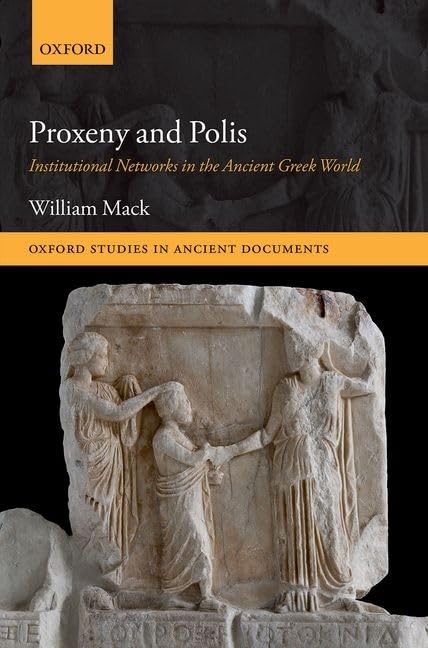
Known from ancient authors such as Herodotus, Thucydides, and Plato, and more than 2,500 inscriptions, proxeny (a form of public guestfriendship) is the best attested interstate institution of the ancient world. Proxeny and Polis offers a comprehensive reexamination of our evidence for this important Greek institution and uses it to examine the structure and dynamics of the interstate system of the Greek world, and the way in which these were transformed under the Roman Empire.Based on a detailed analysis of the function of the formulaic language of honorific decrees, this volume presents a new reconstruction of proxeny, and explores the way in which interstate institutions shaped the behaviour of individuals and communities in the ancient world. It draws on other material which has not been systematically exploited to reconstruct the proxeny networks of Greek citystates. This material reveals the extraordinary density of formal interconnections which characterized the ancient Greek world before the age of Augustus and reflected both trade and political contacts of different kinds.It also traces the disappearance of both proxeny and the broader institutional system of which it was part. Drawing on nuanced analysis of quantitative trends in the epigraphic record, it argues that the Greek world underwent a profound reorientation by the time of the Roman Principate, which fundamentally altered how Greek cities viewed relations with each other.
⚠️ WARNING (California Proposition 65):
This product may contain chemicals known to the State of California to cause cancer,
birth defects, or other reproductive harm.
For MAP (Minimum Advertised Price) violations and Intellectual Property (IP) or Trademark concerns, please contact:
support@ergodebooks.com
⚠️ California Proposition 65 Warning: Some products sold on this website may expose you to chemicals known to the State of California to cause cancer, birth defects, or other reproductive harm. For more information, visit www.P65Warnings.ca.gov.