If you have any questions, you are always welcome to contact us. We'll get back to you as soon as possible, withing 24 hours on weekdays.
Customer service
All questions about your order, return and delivery must be sent to our customer service team by e-mail at yourstore@yourdomain.com
Sale & Press
If you are interested in selling our products, need more information about our brand or wish to make a collaboration, please contact us at press@yourdomain.com
Help
If you have any questions, you are always welcome to contact us. We'll get back to you as soon as possible, withing 24 hours on weekdays.
Customer service
All questions about your order, return and delivery must be sent to our customer service team by e-mail at yourstore@yourdomain.com
Sale & Press
If you are interested in selling our products, need more information about our brand or wish to make a collaboration, please contact us at press@yourdomain.com
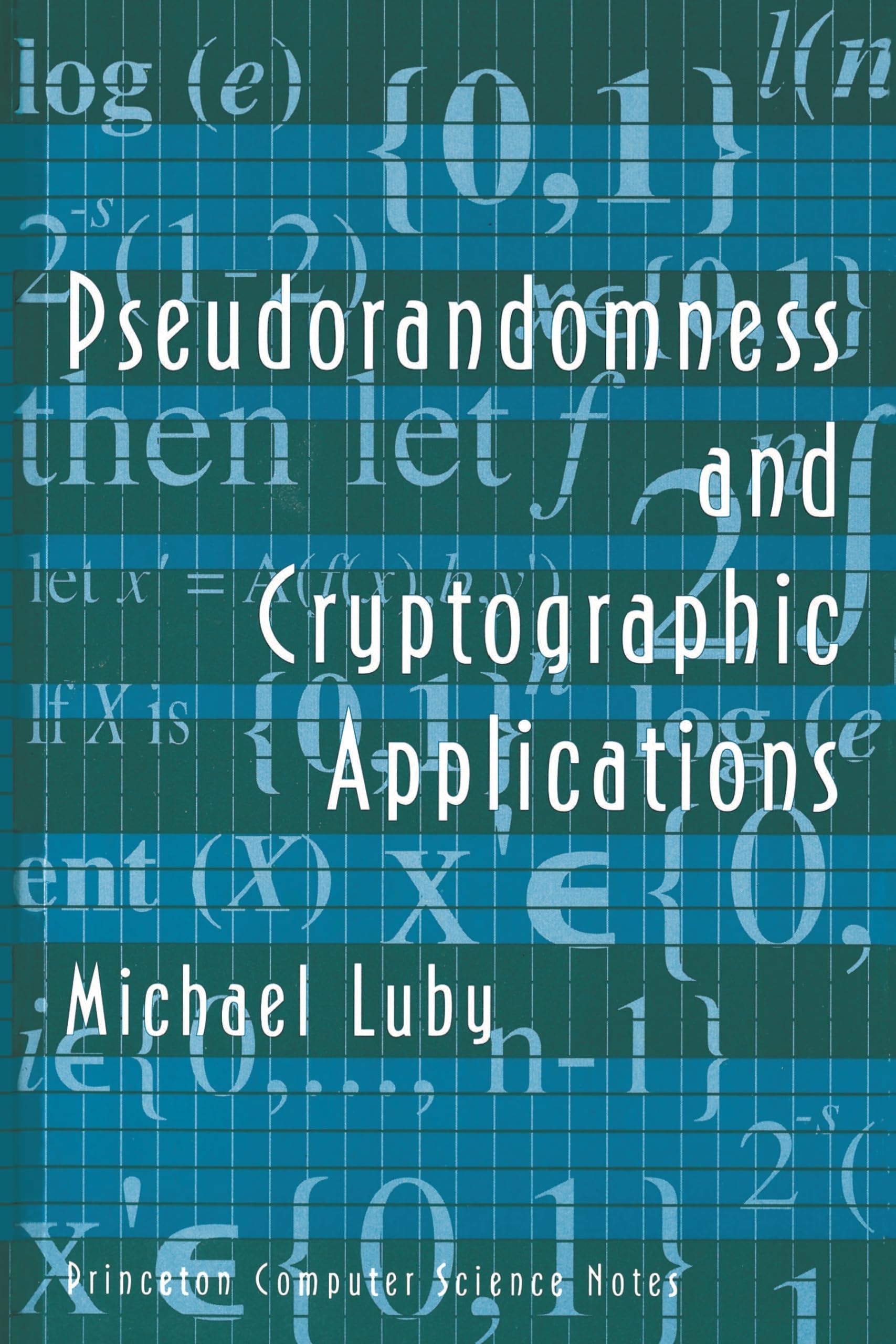
A pseudorandom generator is an easytocompute function that stretches a short random string into a much longer string that 'looks' just like a random string to any efficient adversary. One immediate application of a pseudorandom generator is the construction of a private key cryptosystem that is secure against chosen plaintext attack.There do not seem to be natural examples of functions that are pseudorandom generators. On the other hand, there do seem to be a variety of natural examples of another basic primitive: the oneway function. A function is oneway if it is easy to compute but hard for any efficient adversary to invert on average.The first half of the book shows how to construct a pseudorandom generator from any oneway function. Building on this, the second half of the book shows how to construct other useful cryptographic primitives, such as private key cryptosystems, pseudorandom function generators, pseudorandom permutation generators, digital signature schemes, bit commitment protocols, and zeroknowledge interactive proof systems. The book stresses rigorous definitions and proofs.
⚠️ WARNING (California Proposition 65):
This product may contain chemicals known to the State of California to cause cancer,
birth defects, or other reproductive harm.
For MAP (Minimum Advertised Price) violations and Intellectual Property (IP) or Trademark concerns, please contact:
support@ergodebooks.com
⚠️ California Proposition 65 Warning: Some products sold on this website may expose you to chemicals known to the State of California to cause cancer, birth defects, or other reproductive harm. For more information, visit www.P65Warnings.ca.gov.