
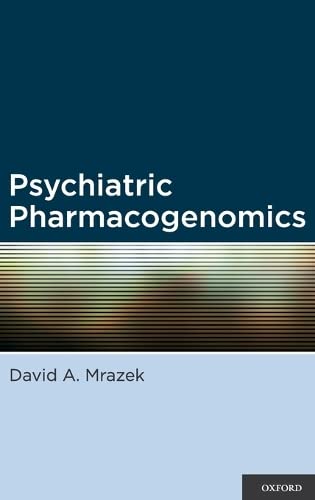
Title
Psychiatric Pharmacogenomics
Sold by Ergodebooks, an authorized reseller.
Returns accepted within 30 days | support@ergodebooks.com
Shipping Information
- Free Standard Shipping — United States only
- Processing Time: 3–5 business days
- Estimated Delivery: 6–10 business days after dispatch
- Double-boxed, fully insured & discreetly packaged
- Tracking number sent via email once dispatched
Returns & Refund
Returns accepted within 30 days of delivery.
Damaged or Defective Item
Free return shipping + replacement or full refund
Wrong Item Received
Free return shipping + replacement or full refund
Change of Mind
Return shipping at customer's expense · 25% restocking fee applies
Payment Option

Psychiatric Pharmacogenomics Is A Book Written To Help Clinicians To Use Pharmacogenomic Testing To Improve The Pharmacotherapy That They Provide For Their Patients. It Is Designed To Teach Clinicians How To Order Pharmacogenomic Tests And Interpret The Results. Clinical Examples Are Used To Underscore The Specific Indications For Pharmacogenomic Testing And To Clarify The Clinical Usefulness Of Identifying Atypical Genotypes That Result In Problematic Responses To Medication.The First Section Of The Book Begins With A Basic Review Of Molecular Genetics. Additionally, The Book Also Includes An Extensive Glossary Of Technical Terms Associated With Molecular Genetics And Pharmacogenomics. The Clinical Utility Of Pharmacogenomic Testing Is Demonstrated Throughout The Book By Describing The Implications Of Genetic Variations For The Care Of Individual Patients.The Second Section Of The Book Is Organized Into Fourteen Chapters That Each Focus On The Clinical Implications Of Testing For Specific Genes For Which Variants Have Been Associated With Either Therapeutic Response Or Side Effects Of Psychotropic Medications. Each Of These Chapters Is Structured In The Same Manner And Involves A Description Of The Gene And Its Significant Variants. Each Chapter Also Includes One Or More Clinical Vignettes.The Third Section Of The Book Discusses The Clinical Usefulness Of Pharmacogenomic Testing, Ethical Issues Associated With Pharmacogenomic Testing, And Provides Predictions For The Future Development Of More Sophisticated Pharmacogenomic Testing.
⚠️ WARNING (California Proposition 65):
This product may contain chemicals known to the State of California to cause cancer, birth defects, or other reproductive harm.
For more information, please visit www.P65Warnings.ca.gov.
- Q: What is the page count of Psychiatric Pharmacogenomics? A: The book has two hundred eighty pages. It covers various aspects of pharmacogenomics and its clinical implications.
- Q: What are the dimensions of the book? A: The dimensions are one point one inches in depth, six point four two inches in width, and nine point two nine inches in height.
- Q: What type of binding does this book have? A: The book is bound in hardcover. This provides durability and a professional appearance for clinical reference.
- Q: Who is the author of Psychiatric Pharmacogenomics? A: The book is authored by David A. Mrazek. He is recognized for his expertise in psychopharmacology and genetics.
- Q: What is the primary focus of this book? A: The book focuses on pharmacogenomic testing in psychiatry. It aims to enhance the pharmacotherapy provided by clinicians.
- Q: How does this book assist clinicians? A: It teaches clinicians how to order and interpret pharmacogenomic tests. Clinical examples highlight the utility of these tests.
- Q: Is this book suitable for beginners in pharmacogenomics? A: Yes, the book is designed for clinicians at various experience levels. It begins with a basic review of molecular genetics.
- Q: What type of clinical examples are included? A: Clinical vignettes illustrate the implications of genetic variations on medication responses. These examples clarify practical applications.
- Q: Can this book help with understanding genetic variations? A: Yes, it discusses the significance of identifying atypical genotypes. It explains how these variations affect medication responses.
- Q: What ethical issues does the book address? A: The book discusses ethical concerns surrounding pharmacogenomic testing. It provides context for responsible testing and interpretation.
- Q: How should I store this book? A: Store it in a cool, dry place away from direct sunlight. This helps preserve the quality of the hardcover binding and pages.
- Q: Can this book be used as a textbook for a course? A: Yes, it can be utilized as a textbook. Its structured chapters and clinical insights make it suitable for educational settings.
- Q: Does the book include a glossary? A: Yes, it has an extensive glossary of technical terms. This aids readers in understanding complex terminology.
- Q: What is the target audience for this book? A: The target audience includes clinicians and healthcare professionals. It is particularly useful for those involved in psychiatric care.
- Q: Are there any predictions for future pharmacogenomic developments in the book? A: Yes, the book provides predictions for advancements in pharmacogenomic testing. It discusses potential future applications and technologies.
- Q: Is this book recommended for pharmacology students? A: Yes, it is recommended for pharmacology students. It offers valuable insights into the intersection of genetics and medication.