

Title
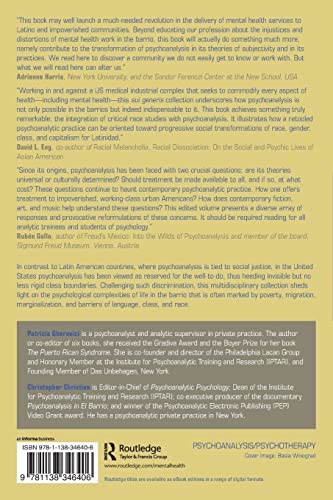
Psychoanalysis in the Barrios: Race, Class, and the Unconscious,Used
Sold by Ergodebooks, an authorized reseller.
Returns accepted within 30 days | support@ergodebooks.com
Shipping Information
- Free Standard Shipping — United States only
- Processing Time: 3–5 business days
- Estimated Delivery: 6–10 business days after dispatch
- Double-boxed, fully insured & discreetly packaged
- Tracking number sent via email once dispatched
Returns & Refund
Returns accepted within 30 days of delivery.
Damaged or Defective Item
Free return shipping + replacement or full refund
Wrong Item Received
Free return shipping + replacement or full refund
Change of Mind
Return shipping at customer's expense · 25% restocking fee applies
Payment Option

Psychoanalysis in the Barrios: Race, Class, and the Unconscious demonstrates that psychoanalytic principles can be applied successfully in disenfranchised Latino populations, refuting the misguided idea that psychoanalysis is an expensive luxury only for the wealthy.As opposed to most Latin American countries, where psychoanalysis is seen as a practice tied to the promotion of social justice, in the United States psychoanalysis has been viewed as reserved for the welltodo, assuming that poor people lack the "sophistication" that psychoanalysis requires, thus heeding invisible but no less rigid class boundaries. Challenging such discrimination, the authors testify to the efficacy of psychoanalysis in the barrios, upending the unfounded widespread belief that poor people are so consumed with the pressures of everyday survival that they only benefit from symptomfocused interventions. Sharing vivid vignettes of psychoanalytic treatments, this collection sheds light on the psychological complexities of life in the barrio that is often marked by poverty, migration, marginalization, and barriers of language, class, and race.This interdisciplinary collection features essays by distinguished international scholars and clinicians. It represents a unique crossover that will appeal to readers in clinical practice, social work, counselling, anthropology, psychology, cultural and Latino studies, queer studies, urban studies, and sociology.
⚠️ WARNING (California Proposition 65):
This product may contain chemicals known to the State of California to cause cancer, birth defects, or other reproductive harm.
For more information, please visit www.P65Warnings.ca.gov.
- Q: What is the page count of this book? A: This book has two hundred forty-four pages. It provides an in-depth exploration of psychoanalysis in disenfranchised Latino populations.
- Q: What are the dimensions of the book? A: The book measures six point fourteen inches in length, nine point twenty-one inches in height, and zero point fifty-nine inches in width.
- Q: What type of binding does this book have? A: This book is available in paperback binding. This makes it lightweight and flexible for easy reading.
- Q: How do I apply the concepts in this book? A: You can apply the concepts by integrating psychoanalytic principles into clinical practice with Latino populations. It provides case studies and vignettes for practical understanding.
- Q: Is this book suitable for beginners in psychology? A: Yes, this book is suitable for beginners as well as experienced practitioners. It covers foundational concepts in an accessible manner.
- Q: What is the target audience for this book? A: The target audience includes students and professionals in psychology, social work, and cultural studies. It also appeals to those interested in urban and Latino studies.
- Q: How should I store this book for preservation? A: Store this book in a cool, dry place, away from direct sunlight. This will help maintain its condition over time.
- Q: Can I lend this book to others? A: Yes, you can lend this book to others. Just ensure to keep it in good condition for future readers.
- Q: What if the book arrives damaged? A: If the book arrives damaged, you should contact the seller for a return or replacement. Most sellers have specific return policies for such issues.
- Q: Does this book contain sensitive content? A: Yes, this book discusses topics related to race, class, and psychological trauma. It is recommended for mature readers who can handle complex themes.
- Q: Is there a glossary or index in the book? A: Yes, the book includes an index for easy navigation through its themes and concepts. This feature aids in research and reference.
- Q: What makes this book unique compared to others in its field? A: This book is unique because it focuses on the application of psychoanalysis in marginalized communities, challenging prevailing stereotypes about mental health.
- Q: Can the insights from this book be applied globally? A: Yes, the insights can be applied globally, especially in contexts where marginalized groups face similar psychological challenges.
- Q: Who is the author of this book? A: The author of this book is Patricia Gherovici, a prominent figure in the field of psychoanalysis.
- Q: Does this book discuss cultural aspects of psychoanalysis? A: Yes, it discusses cultural aspects extensively, highlighting the interplay between race, class, and the unconscious in psychoanalytic practice.
- Q: Is this book part of a series? A: No, this book is a standalone publication. It does not belong to a series but contributes to the discourse on psychoanalysis and social justice.